

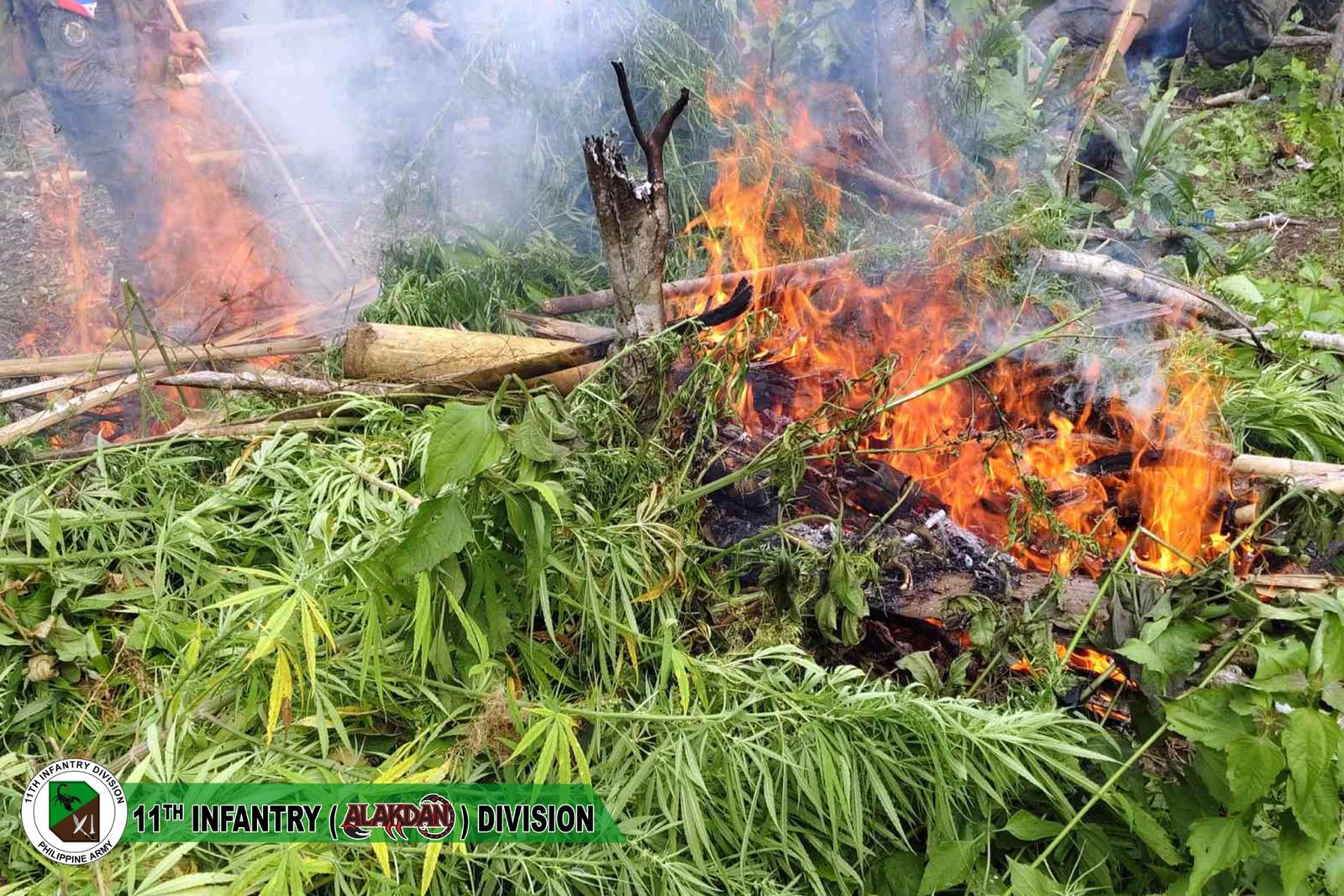
KALINGALAN CALUANG, Sulu — In a coordinated sweep across a remote barangay in this island municipality, government forces on Tuesday eradicated what authorities described as more than ₱10 million worth of fully grown marijuana plants, underscoring the Philippine government’s continuing campaign to suppress illegal drug cultivation in far-flung areas of Mindanao.
The operation, carried out on March 3 in Barangay Masjid Punjungan, brought together units of the Armed Forces of the Philippines, the Philippine National Police, the Criminal Investigation and Detection Group, and the Philippine Drug Enforcement Agency in what officials called a deliberate, intelligence-driven effort to dismantle marijuana plantations concealed in rugged terrain.
By late afternoon, authorities said they had discovered and destroyed two plantation sites spanning a combined 3,000 square meters. In total, 11,500 fully grown marijuana plants were uprooted and burned on site, with an estimated street value of ₱10,350,000.
The first plantation, measuring approximately 1,000 square meters, yielded 5,500 mature plants. A second, larger site — about 2,000 square meters — contained 6,000 plants. Both were located in an upland area of Masjid Punjungan, a village that sits amid Sulu’s dense vegetation and rolling hills, terrain that has historically presented challenges to law enforcement operations.
Military officials said the mission was led by the 1102nd Infantry “Ganarul” Brigade under the 11th Infantry “Alakdan” Division, in coordination with provincial and municipal police units. Participating forces included elements of the 21st Infantry “Invincible” Battalion, the 101st Infantry “Sajahitra” Battalion, the Sulu Police Provincial Office, CIDG–Region 9, the 1st and 2nd Provincial Mobile Force Companies of Sulu, the 905th Maneuver Company of the Regional Mobile Force Battalion 9, and the Municipal Police Station of Kalingalan Caluang.
The operation unfolded without reported armed confrontation, though officials declined to provide specific details about whether suspects had been identified or fled prior to the arrival of troops. No arrests were immediately announced.
Brig. Gen. Alaric Avelino Delos Santos, commander of the 1102nd Infantry Brigade, praised what he described as seamless coordination among military and law enforcement agencies. “This accomplishment reflects the strength of inter-agency collaboration and the shared resolve to eliminate illegal drug activities in our area of responsibility,” he said in a statement released after the operation.
Maj. Gen. Leonardo I. Peña, who commands Joint Task Force Orion and the 11th Infantry Division, framed the eradication as part of a broader “whole-of-nation approach” aimed at preserving stability in Sulu, a province that for decades has grappled with insurgency, clan conflicts, and criminal networks.
“Unified action remains vital in dismantling illegal drug activities and protecting our communities,” General Peña said. He added that sustained operations would continue to prevent the resurgence of marijuana cultivation in isolated barangays.
Local officials echoed the security sector’s resolve. Municipal Administrator Hon. Hji Peping Halun emphasized that the local government of Kalingalan Caluang stands firmly against illegal drugs and remains committed to safeguarding residents from the social and economic harms associated with narcotics.
The Philippine government’s anti-drug campaign, launched with renewed intensity in recent years, has largely focused on urban centers and trafficking syndicates. Yet in provinces like Sulu — where geography can shield illicit plantations from easy detection — marijuana cultivation remains a persistent concern.
Security analysts note that marijuana farms in remote areas often exploit limited state presence, difficult terrain, and economic hardship among rural populations. Eradication efforts, while symbolically powerful, can be logistically demanding and may require repeated operations to ensure long-term impact.
In Masjid Punjungan, authorities said the plants were destroyed on site to prevent their re-entry into circulation. Photographs released by the operating units showed uniformed personnel standing amid rows of uprooted stalks, some taller than the soldiers themselves, before the plants were set ablaze.
Officials did not disclose how the plantation sites were first identified but indicated that intelligence and community information played a role. The PNP, in a separate statement, reiterated its call for public cooperation, urging residents to report suspicious agricultural activities or the presence of illegal crops in their communities.
The absence of reported violence during the mission was seen by some officials as a positive sign, reflecting improved coordination and possibly diminished protection for illegal cultivators. Still, authorities acknowledged that vigilance remains necessary.
Sulu, part of the Bangsamoro Autonomous Region in Muslim Mindanao, has seen gradual improvements in security conditions in recent years. Government forces have sought to sustain these gains through continued presence, civic engagement, and law enforcement operations targeting criminal enterprises.
For residents of Kalingalan Caluang, Tuesday’s operation was both a disruption and a signal: a reminder that even in remote corners of the province, state authorities are asserting their reach.
As dusk settled over Masjid Punjungan, the cleared fields bore little trace of the plantations that had stood there only hours before — a charred patch of earth where thousands of plants once grew, and a renewed pledge from officials that such fields would not be allowed to return.
Stay informed — get Negros Oriental news weekly
Free newsletter, no spam. Unsubscribe anytime.
