

A Man Who Chose Integrity Over Power
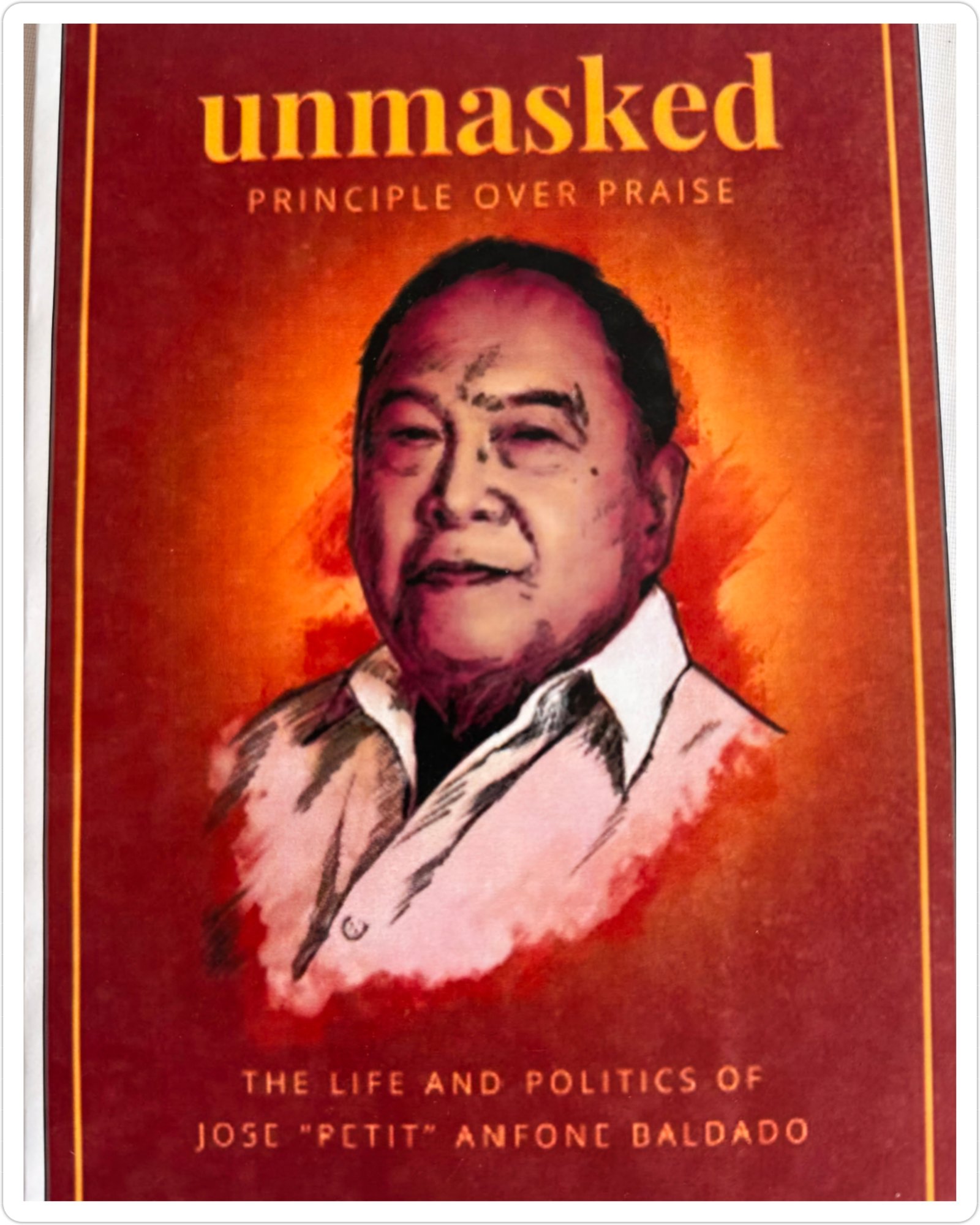
In “Unmasked: Principle Over Praise,” Gemma Minda Lacsina Iso tells the story of Jose “Petit” Anfone Baldado — a public servant who walked away from applause, but never from faith.
In a political culture long shadowed by excess and cynicism, Gemma Minda Lacsina Iso’s Unmasked: Principle Over Praise emerges as a work of rare clarity — part biography, part meditation, part quiet act of defiance. It chronicles the life of Jose “Petit” Anfone Baldado, former mayor of Manjuyod, vice governor and governor of Negros Oriental, who devoted over four decades to public service and left it with little more than peace of mind.
Iso writes not as a campaign biographer or historian but as a storyteller in the purest sense — weaving together memory, loss, and moral inquiry. Her portrait of Baldado is tender yet unflinching: a man of conviction, occasionally conflicted, often misunderstood, but ultimately steadfast in his belief that integrity is its own reward.
A Life Measured Not by Power, but by Purpose
The book opens with Baldado’s spiritual wrestling — his unease with dogma, his questioning of papal infallibility, his rejection of the hollow pageantry of modern religion. “He has not rejected faith,” Iso writes, “he has rejected what he believes is the distortion of it.”
In those lines, one senses both the man and the nation he served — searching, wounded, and weary of spectacle. Baldado’s rebellion was never against God, but against hypocrisy itself. He walked away not to renounce belief, but to rediscover it in its purest, most human form.
The Silence After the Applause
Iso’s prose reaches its most lyrical when describing the years after politics — the stillness that followed three decades of unbroken public life. There are no crowds now, only rusting gates, fading campaign posters, and the hum of a kitchen light above bottles of medicine lined like sentinels of aging.
Yet in this humility lies a strange grandeur. “There was a certain humility in that,” Iso observes. “Age had its way of peeling back the importance of applause.”
It is in these passages that Baldado becomes something larger than a local statesman. He becomes a mirror of a generation of Filipino leaders who came of age in the post-Marcos era — decent men who never amassed wealth, who measured victory not in contracts but in conscience.
Faith Without Blueprints
Perhaps the most moving sections of Unmasked are those of doubt and reckoning. Baldado, once a man of certainty, confronts uncertainty with grace. He reads his worn Bible not to strengthen faith, but to remember who he is.
“Faith,” Iso writes through him, “doesn’t ask for blueprints. It asks for belief.”
It is a line that lingers — a quiet theology for a man who lived his politics as prayer: simple, steadfast, unadorned.
An Uncertain Yet Solid Tomorrow
As the narrative moves through Baldado’s twilight years, Iso paints him not as a fallen politician, but as a man reborn into ordinariness — brewing coffee at dawn, walking the beach at Silliman, sharing afternoons with his wife Janet, and sending short messages to his children about grace and mistakes.
There are no elegies here, no monuments. Instead, there is continuity — the sense that goodness, once lived consistently, becomes its own monument.
In one of the final passages, Iso writes of Petit at rest, surrounded by his family: “He smiled, not because life was perfect, but because they were there.”
The Author’s Quiet Power
Gemma Iso, a journalist known for her work with The Independent Singapore and Dumaguete Metro Post, brings both precision and tenderness to her subject. She writes with a grace that transcends mere reportage — part chronicler, part poet of the ordinary.
Her language carries the rhythm of prayer and the discipline of truth. What emerges is not hagiography, but humanity — a portrait of a man who dared to remain decent in a time when decency had gone out of style.
The Legacy of a Simple Life
In the end, Unmasked is less about politics than about the moral geography of the Filipino spirit. It asks, quietly but persistently: What does it mean to live without compromise?
Petit Baldado’s answer was his life itself — modest, steadfast, grounded in faith, untouched by greed. In an era of loud victories, he found triumph in silence.
And for that, as Iso reminds us in the book’s closing line, “he was never defeated. Not really. Not ever.”
