
NEGROS ORIENTAL, Philippines — Three years have passed since the morning when gunfire shattered the quiet town of Pamplona and claimed the life of Governor Roel R. Degamo along with nine others. The killings on March 4, 2023, stunned the Philippines and forced a national reckoning with the persistent dangers of political violence in local governance.
What has come to be known as the Pamplona massacre remains one of the most consequential criminal cases in recent Philippine political history — a case still unfolding in courtrooms as investigators and prosecutors attempt to establish responsibility for an attack that unfolded in broad daylight.
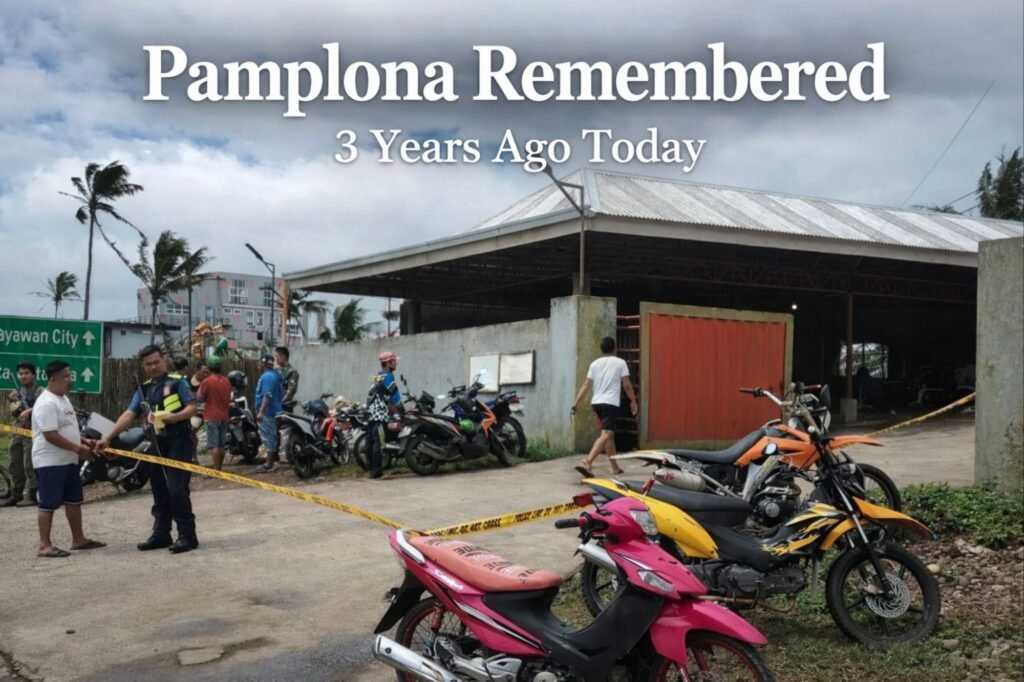
The violence began shortly after 9:30 a.m. at the governor’s residential compound in Pamplona, a rural municipality about 20 kilometers from the provincial capital of Dumaguete. Degamo, who had been meeting constituents that morning and distributing assistance to residents, was inside the compound when a group of armed men arrived.
Authorities later said the assailants wore military-style tactical gear and pixelated camouflage uniforms. Armed with high-powered rifles, they entered the compound and opened fire.
The attack was swift and chaotic. Witness accounts described people scrambling for cover as the gunmen fired repeatedly into the area where Degamo and civilians had gathered.
Degamo was rushed to a nearby hospital but was pronounced dead at 11:41 a.m., according to official reports. Nine other people — aides and civilians who had come to the compound seeking assistance — were also killed. Approximately 17 individuals were wounded.
The gunmen fled the scene in three sport utility vehicles, which were later found abandoned. Within hours and in the days that followed, authorities arrested several suspects believed to have taken part in the shooting.
For investigators, however, the arrests of the alleged gunmen were only the beginning of a far more complicated inquiry.
The case soon expanded to include allegations that the attack had been orchestrated by political figures in the province. Prosecutors later filed multiple murder charges against Arnolfo “Arnie” Teves Jr., a former congressman representing Negros Oriental’s third district.
Teves denied the allegations and insisted he was overseas when the killings occurred, setting off an international search that lasted more than a year.
In March 2024, he was arrested in Timor-Leste. After prolonged legal proceedings in that country, he was deported to the Philippines in May 2025 and placed in government custody.
As of March 2026, Teves remains detained while facing non-bailable charges in connection with the Pamplona massacre. The trial proceedings related to the killings are ongoing.
The case has drawn national attention not only because of the scale of the violence but also because of the political context surrounding it.
Degamo had returned to the governorship in 2022 after the Commission on Elections ruled in his favor in a contested electoral protest against Pryde Henry Teves, the brother of the former congressman.
That ruling restored Degamo to office after years of political dispute in the province. The rivalry between political factions in Negros Oriental had long been intense, though the March 2023 attack represented an unprecedented escalation.
Roel Degamo himself had been a prominent figure in provincial politics for over a decade. Over the course of his career, he served multiple terms as governor and was known for welfare programs aimed at poor communities.
His death sent shock waves through the province and the nation.
In the weeks following the attack, Philippine authorities launched a series of security operations across Negros Oriental aimed at dismantling private armed groups and illegal weapons networks believed to be operating in the area.
Several raids resulted in the seizure of firearms and the arrest of individuals suspected of involvement in armed activities tied to local political disputes.
The Degamo case has continued to move through the legal system amid a series of developments.
On January 16, 2026, a Manila court acquitted Teves in a separate criminal case related to the 2019 killing of a provincial board member, citing insufficient evidence. The ruling did not affect the multiple murder charges related to the Pamplona massacre, which remain pending.
Legal proceedings in the Degamo case have included hearings involving witness testimonies and the presentation of evidence. Court schedules are expected to extend through 2026 given the complexity of the case and the number of accused individuals involved.
For many residents of Negros Oriental, the massacre remains a defining moment in the province’s recent history.
Political violence has long existed in parts of the Philippines, particularly during periods of intense local rivalry. Yet the scale and brazenness of the Pamplona attack — carried out in daylight against a sitting governor — marked a particularly alarming episode.
It also renewed calls from civil society groups and national leaders for stronger action against private armed groups and politically motivated violence.
The killings prompted renewed discussion about security for public officials and the broader challenge of dismantling entrenched political clans whose rivalries sometimes turn deadly.
Three years later, the legal process continues, moving at the deliberate pace of the courts.
For the families of the ten people killed in the attack, the passage of time has not diminished the weight of the tragedy.
The Pamplona massacre remains both a criminal case and a symbol — a reminder of the risks faced by public officials and citizens alike when political competition descends into violence.
As the third anniversary of the killings arrives, the central question that emerged in the aftermath of that morning in March 2023 remains unresolved: whether the Philippine justice system will ultimately deliver accountability for one of the most shocking political assassinations in the country’s recent past.
Stay informed — get Negros Oriental news weekly
Free newsletter, no spam. Unsubscribe anytime.
