

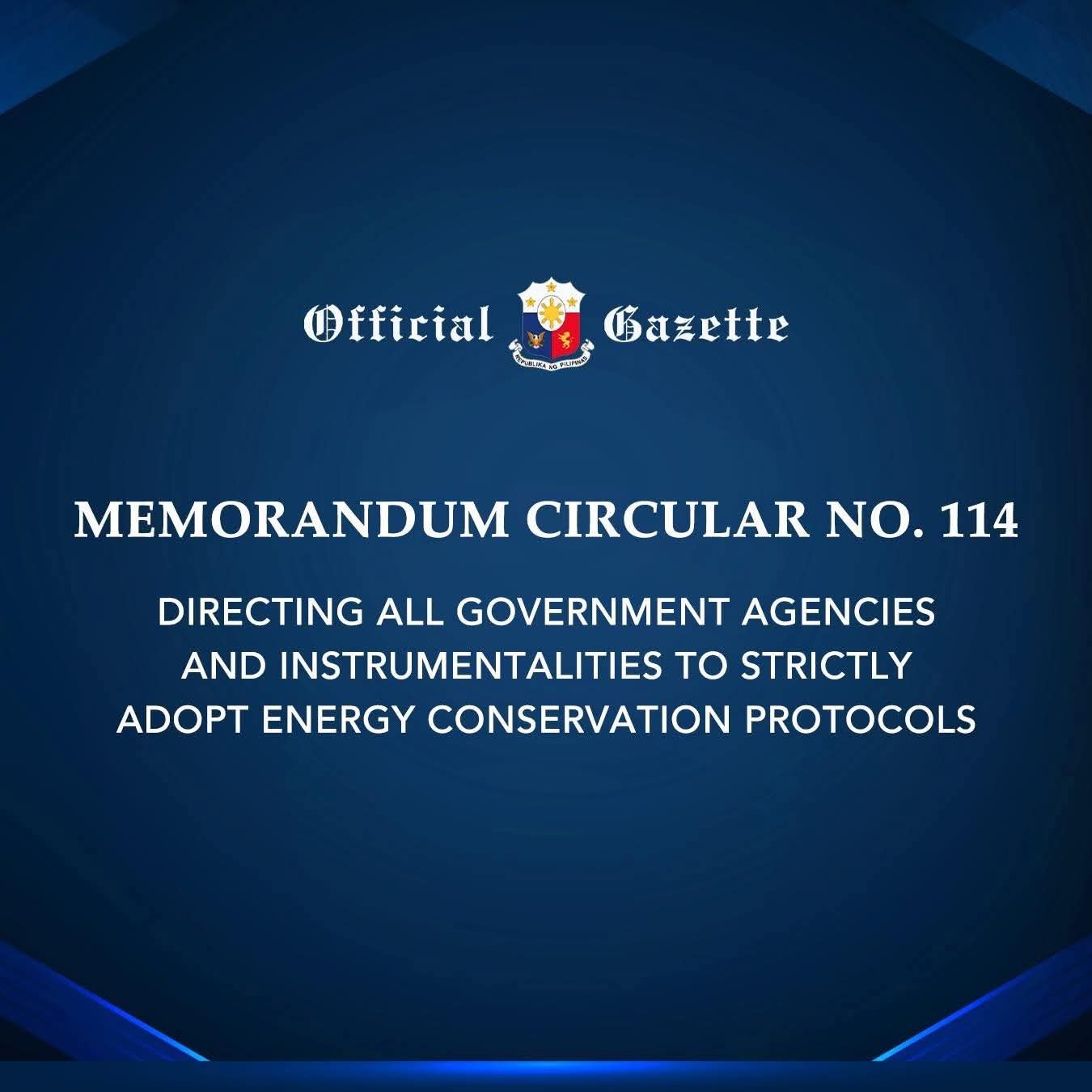
MANILA, Philippines — The national government has ordered all government agencies and state institutions to immediately adopt strict energy conservation protocols, including limits on air-conditioning use, reduced official travel and the adoption of flexible work arrangements, under a new directive issued by the Office of the President.
The order, Memorandum Circular No. 114, was issued on March 6, 2026, directing agencies across the bureaucracy to implement measures aimed at reducing electricity and fuel consumption by 10 to 20 percent, while maintaining uninterrupted delivery of public services.
The directive was issued through the Office of the President in Malacañang and published in the Official Gazette, citing rising global energy volatility and the need to improve efficiency in government operations.
Energy Conservation as Government Policy
The memorandum anchors the directive on several existing laws and policies governing energy efficiency and public resource management.
Among these are provisions of the Administrative Code of 1987, which requires that government resources be utilized efficiently and safeguarded against waste, and Republic Act No. 11285, the Energy Efficiency and Conservation Act, which institutionalized energy conservation programs across government and private sectors.
The circular also references Administrative Order No. 15 (2024), which mandates government agencies and government-owned or controlled corporations (GOCCs) to implement the Government Energy Management Program (GEMP) and comply with guidelines issued by the Department of Energy (DOE) and the Inter-Agency Energy Efficiency and Conservation Committee (IAEECC).
Officials said the order comes amid ongoing geopolitical tensions affecting global fuel markets, resulting in fluctuating energy prices and pressure on national economies.
“The ongoing geopolitical tensions have led to significant volatility in global energy markets, resulting in the rising cost of fuel that impacts the national economy,” the memorandum states.
Coverage Across Government
The directive applies to all national government agencies and instrumentalities, including GOCCs, as well as constitutional bodies and state universities and colleges. Local government units are also encouraged to adopt similar measures.
Under the order, agencies must immediately implement specific conservation protocols designed to reduce electricity and fuel consumption across government operations.
Among the mandated measures is the standardization of air-conditioning thermostat settings at 24 degrees Celsius in government offices.
Agencies are also instructed to activate sleep settings on electronic equipment, turn off non-essential lighting and devices during lunch breaks and after office hours, and ensure that energy-efficient practices are observed across workplaces.
Shift to Digital and Virtual Meetings
Another key component of the directive is the move toward virtual meetings as the default mode for government coordination and conferences.
Inter-agency meetings, consultations, seminars and workshops are required to be conducted through secure digital platforms, except in cases where physical presence is legally required or operationally necessary.
To support the transition, agency heads are instructed to ensure offices have adequate digital infrastructure and communication systems.
The directive also limits official travel.
Government personnel may travel only for essential and indispensable functions, and trips deemed unnecessary — particularly those that can be replaced by online meetings — are prohibited.
Authorities emphasized that travel without clear justification, operational necessity or program relevance would be considered unnecessary under the new policy.
Reducing Fuel Consumption in Government Fleets
The circular also outlines several measures to improve the fuel efficiency of government vehicles.
Agencies are required to strengthen fleet management practices, including:
• Trip consolidation, combining multiple official tasks into a single journey
• Route optimization, using the shortest and least congested travel paths
• Minimizing engine idling, particularly during waiting periods
• Adoption of the “full-tank method” for monitoring fuel consumption and ensuring proper vehicle maintenance
These measures are intended to reduce fuel usage and improve monitoring of government transportation costs.
Other Workplace Measures
The memorandum encourages government personnel to reduce electricity use through simple behavioral changes.
Among these is the minimization of elevator use, encouraging employees to use stairs when moving between floors whenever feasible.
Agencies are also authorized to adopt additional energy conservation practices consistent with national policies on efficient energy use.
Flexible Work Arrangements Introduced
To further reduce electricity demand in government buildings and lower transport fuel consumption, the circular also introduces flexible work arrangements.
Agencies are authorized to adopt a four-day on-site workweek, either through compressed schedules or designated work-from-home days.
The arrangement will take effect starting March 9, 2026 and will remain in place until lifted or modified by the President.
Implementation will follow guidelines issued by the Civil Service Commission, particularly those governing flexible work arrangements in government offices.
Each agency must develop internal guidelines to ensure proper monitoring of employee attendance, productivity and performance under the new system.
Public Services Must Continue
Despite the conservation measures, the memorandum emphasizes that government services must not be disrupted.
Agencies providing essential services, including health care, public safety and emergency response, are required to remain fully operational.
Frontline government services must continue without interruption even as agencies implement energy conservation measures.
Monitoring and Compliance
The directive also introduces monitoring and reporting requirements to ensure compliance.
Government agencies must:
• Designate an Energy Conservation Officer or Certified Energy Manager
• Cooperate with Department of Energy audits and inspections
• Submit monthly electricity and fuel consumption data through the GEMP Online System
The Inter-Agency Energy Efficiency and Conservation Committee will submit regular reports to the Office of the President detailing the compliance status of each agency.
The memorandum circular took immediate effect upon issuance on March 6, 2026, signaling the government’s push to institutionalize energy conservation as part of everyday public sector operations.
Officials say the policy is intended not only to cut operational costs but also to promote a broader culture of responsible energy use within government.
Photo Credits:
Official Gazette of the Republic of the Philippines / Office of the President – Memorandum Circular No. 114 (Energy Conservation Protocols).
Stay informed — get Negros Oriental news weekly
Free newsletter, no spam. Unsubscribe anytime.
