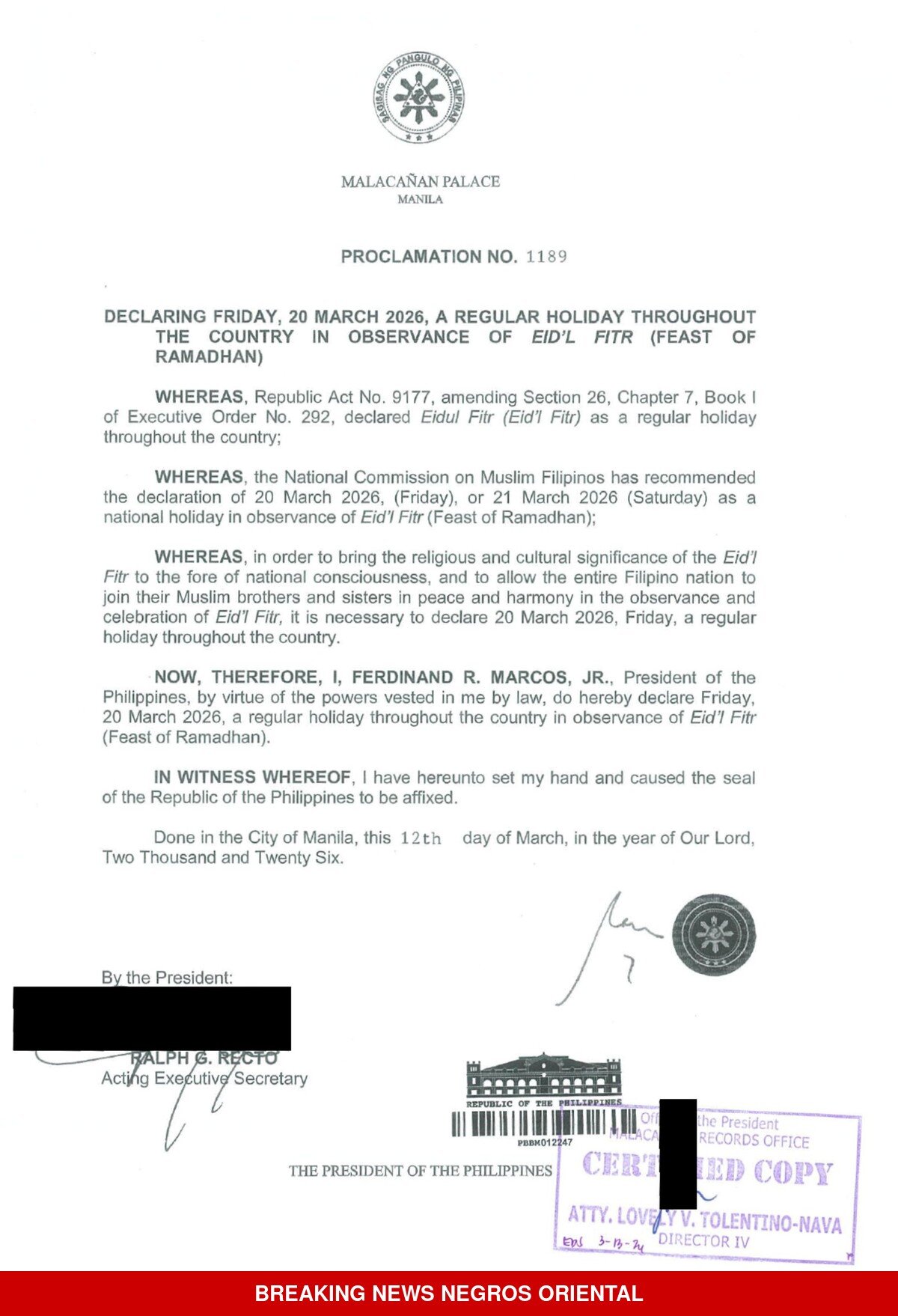
President Ferdinand R. Marcos Jr. has officially declared Friday, March 20, 2026, as a regular holiday throughout the Philippines in observance of Eid’l Fitr, also known as the Feast of Ramadan. The declaration was formalized through Proclamation No. 1189, signed on March 12, 2026.
According to the proclamation issued by Malacañang Palace, the holiday declaration aims to highlight the religious and cultural significance of Eid’l Fitr and enable all Filipinos to join their Muslim compatriots in celebrating this important Islamic festival in “peace and harmony.”
Legal Foundation for Holiday Declaration
The proclamation is grounded in Republic Act No. 9177, which amended Section 26, Chapter 7, Book I of Executive Order No. 292, officially recognizing Eid’l Fitr as a regular holiday throughout the country. This law provides the legal framework for the annual declaration of the Islamic celebration as a national holiday.
The specific date selection followed a recommendation from the National Commission on Muslim Filipinos (NCMF), which suggested either March 20, 2026 (Friday) or March 21, 2026 (Saturday) for the national holiday observance. The President ultimately chose the Friday date for the official declaration.
Significance of Eid’l Fitr
Eid’l Fitr marks the end of Ramadan, the holy month of fasting observed by Muslims worldwide. The celebration is one of the most significant festivals in the Islamic calendar, representing spiritual renewal, community solidarity, and charitable giving.
For the estimated 11 million Muslim Filipinos, particularly those in Mindanao and other regions with significant Muslim populations, Eid’l Fitr is a time of prayer, feasting, and family gatherings. The holiday typically involves special prayers at mosques, the exchange of gifts, and the sharing of meals with family and community members.
The proclamation emphasizes the government’s commitment to recognizing the religious diversity of the Philippines and ensuring that Muslim Filipinos can fully observe their religious practices without workplace or academic conflicts.
Impact on Government and Private Sectors
As a regular holiday, March 20, 2026, will result in the suspension of work in government offices nationwide. Government employees will be entitled to their full daily wage without reporting to work, unless they are required for essential services.
Private sector employees are also expected to benefit from the holiday declaration. Under Philippine labor laws, employees who work on regular holidays are entitled to receive 200 percent of their regular daily wage. Those who do not work on the holiday still receive 100 percent of their regular pay.
The declaration will also affect the operations of banks, schools, and other institutions that typically follow government holiday schedules. Financial markets and stock exchanges are expected to remain closed on this date.
Regional Impact on Negros Oriental
While Negros Oriental has a predominantly Christian population, the province is home to several Muslim communities, particularly in urban centers like Dumaguete City. Local Muslim organizations and interfaith groups in the province have historically used Eid’l Fitr as an opportunity to promote religious understanding and cultural exchange.
The holiday declaration will benefit Muslim students and workers in Negros Oriental, allowing them to participate fully in religious observances without academic or employment penalties. Educational institutions across the province, including Silliman University and Foundation University, typically close during declared national holidays.
Local government units in Negros Oriental are expected to issue their own advisories regarding the suspension of classes and government services on March 20, 2026.
Official Documentation and Authority
The proclamation was signed by President Marcos under the authority vested in him by law, with Acting Executive Secretary Ralph G. Recto serving as the countersigning official. The document was certified by Director IV Atty. Lovely V. Tolentino-Nava, ensuring its legal authenticity.
The proclamation follows the standard format for presidential holiday declarations, clearly stating the legal basis, rationale, and specific date for the observance. The document carries the official seal of the Republic of the Philippines and was issued from Manila.
Historical Context of Eid’l Fitr Recognition
The recognition of Eid’l Fitr as a national holiday represents part of the Philippine government’s broader efforts to acknowledge the country’s religious diversity. The inclusion of Islamic holidays in the national calendar demonstrates the state’s commitment to inclusive governance and respect for minority rights.
Previous administrations have consistently maintained this tradition, with annual proclamations typically issued based on lunar calendar calculations and recommendations from Islamic religious authorities. The timing of Eid’l Fitr varies each year as it depends on the sighting of the new moon, which marks the end of Ramadan.
Looking Ahead
The early announcement of the holiday date allows government agencies, private companies, and educational institutions adequate time to adjust their schedules and operations. It also provides Muslim families with certainty for planning their Eid’l Fitr celebrations and travel arrangements.
Similar proclamations are expected annually, with dates determined by Islamic lunar calendar calculations and formal recommendations from the National Commission on Muslim Filipinos. The consistent recognition of Eid’l Fitr reinforces the Philippines’ commitment to religious tolerance and cultural inclusivity.
Photo credit: Photo from Official Gazette of the Philippines
Stay informed — get Negros Oriental news weekly
Free newsletter, no spam. Unsubscribe anytime.