
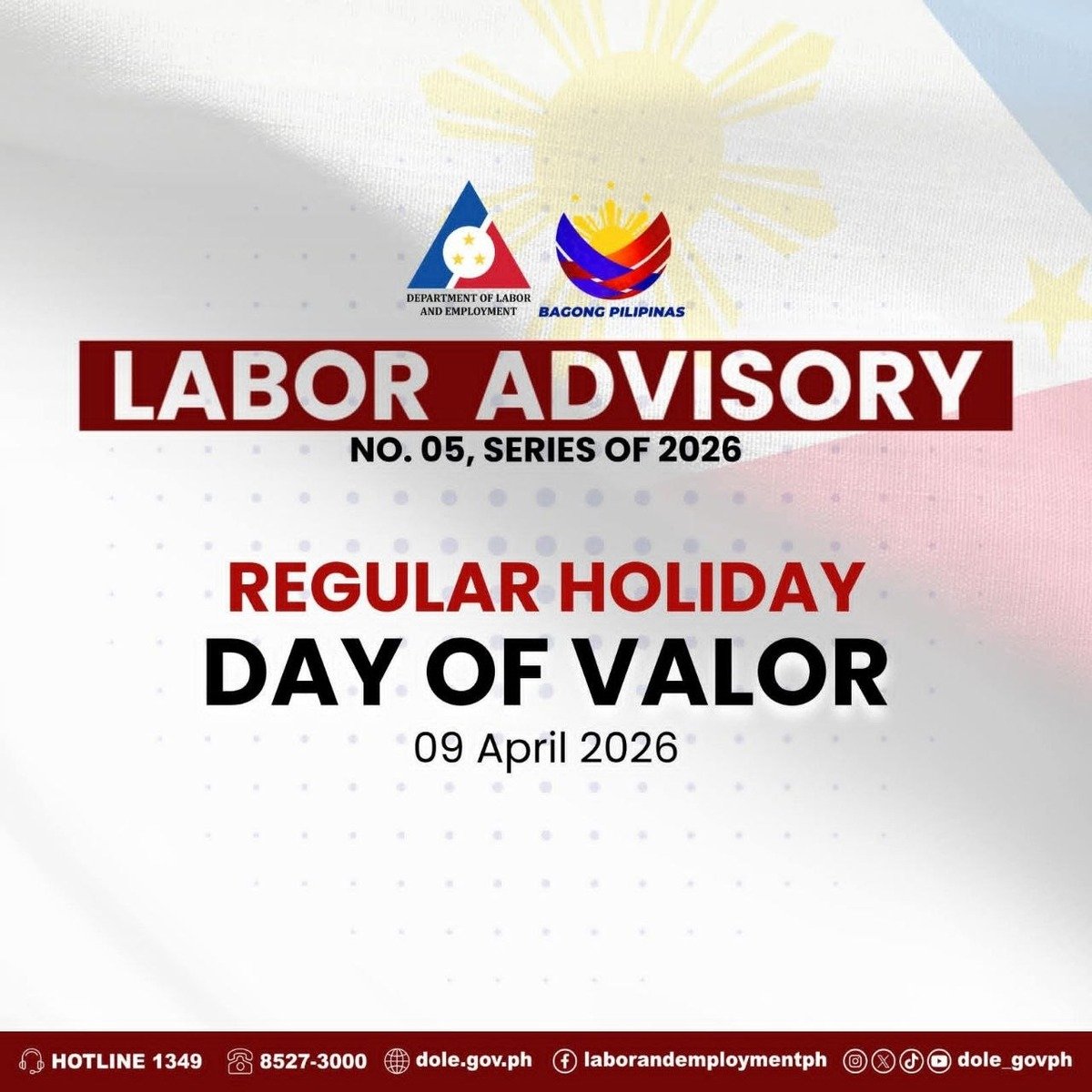
All employers nationwide must adhere to specific compensation guidelines for the upcoming Day of Valor regular holiday on April 9, 2026, according to Labor Advisory No. 05, series of 2026, issued by the Department of Labor and Employment (DOLE).
The comprehensive advisory details mandatory wage provisions that protect workers’ financial interests during the national commemoration while establishing clear expectations for business operations during the holiday period.
Basic Holiday Pay Entitlements
Workers qualify for complete daily wage compensation without reporting to work on April 9, provided they maintain attendance or hold approved paid leave status on the working day that immediately precedes the holiday. This fundamental provision ensures economic security for employees observing the national holiday.
Stay informed with our free weekly newsletter. No spam, unsubscribe anytime.
The standard calculation for non-working employees follows a simple formula: Basic Wage multiplied by 100%. However, eligibility requires specific attendance conditions that employers must carefully monitor and verify.
When the preceding day represents a non-working period at the establishment or coincides with an employee’s scheduled rest day, alternative qualification rules take effect. Under these circumstances, workers remain eligible for holiday compensation if they reported for duty or maintained paid leave status on the day immediately before the non-working period or rest day.
Enhanced Pay for Holiday Workers
Employees choosing to work during Day of Valor receive significantly increased compensation reflecting the premium nature of holiday labor. For standard eight-hour shifts performed on April 9, employers must provide 200% of regular daily wages.
This doubled compensation rate acknowledges workers who forgo holiday observance to maintain essential services and business operations across various economic sectors.
Beyond the standard eight-hour period, overtime provisions apply with additional complexity. Extended work during the regular holiday triggers an extra 30% of the hourly rate calculation, computed as: Hourly rate of basic wage x 200% x 130% x actual hours worked beyond eight hours.
Rest Day Holiday Combinations
Complex compensation structures emerge when Day of Valor coincides with individual employees’ regular rest days. These scenarios require employers to apply multiple premium calculations that significantly increase wage obligations.
For standard work performed during a regular holiday falling on a rest day, employers must pay an additional 30% premium on top of the holiday rate. The calculation becomes: Basic Wage x 200% x 130%.
This enhanced structure recognizes that workers sacrifice both their regular day off and a national holiday, warranting additional compensation beyond standard holiday premiums.
Complex Overtime Scenarios
The most intricate compensation requirements involve overtime work during holidays that also fall on rest days. These circumstances trigger the highest wage multiplication factors outlined in the DOLE advisory.
Extended work under these conditions requires calculation of: Hourly rate of basic wage x 200% x 130% x 130% x number of overtime hours. This triple premium structure ensures substantial compensation for the most demanding work schedule combinations possible.
Day of Valor Historical Context
April 9 annually commemorates the fall of Bataan during World War II, honoring the bravery of Filipino and American forces who resisted Japanese occupation. This historical significance underlies the holiday’s regular status and associated worker protections.
The commemoration preserves memories of wartime sacrifice and courage while ensuring modern workers can observe this important national remembrance without financial hardship through guaranteed wage provisions.
Compliance and Enforcement
DOLE emphasizes that holiday pay requirements represent non-negotiable legal obligations for all employers. Violations can result in significant penalties under Philippine labor law, making compliance essential for business operations.
The department maintains multiple support channels including hotlines 1349 and 8527-3000, plus their official website at dole.gov.ph. These resources provide clarification and assistance for both employers and workers regarding specific situations and calculations.
Labor rights advocates stress that these provisions constitute fundamental protections that cannot be waived through individual contracts or employer agreements, regardless of specific workplace arrangements.
Sectoral Economic Considerations
Holiday pay regulations create varying impacts across different economic sectors. Essential services, retail establishments, and hospitality businesses typically maintain operations during holidays, making these enhanced compensation requirements significant operational considerations.
For workers, comprehensive holiday pay provisions provide financial security and appropriate recognition for holiday labor, ensuring economic protection during national observances.
The balanced regulatory approach protects fundamental worker rights while providing clear operational guidelines that enable businesses to plan staffing and budget appropriately for holiday periods.
DOLE’s advisory reinforces the government’s commitment to maintaining equitable labor relations that recognize both worker welfare and legitimate business operational needs during national holidays.
Stay informed — get Negros Oriental news weekly
Free newsletter, no spam. Unsubscribe anytime.


- 01
- 02
- 03
- 04