
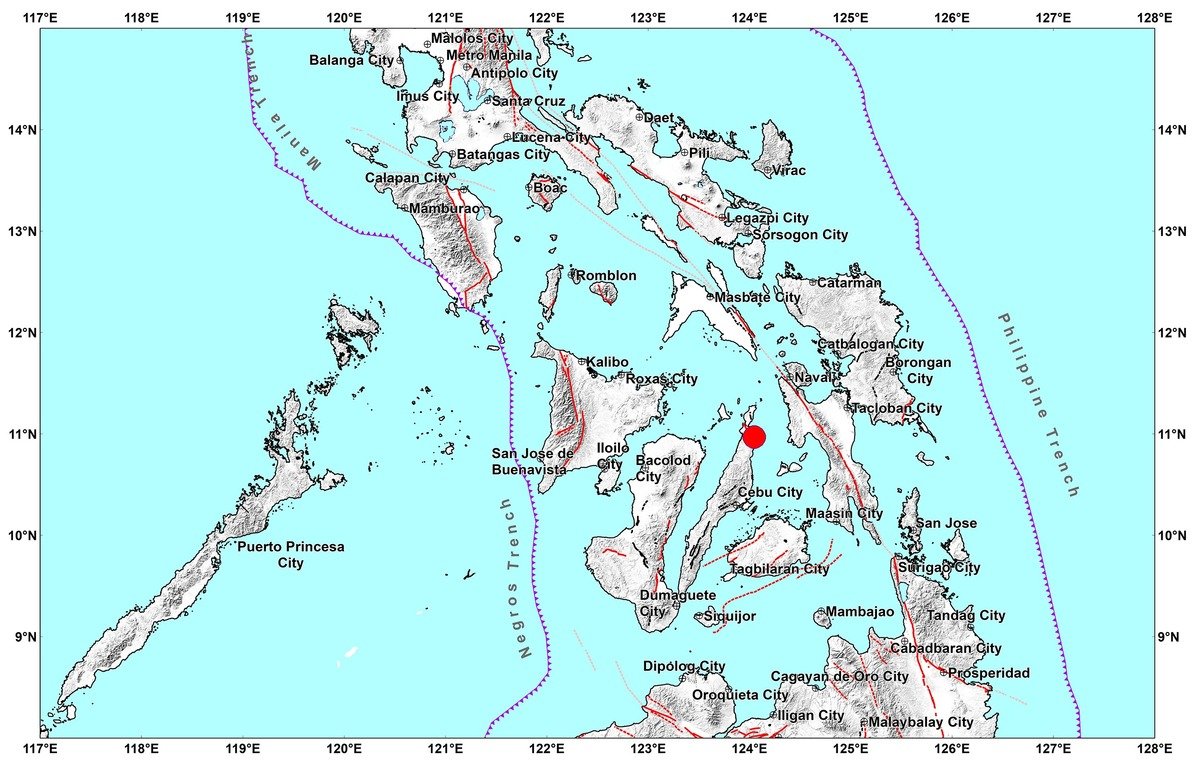
Communities across Central Visayas felt strong tremors Sunday afternoon when a 5.1-magnitude earthquake rattled the region, originating from waters near Bogo City in Cebu province. The Philippine Institute of Volcanology and Seismology (PHIVOLCS-DOST) has cautioned residents to prepare for potential structural damage and subsequent aftershocks.
For residents of Negros Oriental, the seismic event serves as a reminder of the active geological conditions in our region, though the province experienced only minor shaking from this particular tremor.
Seismic Details and Location
PHIVOLCS-DOST recorded the tectonic earthquake at exactly 3:22 PM Philippine Standard Time on April 6, 2026. The quake’s epicenter was pinpointed at coordinates 10.96°N, 124.05°E, positioned 12 kilometers south 38° east of Bogo City. Scientists noted the earthquake’s shallow depth of 11 kilometers, which contributed to the intensity of shaking felt across the region.
Stay informed with our free weekly newsletter. No spam, unsubscribe anytime.
The relatively shallow nature of the earthquake, combined with its moderate magnitude, created conditions that amplified ground motion across multiple provinces in the Visayas archipelago.
Intensity Reports from Affected Communities
Residents closest to the epicenter experienced the most significant shaking, with Bogo City and Medellin in Cebu reporting Intensity V tremors according to the PHIVOLCS Earthquake Intensity Scale. This level of shaking is described as strong, causing people to feel unsteady and potentially awakening sleeping individuals.
Communities in Sogod, Cebu, and Villaba, Leyte reported Intensity IV shaking, characterized as moderately strong tremors that can cause hanging objects to swing noticeably.
Multiple locations across Cebu province experienced Intensity III shaking, including Bantayan, Liloan, City of Toledo, and Tudela. The tremors also reached urban centers, with both Cebu City and Mandaue City residents reporting similar intensity levels.
Lighter tremors classified as Intensity II were felt in several areas, including Inabanga in Bohol province, as well as Argao and Talisay City in Cebu. The earthquake’s reach extended to produce Intensity I shaking in Badian and San Fernando, both in Cebu.
Scientific Instrument Readings Reveal Wider Impact
Beyond public reports, PHIVOLCS seismological monitoring equipment detected earthquake effects across an even broader geographic area. Instrumental readings showed Intensity IV shaking in San Francisco, Cebu, and extended to Leyte province locations including Hilongos and Villaba.
The scientific instruments captured Intensity III readings from diverse locations spanning multiple provinces. In Masbate, the monitoring station at Esperanza recorded notable shaking, while Cebu installations in Liloan and Cebu City confirmed similar readings. Lapu-Lapu City’s instruments also detected Intensity III motion.
Leyte province showed widespread seismic activity through instrumental recordings, with Intensity III readings from Abuyog, Baybay City, Carigara, and Isabel, as well as Ormoc City. Southern Leyte’s Hinundayan also registered similar measurements.
The earthquake’s influence reached even further, with Intensity II readings recorded instrumentally across Capiz, Iloilo, Negros Occidental, various additional Cebu monitoring points, Biliran, multiple other Leyte municipalities, and additional Southern Leyte locations.
Minimal but detectable Intensity I readings extended the earthquake’s measurable impact to provinces including Masbate, Capiz, Guimaras, Iloilo, Negros Occidental, Bacolod City, Eastern Samar, and Samar.
Official Warnings and Preparedness Measures
PHIVOLCS has issued clear warnings regarding expected consequences from this seismic event. The agency anticipates structural damage in areas closest to the epicenter and advises all affected communities to prepare for aftershocks following the main earthquake.
The earthquake’s characteristics—including its magnitude, shallow depth, and tectonic origin—combined to create conditions conducive to both widespread shaking and potential property damage. These factors influenced PHIVOLCS’ decision to issue damage warnings for the affected region.
The official earthquake bulletin was released at 4:09 PM on April 6, 2026, with PHIVOLCS noting this represents their final bulletin unless additional significant information becomes available.
Community Response and Safety Recommendations
PHIVOLCS urges residents throughout the affected areas to maintain heightened awareness for potential aftershocks and to conduct thorough inspections of buildings and structures for any earthquake-related damage.
For Negros Oriental residents, this event underscores the importance of earthquake preparedness given our location within the seismically active Philippines. While our province experienced minimal effects from this particular earthquake, maintaining readiness for future seismic events remains crucial.
Residents seeking updated information should monitor official PHIVOLCS communications through their website at phivolcs.dost.gov.ph for the most current seismological data and safety guidance.
Stay informed — get Negros Oriental news weekly
Free newsletter, no spam. Unsubscribe anytime.

- 01
- 02
- 03
- 04