
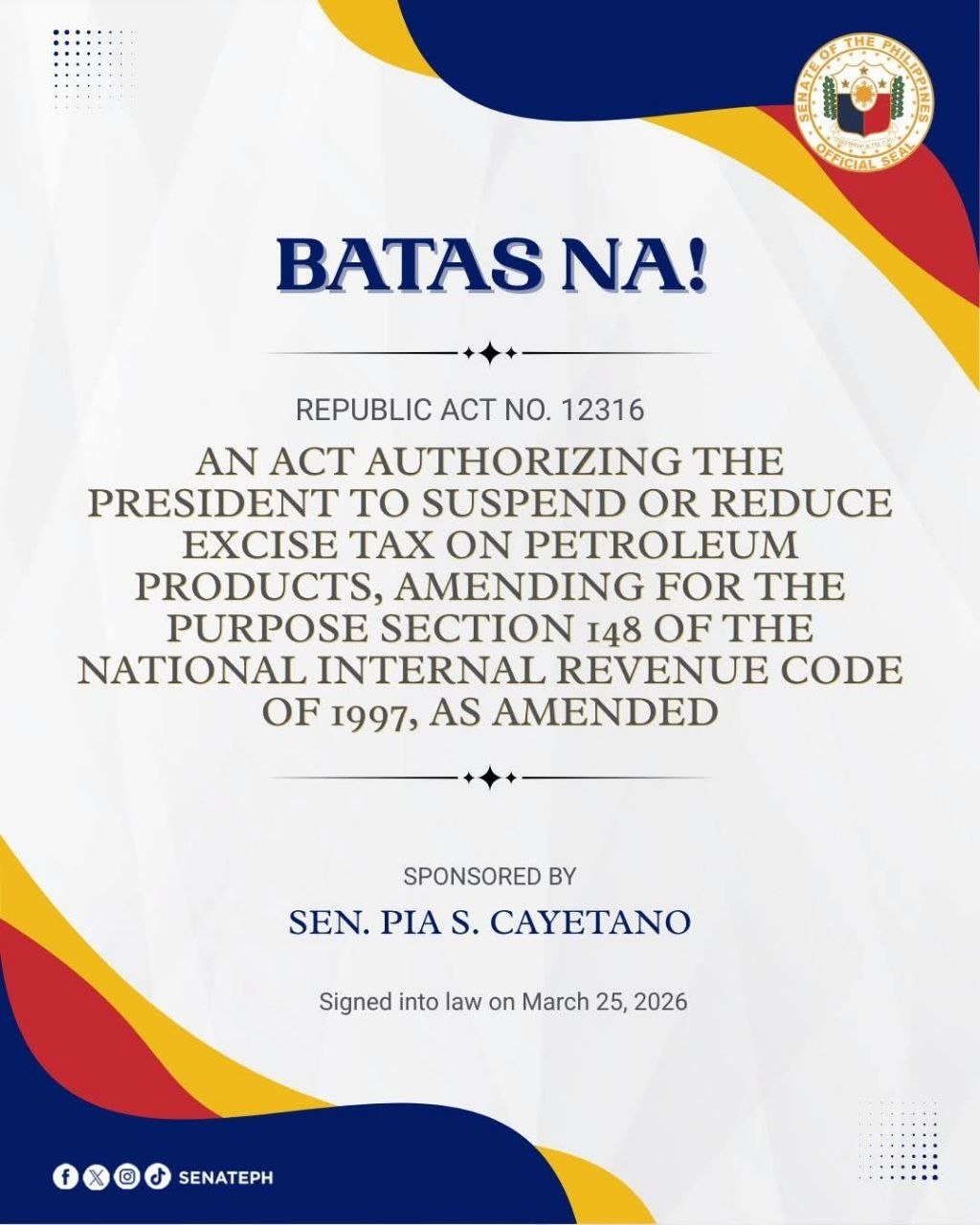
Republic Act No. 12316, recently signed by President Ferdinand “Bongbong” Marcos Jr., establishes emergency presidential powers to suspend or reduce excise taxes on petroleum products whenever global oil prices surpass the critical USD 80 per barrel mark.
Enacted on March 25, 2026, this legislation modifies Section 148 of the National Internal Revenue Code of 1997, creating a safety net for Filipino consumers against unpredictable international oil market fluctuations. The new law arrives at a time when Middle Eastern conflicts continue pushing global crude prices upward, intensifying financial pressures on Philippine households already confronting inflationary challenges.
Clear Trigger Mechanisms Established
The legislation, championed by Sen. Pia S. Cayetano in the Senate, creates a precise activation system requiring specific market conditions before presidential action becomes permissible. Emergency tax suspension authority can only be exercised when Dubai crude oil maintains a one-month average price of USD 80 per barrel or above, establishing an objective benchmark for implementing relief measures.
Stay informed with our free weekly newsletter. No spam, unsubscribe anytime.
This threshold was determined through careful analysis of historical petroleum price trends and their corresponding effects on Philippine fuel costs. The USD 80 level ensures intervention occurs only during periods of genuinely elevated global energy prices that would substantially impact Filipino consumers.
Built-in Limitations Prevent Overuse
Despite expanding executive flexibility during energy emergencies, the law incorporates strict boundaries to avoid indefinite tax relief that might compromise government revenue streams. Presidential suspension orders carry a maximum duration of three months, ensuring interventions remain temporary and focused.
Additional constraints limit total relief within any calendar year to no more than twelve months cumulative duration. This safeguard prevents consecutive suspension orders from essentially eliminating fuel excise taxes permanently, preserving equilibrium between emergency assistance and fiscal accountability.
The complete authority under RA 12316 terminates on December 31, 2028, necessitating future congressional action for extensions beyond that deadline. This expiration provision guarantees legislative review of the measure’s effectiveness before continuation past its initial implementation phase.
Automatic Restoration Provisions
Built-in triggers for ending tax suspensions eliminate discretionary components that might lead to extended relief periods. Excise taxes automatically resume once Dubai crude prices drop below USD 80 per barrel for thirty consecutive days, guaranteeing relief measures conclude when market conditions stabilize.
Tax collection also resumes upon expiration of three-month suspension periods, regardless of prevailing oil price conditions. This dual-trigger system ensures suspension periods cannot exceed intended durations irrespective of continuing energy market volatility.
These automatic restoration mechanisms eliminate requirements for separate executive actions to terminate tax relief, reducing potential political pressures to extend suspensions beyond economically warranted timeframes.
Rigorous Oversight and Transparency
Addressing concerns about revenue losses and potential executive overreach, the law establishes comprehensive reporting obligations ensuring transparency and accountability. Within 15 days of issuing suspension orders, the President must submit detailed congressional reports providing immediate legislative oversight of executive decisions.
Monthly progress reports must follow, explaining suspension rationales, quantifying foregone government revenue, and documenting impacts on inflation and household finances. These regular updates enable lawmakers to assess the effectiveness and fiscal consequences of tax relief initiatives.
Reporting requirements extend beyond executive agencies, mandating oil companies and relevant government departments to provide monthly data ensuring complete implementation accountability. This extensive information gathering will supply policymakers with comprehensive details about suspension order effects on fuel pricing and consumer behavior.
Revenue Protection and Economic Balance
The legislation represents careful balancing between immediate pump price relief and national tax base protection. Sen. Cayetano highlighted transparency as a fundamental component, noting that reporting requirements will maintain public awareness of authority exercise.
Petroleum excise taxes constitute major government revenue sources, with proceeds typically supporting infrastructure development and social programs. The law’s temporal restrictions and oversight provisions ensure revenue losses remain temporary and thoroughly documented.
Geopolitical Context and Energy Security
The law’s signing timing reflects mounting global energy security concerns amid persistent Middle Eastern conflicts contributing to oil price instability. Recent months witnessed significant crude price fluctuations due to geopolitical tensions affecting major petroleum-producing areas.
Philippine consumers experience these global price movements through increased gasoline station costs, with fuel prices directly influencing transportation expenses and subsequently affecting goods and services pricing throughout the economy. The new legislation provides government intervention mechanisms when external shocks threaten excessive burdens on Filipino families.
Energy security has emerged as an increasingly critical policy consideration as global supply chains face various disruptions, making domestic policy instruments like tax suspension authority more valuable for economic management.
Implementation Framework and Future Outlook
With the law now effective, government agencies must establish procedures for monitoring Dubai crude prices and implementing suspension orders when threshold conditions materialize. The Department of Energy and Bureau of Internal Revenue will assume primary roles in tracking market conditions and executing relief measures.
The three-year authority period concluding December 31, 2028, will provide policymakers with practical experience using this mechanism and performance data. This information will guide future decisions regarding extension, modification, or authority expiration.
Industry stakeholders and consumer advocates will closely monitor implementation, particularly how rapidly relief measures translate into reduced pump prices for Filipino motorists when suspension orders take effect.
Photo credit: Photo courtesy of Malacañang Palace
Stay informed — get Negros Oriental news weekly
Free newsletter, no spam. Unsubscribe anytime.




- 01
- 02
- 03
- 04