
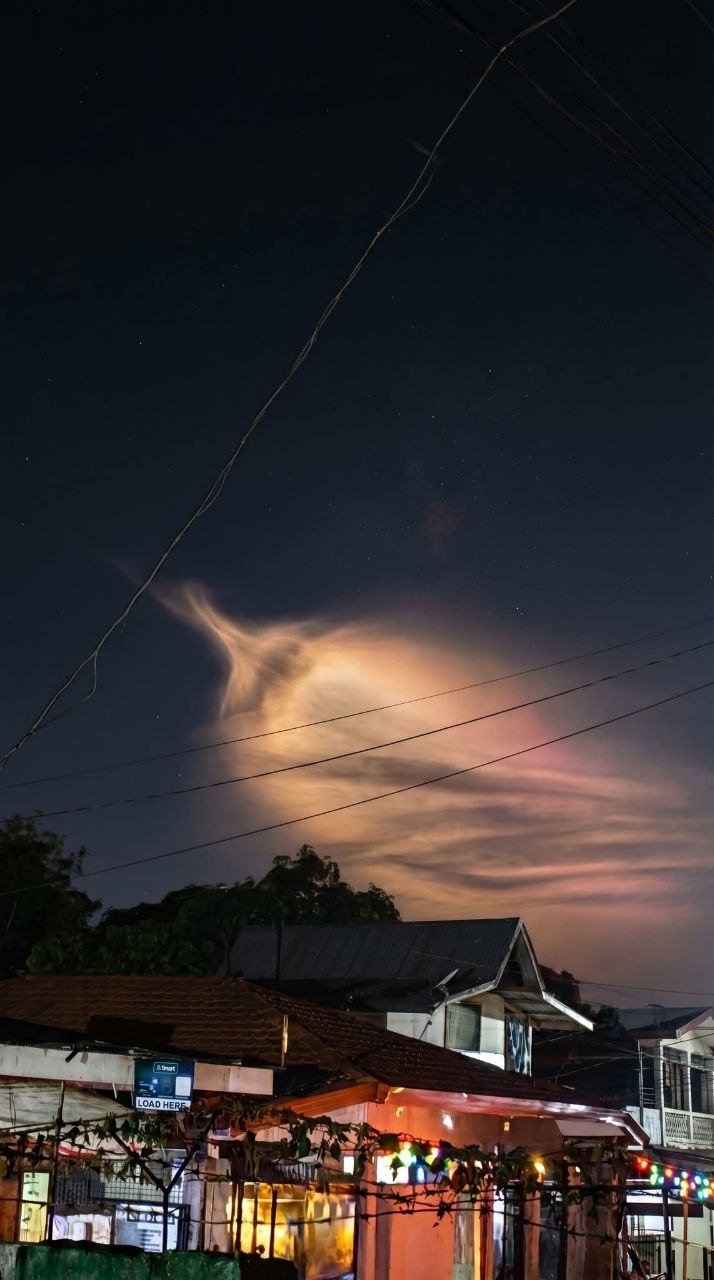
A brilliant jellyfish-like formation that captivated observers across Luzon on Saturday evening has been officially attributed to the exhaust trail of a Chinese rocket launch, according to the Philippine Space Agency (PhilSA), which issued a clarification on Sunday to address widespread public speculation about the unusual celestial display.
The luminous spectacle appeared at approximately 7:40 p.m. Philippine Standard Time on April 11, featuring a distinctive glowing “bell” shape with trailing streamers that resembled tentacles, prompting numerous social media posts from residents who described witnessing what appeared to be a slow-moving fireball with an otherworldly appearance.
PhilSA’s Sunday advisory confirmed that the atmospheric phenomenon coincided with China’s launch of the Jielong-3 rocket from a sea-based platform in the South China Sea at 7:32 p.m. PST, creating what space scientists classify as a “space jellyfish” effect when rocket exhaust interacts with sunlight at extreme altitudes.
Stay informed with our free weekly newsletter. No spam, unsubscribe anytime.
Understanding the Space Jellyfish Phenomenon
The striking visual effect occurs through a well-documented atmospheric process that requires specific conditions to become visible from Earth’s surface. According to PhilSA’s explanation, rocket exhaust expelled at high altitudes expands rapidly in the thin upper atmosphere, forming a wide plume of gas and ice crystals that can extend across hundreds of kilometers.
During twilight hours, when ground-based observers experience darkness while high-altitude regions remain illuminated by the Sun, this expanding exhaust cloud becomes visible as sunlight scatters off the dispersing materials. The result is a characteristic luminous formation with a bright central region and flowing, tentacle-like extensions that create the jellyfish appearance.
The phenomenon becomes most pronounced when rockets operate at altitudes ranging from tens to hundreds of kilometers above Earth, where the near-vacuum conditions allow exhaust plumes to expand dramatically beyond their typical size at lower altitudes.
Mission Details and Satellite Deployment
Saturday’s launch involved the Jielong-3 vehicle, internationally designated as the Smart Dragon-3, which represents China’s solid-fueled orbital launch technology. The mission successfully deployed a constellation of 10 CentiSpace-1 satellites into low Earth orbit as part of Future Navigation’s precision positioning system development project.
Sea-based launches have become increasingly common for various international space programs due to their operational flexibility and reduced constraints compared to fixed terrestrial launch sites. The South China Sea platform used for Saturday’s mission provided an optimal trajectory for the satellite deployment while creating the atmospheric conditions necessary for the visible phenomenon over Philippine territory.
International space monitoring networks tracked the launch trajectory and payload deployment, confirming the timing and flight path that aligned precisely with the widespread sightings reported across Luzon.
Widespread Public Interest and Documentation
The mysterious display generated extensive documentation from observers throughout Luzon, with particularly detailed reports emerging from Tarlac province, including the municipality of Pura. Social media platforms experienced a surge of posts featuring photographs and videos of the glowing formation, with many users initially speculating about extraterrestrial origins or unusual meteorological events.
The consistent timing of reports from multiple geographic locations helped PhilSA correlate the sightings with the rocket launch, as the eight-minute delay between launch and visibility matched the expected time for the exhaust plume to reach optimal illumination conditions for ground observation.
Many observers noted the formation’s slow movement across the sky and its gradual dissipation over several minutes, characteristics that align with the behavior of high-altitude rocket exhaust as it expands and disperses in the upper atmosphere.
Growing Frequency of Similar Events
PhilSA noted that such phenomena are expected to become more frequent as global space launch activity continues expanding. The proliferation of satellite constellation projects, commercial space missions, and international space programs has resulted in increased rocket traffic that may produce similar atmospheric effects visible from Philippine territory.
The agency has previously issued comparable explanations for Long March rocket launches and other Chinese space missions whose flight paths created visible effects over the Philippines. This trend reflects the broader increase in space industry activity across the Asia-Pacific region.
Statistical data from international space monitoring organizations shows a significant increase in annual launch frequency, with China, the United States, and other spacefaring nations conducting regular missions that may generate atmospheric phenomena observable from the Philippines.
Official Guidance for Future Observations
PhilSA emphasized the importance of consulting official sources when unusual atmospheric phenomena occur, encouraging the public to seek verified information through government channels rather than relying exclusively on social media speculation. The agency maintains comprehensive monitoring systems for tracking space activities that may affect or be visible from Philippine airspace.
Officials assured the public that space jellyfish phenomena present no safety risks to aviation, ground infrastructure, or public welfare. These effects occur at altitudes far exceeding commercial flight paths and naturally dissipate as exhaust materials disperse in the upper atmospheric layers.
The space agency’s monitoring capabilities enable timely identification and explanation of such phenomena, helping to address public curiosity while providing scientific context for unusual but harmless atmospheric displays that may continue to occur as space activity increases.
Stay informed — get Negros Oriental news weekly
Free newsletter, no spam. Unsubscribe anytime.




- 01
- 02
- 03
- 04