
Eight days into the biggest FIFA World Cup ever staged, the 2026 edition has already rewritten expectations — not just in terms of sheer volume of goals, but in the parade of upsets that have unsettled even the most fancied sides. Spread across three co-host nations — the United States, Canada, and Mexico — the tournament’s expanded group stage has produced 71 goals in its first 23 matches, a rate that makes this one of the highest-scoring World Cup openings in the competition’s history, according to tournament records.
By June 19, 2026, all 48 participating nations had taken to the pitch at least once. What emerged from those opening fixtures was a tournament that defied the low-scoring, cautious-play fears that had surrounded the expanded format. Nearly every match delivered at least two goals, and several produced far more.
A Tournament Transformed by the 48-Team Format
For the first time in World Cup history, 48 nations are competing for the trophy — a significant jump from the 32-team format used in previous editions. FIFA organized these nations into 12 groups of four, with the top two sides from each group progressing to a newly introduced Round of 32. Notably, the eight best third-placed teams across all groups will also advance, giving more nations a realistic path into the knockout rounds.
This structural adjustment has changed how teams approach group-stage football. With a third-place finish potentially sufficient to stay alive in the competition, sides have shown less reluctance to commit to attacking play. The group stage is scheduled to conclude on June 27, 2026, with the Round of 32 beginning the next day. The final is set for July 19 at MetLife Stadium in East Rutherford, New Jersey, FIFA confirmed.
Pre-tournament skeptics had warned that welcoming 16 additional nations would produce lopsided, uncompetitive encounters in the early rounds. The opening week largely silenced those concerns.
Cabo Verde Stuns Spain in the Result of the Opening Round
No result from the first round of fixtures generated more discussion than the goalless stalemate in Group H, where Spain — widely regarded as one of the tournament’s strongest contenders — were unable to find a breakthrough against Cabo Verde, an island nation making its debut at the World Cup finals and one of the smallest countries ever to qualify. The draw immediately cast doubt on Spain’s standing as a title favourite and drew widespread attention to the quality of some of the tournament’s newcomers.
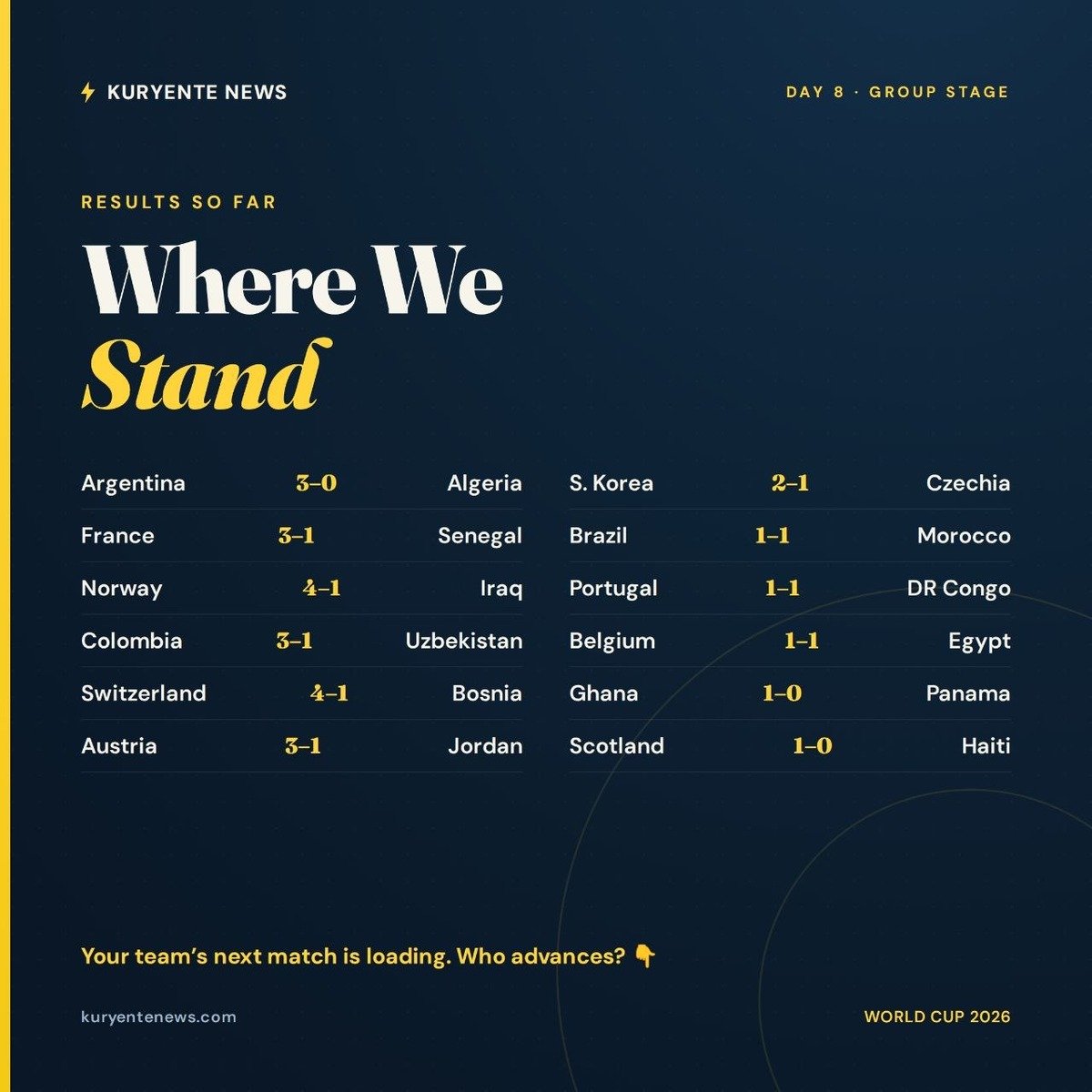
Australia added to the upset count in Group D, beating Türkiye 2-0 in a result that upended expectations for that group. Ivory Coast claimed a narrow 1-0 win over Ecuador in another tightly fought encounter. Several established footballing nations also failed to win their opening games.
Brazil were held to a 1-1 draw by Morocco, with Vinícius Júnior converting to secure a point for the South Americans. Portugal, with Cristiano Ronaldo back on the World Cup stage, also drew 1-1, this time against the Democratic Republic of Congo. Belgium, another side frequently mentioned as a contender, shared the spoils 1-1 with Egypt.
Star Forwards Deliver on the Biggest Stage
While the underdogs commanded much of the attention, the world’s most prominent forwards wasted no time announcing themselves in the opening fixtures.
France captain Kylian Mbappé scored twice as his side beat Senegal 3-1, with Paris Saint-Germain club colleague Bradley Barcola also registering on the scoresheet. Norway striker Erling Haaland netted his first-ever goals at a World Cup finals — a brace — helping his team to a comfortable 4-1 victory over Iraq. England skipper Harry Kane also scored twice in a high-scoring 4-2 win over Croatia. Defending champions Argentina were dominant, defeating Algeria 3-0 with little trouble.
These early showings from the sport’s highest-profile attacking players have fuelled speculation about what individual goalscoring records could look like if the current pace carries through to the knockout stages, tournament analysts noted.
Germany’s Seven-Goal Rout Tops the Scoreboard
Among the most commanding performances of the opening week, Germany delivered the tournament’s widest winning margin so far, overwhelming Curaçao 7-1. The four-time world champions showed no signs of rustiness, dismantling their opponents in a result that underlined their ambitions for the competition. Co-host Canada, after drawing 1-1 with Bosnia and Herzegovina in their tournament opener, bounced back impressively with a 6-0 demolition of Qatar. Sweden also impressed, scoring five times against Tunisia in a 5-1 victory, while Switzerland beat Bosnia and Herzegovina 4-1.
These emphatic results served as a reminder that the same tournament capable of producing giant-killings also remains home to sides willing and able to deliver ruthless, high-scoring performances against lower-ranked opponents.
All Three Host Nations Open Without Defeat
Mexico, the United States, and Canada each avoided defeat in their opening fixtures, generating considerable enthusiasm among supporters across North America, where the co-hosted tournament has already drawn large crowds to stadiums.
Mexico had the honour of kicking off World Cup 2026 at the historic Estadio Azteca in Mexico City, defeating South Africa 2-0. Julián Quiñones scored the tournament’s very first goal of the 2026 edition. The United States put in the most forceful host-nation showing of the opening week, defeating Paraguay 4-1 in front of a packed home crowd, with forward Folarin Balogun playing a central role in the victory. Canada’s record after two games stands at one win and one draw, following their results against Bosnia and Herzegovina and Qatar respectively.
Historic Win for Scotland Ends Decades of Hurt
One of the more emotionally significant moments of the opening round came in Group C, where Scotland recorded their first World Cup victory in several decades. A goal from midfielder John McGinn was enough to down Haiti 1-0, ending a prolonged period of World Cup suffering for a nation whose fans have grown accustomed to early exits and qualification disappointments over the years. The win was greeted with considerable celebration both inside the stadium and back home.
Taken together, the results from Cabo Verde, Australia, Scotland, and several other nations new to the World Cup stage have built a strong early case for the expanded format. What its critics feared would be a diluted competition has instead delivered a diverse and competitive tournament in its opening phase.
Opening Round Full Results Across All 12 Groups
According to official FIFA match records, the following results were posted during the first round of group-stage play:
- Group A: Mexico 2-0 South Africa · South Korea 2-1 Czechia
- Group B: Canada 1-1 Bosnia and Herzegovina · Qatar 1-1 Switzerland
- Group C: Brazil 1-1 Morocco · Scotland 1-0 Haiti
- Group D: USA 4-1 Paraguay · Australia 2-0 Türkiye
- Group E: Germany 7-1 Curaçao · Ivory Coast 1-0 Ecuador
- Group F: Netherlands 2-2 Japan · Sweden 5-1 Tunisia
- Group G: Belgium 1-1 Egypt · Iran 2-2 New Zealand
- Group H: Spain 0-0 Cabo Verde · Saudi Arabia 1-1 Uruguay
- Group I: France 3-1 Senegal · Norway 4-1 Iraq
- Group J: Argentina 3-0 Algeria · Austria 3-1 Jordan
- Group K: Portugal 1-1 DR Congo · Colombia 3-1 Uzbekistan
- Group L: England 4-2 Croatia · Ghana 1-0 Panama
Second Matchday Set to Clarify Standings
With the second round of group fixtures now underway as of June 19, the qualification picture across all 12 groups is beginning to sharpen, the tournament schedule confirms. Several headline matchups in the coming days carry the potential to establish early group leaders and eliminate some of the surprise packages from contention.
Argentina are scheduled to face Austria, while France will take on Iraq. Perhaps the most closely watched fixture of the next round will be Spain against Saudi Arabia — a match that has taken on added urgency following Spain’s failure to beat Cabo Verde. The three host nations will also be aiming to strengthen their positions and move closer to securing berths in the Round of 32.
With 71 goals already on the board through just 23 matches and the knockout stage still weeks away, the 2026 FIFA World Cup has established itself as a tournament of genuine unpredictability and goal-scoring abundance. Whether the opening week’s pace can be sustained through the group stage and into the knockouts remains to be seen — but through eight days, the competition has made a compelling argument for its own ambition and scale.
Source: wire reports