DUMAGUETE CITY, Philippines — The message came in shortly before 5 a.m., written in Bisaya, from a health worker who asked that nothing about her be published.
“Hello sir, can you help me — without me saying who I am or my background,” she wrote. “I just want to report that the face masks supplied to our province are already expired.”
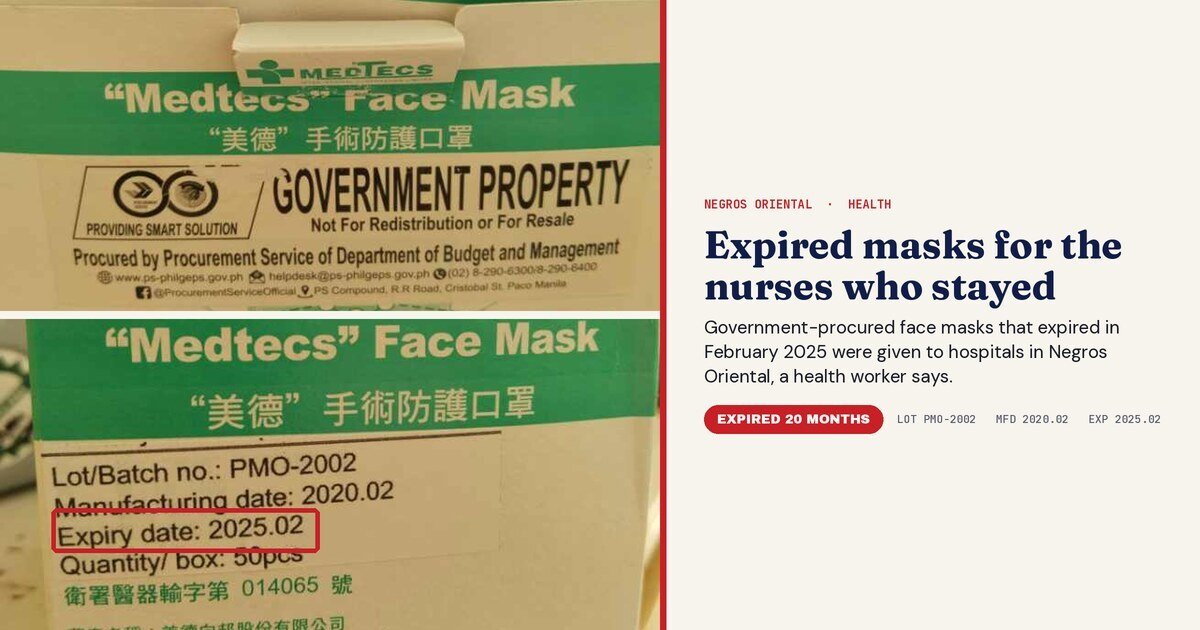
The photographs she sent show a green-and-white box of “Medtecs” face masks. A sticker from the Procurement Service of the Department of Budget and Management (PS-DBM) marks it “GOVERNMENT PROPERTY, Not for Redistribution or for Resale.” The side panel lists Lot PMO-2002, a manufacturing date of February 2020 and an expiry date of February 2025. By the time the photos were taken, the masks had been expired for about 20 months.
Asked where the masks had gone, she replied that they were given to hospitals within the province of Negros Oriental. Then she added: “It’s terrible. We healthcare workers are the ones who have to endure their corruption.” She did not say whom she meant.
The number of boxes distributed, the facilities that received them, the office that released them, and whether staff have worn the masks could not be independently confirmed.
The box appears to have been packaged for export. Its traditional Chinese text names a Taipei importer and carries a Taiwanese medical device import license number, while the label says the masks were made in the Freeport Area of Bataan. The PS-DBM sticker is pasted over that packaging.
What happens to an old mask
A surgical mask works largely because of its middle layer, a sheet of meltblown polypropylene that carries an electrostatic charge. The charge pulls in particles small enough to slip between the fibers, many of them only microns across. When the charge fades, the mask can look perfectly intact while protecting far less.
Heat and humidity speed up that loss. In laboratory tests, extended storage at 75 percent relative humidity and 40 degrees Celsius weakened the filters’ electric charge and reduced how well they filtered. Once the charge is gone, the material no longer pulls in particles electrostatically and filters only by mechanical capture. Another study found that at the same temperature, higher humidity made the charge drain faster and filtration fall further. Negros Oriental’s climate is close to those test conditions much of the year, and the box in the photographs was torn open at the top.
The straps fail too. When the U.S. National Institute for Occupational Safety and Health tested stockpiled respirators past their shelf life, five straps broke from one lot and four from another. A loose ear loop leaves a gap, and air moving through the gap bypasses the filter entirely.
U.S. health authorities allow expired masks in only one circumstance. The Centers for Disease Control and Prevention lists using facemasks beyond the manufacturer-designated shelf life as a crisis capacity strategy, the last resort after conventional and contingency measures. That provision was written for the empty shelves of 2020. There is no such shortage in 2026.
The real danger is not that an expired mask does nothing. It is that the wearer cannot tell how much it does. A nurse at a bedside assumes the mask on her face is doing its job, and nothing on its surface tells her otherwise.
The pay gap
The masks reached a workforce that was already stretched thin and underpaid.
Under the 2026 government salary schedule, a Nurse I is paid PHP 42,178 to PHP 45,202 a month across Steps 1 to 8. Many nurses never see that figure. A House bill filed this year noted that of nurses employed locally, 106,694 work in private hospitals, often for minimum wage. That bill, House Bill No. 9841, would mandate a P50,000 entry-level salary for nurses.
Here is what nurses earn in the countries that recruit Filipinos, and in some of the country’s neighbors. Peso figures are approximate.
Singapore: Public-sector staff nurses start at S$2,500 for polytechnic graduates and from S$3,010 for university graduates, about ₱110,000 to ₱132,000. The 2024 median salary for registered nurses was S$5,208, or about ₱229,000.
Japan: Government wage data put the average monthly salary for nurses at ¥352,100, with average annual bonuses of ¥856,500. The monthly pay alone is about ₱134,000.
Taiwan: A Ministry of Labor survey that counts only regular wages shows nurses in health care earning an average of NT$49,880 a month, about ₱92,000.
Saudi Arabia: In a 2025 government-to-government recruitment drive, Saudi Arabia’s Health Ministry offered Filipino nurses a starting monthly salary of SAR 4,110, tax-free, plus free food and accommodation. That is about ₱62,000 before counting the free housing.
United Kingdom: NHS Band 5 nurses in England earn £32,073 a year at entry, about ₱203,000 a month.
United States: The national mean annual wage for registered nurses reached $101,420 in 2025, roughly ₱480,000 a month.
The comparison cuts both ways in Asia. In Malaysia, a diploma nurse in the Health Ministry starts at a basic salary of RM1,974, about ₱27,000. In Indonesia, government hospital nurses with civil service status earn Rp 4 million to Rp 7 million a month, about ₱14,000 to ₱24,000. In China, new nurses with bachelor’s degrees averaged 5,111 yuan a month in 2022, close to a Philippine Nurse I.
So the problem is not that the Philippines pays the least in the region. It is that the country trains nurses to a standard wealthy countries compete for, then pays most of them, especially in private and contractual jobs, far below what a single plane ride away would offer.
The exodus
They leave. The Department of Health estimated in 2021 that about 316,000 licensed Filipino nurses, roughly 51 percent, were working abroad. According to the OECD, 277,266 Philippine-born nurses were working in OECD countries in 2020 and 2021, a 147 percent increase since 2000 and 2001.
The shortage left behind is large. The World Health Organization puts the country’s nurse shortage at 127,000, and expects it to reach 250,000 by 2030 if left unchecked. In February 2026, a workforce assessment by the Second Congressional Commission on Education warned of a shortage of around 290,000 healthcare workers. On the wards, the ideal nurse-to-patient ratio of 1:12 is often exceeded, with some facilities reporting ratios as high as 1:20 to 1:50.
The Asian Development Bank traced the losses directly to low wages and overseas migration.
The concern has reached Congress, where lawmakers have argued that new nurses are not paid enough to keep them practicing their profession at home.
They deserve better
The Philippines may never match a hospital in California or Riyadh on salary. But a box of masks that has not expired is not a matter of national wages. It is a matter of someone checking a date.
The health worker who wrote in did not ask for a raise. She asked that someone look at the box.