
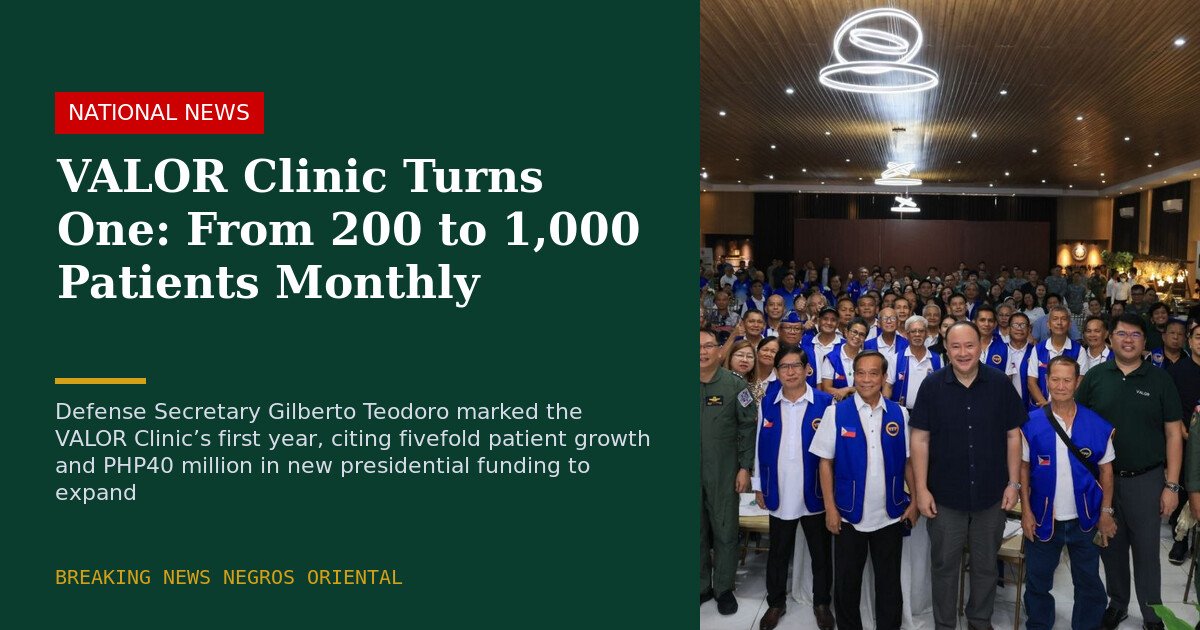
A program designed to bring medical care closer to Filipino veterans celebrated its first anniversary last Thursday, August 14, 2026, with defense and military officials gathering at Bactol Hall, Fernando Air Base (FAB) in Lipa City, Batangas, to take stock of what the Veterans Access to Lifetime Optimized Healthcare (VALOR) Clinic has accomplished — and where it is headed next.
The Thanksgiving Luncheon drew senior officials from the defense establishment, healthcare workers, veteran beneficiaries, and institutional partners of the VALOR Clinic network. The atmosphere, according to the Department of National Defense, was one of collective recognition for the progress made in delivering medical services to veterans and their dependents.
Patient Numbers Tell the Story of Growth
When the Fernando Air Base VALOR Clinic first opened its doors, it served roughly 200 patients in its inaugural month. One year later, that figure has climbed to approximately 1,000 patients per month — a fivefold increase that Secretary of National Defense Gilberto C. Teodoro, Jr. cited as clear evidence of the program’s impact.
Teodoro also noted that the clinic’s operational schedule has been dramatically expanded. Due to staffing constraints early on, the facility initially ran only once a week. It now operates at least five days a week, the Defense Secretary said during the anniversary event.
AFP and VMMC Systems on Path to Integration
Secretary Teodoro used the occasion to articulate a longer-term strategic vision: the full integration of the Armed Forces of the Philippines (AFP) medical system with the veterans’ care infrastructure managed by the Veterans Memorial Medical Center (VMMC).
“The clients of the AFP medical system will be clients of the VMMC, and the sooner we can mitigate their conditions through preventive healthcare, the less problems we will have when they get older,” Teodoro said, underscoring the preventive rather than purely curative thrust of the program.
Under this vision, the VMMC would be repositioned as a highly specialized tertiary-level hospital — a referral center for complex cases that exceed the capacity of local hospitals, outreach clinics, or the AFP Medical Center itself, particularly those requiring specialized equipment unavailable elsewhere.
PHP40 Million in Additional Funding from the Palace
Sustaining an expanding network of clinics comes with logistical demands. Teodoro acknowledged ongoing challenges around staffing, connectivity, medical data privacy, and storage infrastructure. To help address those gaps, he disclosed that President Ferdinand R. Marcos, Jr. has committed PHP40 million in additional funding for VALOR Clinic operations this year — a commitment the Secretary said will help sustain and grow the network’s service capacity.
New Clinics Planned for Cagayan de Oro and Tarlac
Geographic expansion is also on the horizon. The Department of National Defense said that new VALOR Clinics are expected to open in Cagayan de Oro and at Camp Aquino in Tarlac City within the year. A clinic at Fort Magsaysay is also being considered, Teodoro noted, pending the availability of logistics and support systems.
The expansion is intended to extend the VALOR network’s reach into regions where veterans currently have limited access to the program’s services.
VMMC Rehabilitation and Infrastructure Overhaul Underway
Plans to upgrade the VMMC itself are also in progress. Teodoro outlined a rehabilitation roadmap that includes the construction of a larger outpatient department, dedicated specialized centers, an expanded triage area, a research center, and a medical waste disposal facility.
“The VMMC will be a high-quality, high-tier specialized medical center for cases that cannot be remedied by any other medical facility or the AFP medical center for active-duty personnel,” the Defense Secretary said. “So that is the roadmap right now. And that’s where we will go.”
Long Wait Times Acknowledged as a Challenge
The surge in patients, while a positive sign of demand and trust in the program, has also created pressure on wait times at both VMMC and VALOR Clinics. Secretary Teodoro acknowledged this concern, framing the long queues as a reflection of how much veterans value the care being offered — but stressing that shortening those waiting periods remains a priority.
One solution being explored, according to Teodoro, is strengthening partnerships with local hospitals to absorb cases that do not require VMMC-level intervention, with only the most complex cases referred upward to the national facility.
Counseling Program Set for Retiring Military Personnel
The Secretary also announced a transition support initiative for active-duty personnel approaching the end of their service. Under the plan, a structured counseling program will be introduced six months before mandatory retirement — covering both the service members and their families — to ease the adjustment from military to civilian life.
Teodoro framed this as an extension of the government’s broader commitment to the welfare of those who have served, not just as veterans but during the critical transitional period leading up to separation from the armed forces.
By the Numbers
- 200 — patients served at the FAB VALOR Clinic during its first month of operations
- ~1,000 — patients now served per month after one year of operations
- 1 day per week — original operating frequency when the clinic launched due to staffing limits
- 5 days per week — current operating schedule at the Fernando Air Base VALOR Clinic
- PHP40 million — additional funds committed by President Marcos for VALOR Clinic operations this year
- 6 months — the lead time before mandatory retirement at which the new transition counseling program will begin
Why This Matters
The VALOR Clinic program demonstrates a concrete and measurable expansion of government-funded healthcare access for Filipino veterans — with the flagship Fernando Air Base facility already achieving a fivefold increase in monthly patients within its first year of operation. The planned structural integration of AFP and VMMC medical systems, reinforced by fresh presidential funding, marks a significant policy shift toward preventive and long-term care for those who served in the armed forces. Expansion into Cagayan de Oro, Tarlac, and potentially Fort Magsaysay will bring these services to veteran communities in areas that have been underserved by the program up to this point.
Source: Department of National Defense / Philippine News Agency