
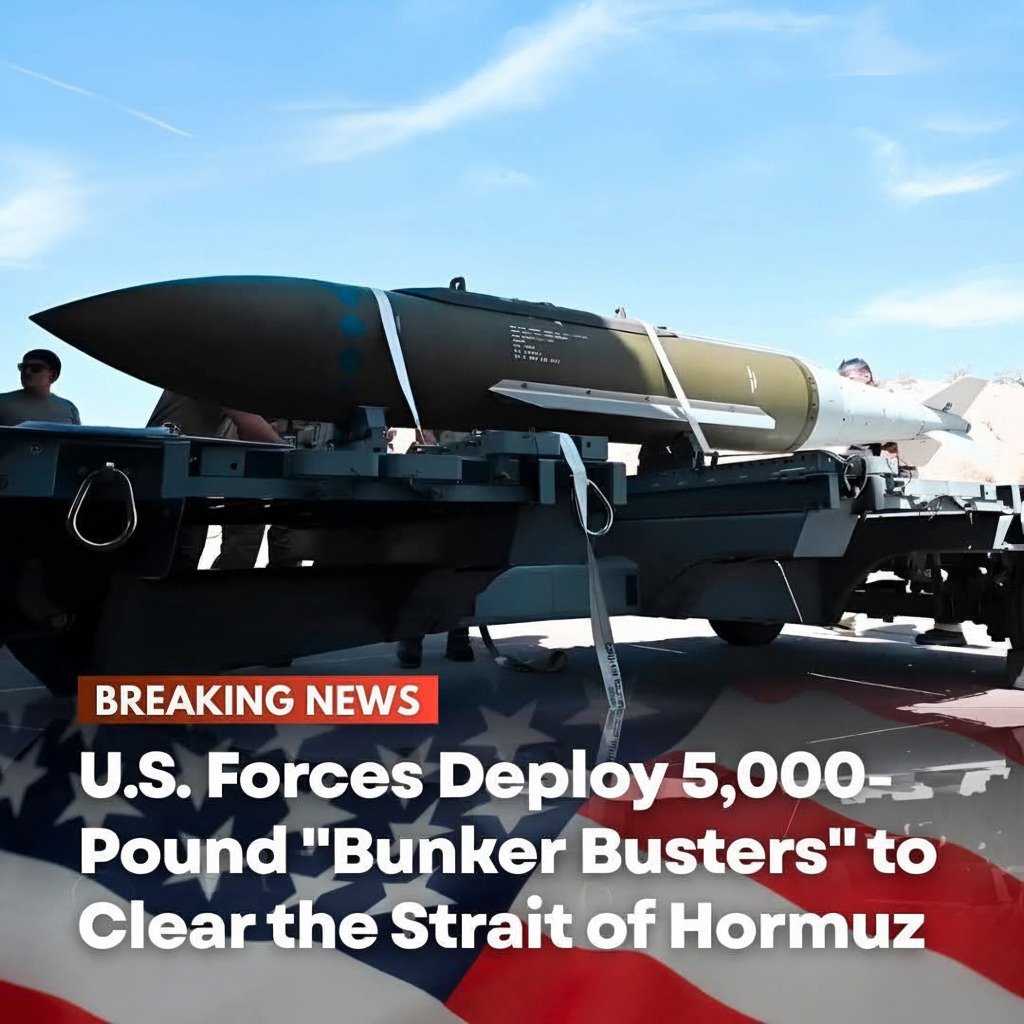
United States Central Command (CENTCOM) announced on March 18, 2026, that American forces successfully employed multiple 5,000-pound deep-penetrator munitions to strike hardened Iranian missile sites. The precision strikes, part of Operation Epic Fury, targeted fortified coastal bunkers along the Strait of Hormuz, which were identified as launch points for Iran’s anti-ship cruise missile (ASCM) batteries. The operation aims to neutralize what the US military deems a persistent threat to global energy corridors and international shipping lanes.
GBU-72/B Advanced Penetrator Makes Combat Debut
While CENTCOM’s initial statement did not specify the munition used, defense officials later confirmed the strike marked the combat debut of the GBU-72/B Advanced 5,000-pound Penetrator. This next-generation bunker buster is designed to destroy deeply buried and hardened targets.
Unlike its predecessor, the laser-guided GBU-28, the GBU-72/B utilizes an advanced GPS/INS guidance tail kit. According to military sources, this allows for high-altitude releases in any weather condition, a critical feature given the often dusty environment of the Iranian coastline.
Deep Earth Penetration Capabilities Target Subterranean Missile Storage
The GBU-72/B is engineered to penetrate dozens of feet of reinforced concrete or earth before detonating. This “delayed fuse” technology is designed to collapse subterranean hangars where Iran stores its Noor and Ghadir anti-ship missiles, effectively disabling the launch capabilities of these weapons.
F-15E Strike Eagles and B-1B Lancers Executed Primary Sorties
Reports indicate that F-15E Strike Eagles and B-1B Lancers carried out the primary strike missions, supported by EA-18G Growlers providing electronic warfare cover. While multiple aircraft are certified to deploy the GBU-72, these platforms were chosen for their range and payload capacity.
Iranian Coastal Defenses Hardened with “Taleghan-Style” Concrete Shells
According to intelligence reports, the Islamic Revolutionary Guard Corps (IRGC) had spent the past year fortifying its coastal batteries, encasing them in what are described as “Taleghan-style” concrete shells covered by soil. This hardening was intended to protect the missile sites from standard 1,000-lb or 2,000-lb Joint Direct Attack Munitions (JDAMs).
Strait of Hormuz Security Prioritized to Protect International Shipping
The Strait of Hormuz, a critical waterway through which approximately 20% of the world’s oil supply passes, had been effectively paralyzed by the threat posed by these Iranian coastal batteries. CENTCOM emphasized that the neutralized sites “posed a direct and imminent risk” to both tankers and U.S. naval assets operating in the region.
Kharg Island Mine Facility Destruction Complements Strait Operation
These strikes follow the March 15 operations on Kharg Island, where U.S. forces destroyed Iranian naval mine storage facilities. Military analysts suggest these actions, taken together, represent a systematic effort to “clear the lanes” and ensure the safety of future international transit through the Strait of Hormuz.
Growing International Rift Over Scale of Operation Epic Fury
The strikes occurred amidst growing disagreements between the United States and its traditional allies regarding the scope and scale of Operation Epic Fury, which is now in its 19th day. Several NATO allies, including Germany and France, as well as Japan and South Korea, have reportedly declined to participate in a proposed joint escort mission to safeguard shipping in the Strait.
President Trump Asserts U.S. Can Act Unilaterally
President Donald J. Trump expressed his “disappointment” with the lack of allied support hours before the strikes. In a post on Truth Social, the President stated that the United States is “the most powerful country anywhere in the world and we do not need the help of anyone” to unblock the waterway.
Oil Prices Fluctuate Amidst Regional Uncertainty
Global oil prices have experienced volatility in the wake of the escalating tensions. Analysts at J.P. Morgan have warned that regional oil producers may only be able to sustain current output levels for “no more than 25 days” should the Strait of Hormuz remain an active combat zone.
CENTCOM Vows to Eliminate All Threats, Regardless of Depth
“The Iranian regime thought their bunkers were impenetrable,” a CENTCOM spokesperson stated. “A few hours ago, we proved that there is no depth we cannot reach and no threat we cannot eliminate.” The spokesperson reiterated the US commitment to maintaining freedom of navigation in international waters.
Photo credit: Photo from US Central Command