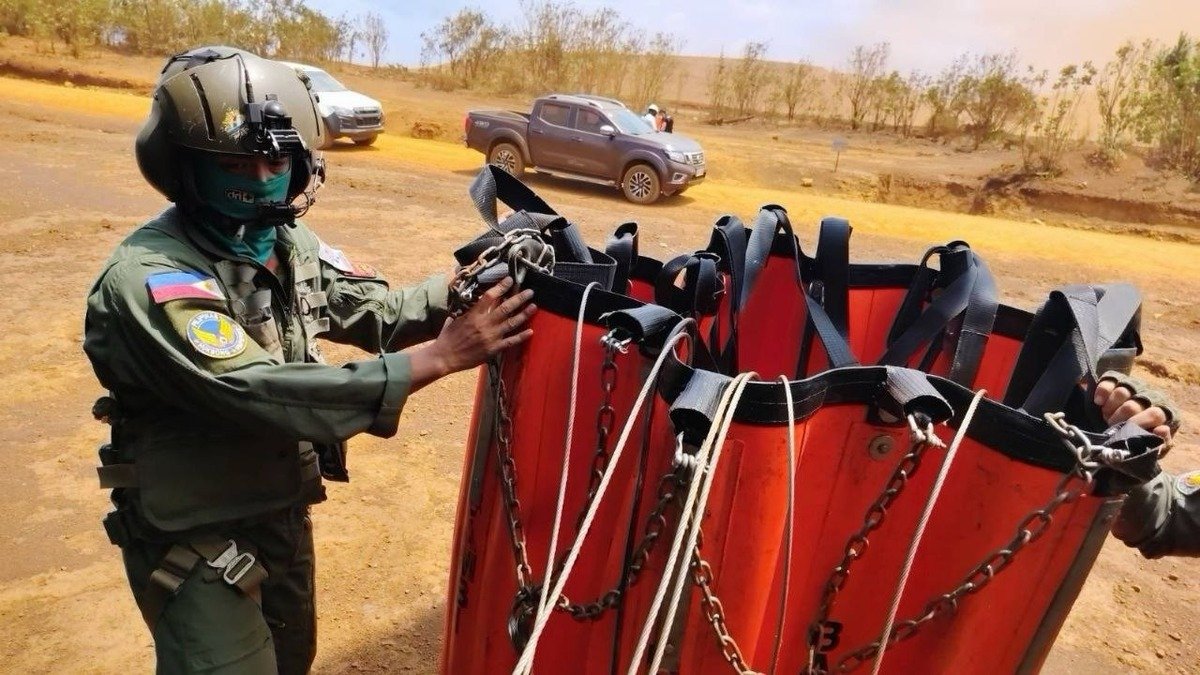
Military aviation units are maintaining round-the-clock firefighting efforts across Homonhon Island in Eastern Samar’s Guiuan municipality, with S-70i Black Hawk helicopters executing continuous water-bombing runs against persistent vegetation fires that remained active as of Monday, April 20, 2026.
The Philippine Air Force headquarters at Col Jesus Villamor Air Base in Pasay City confirmed that specialized heli-bucket operations have been underway since April 19, 2026, working in partnership with the Office of Civil Defense Region VIII to combat the spreading blazes.
Forest and grassland fires continue threatening the island’s natural environment and surrounding communities despite intensive aerial bombardment and coordinated ground suppression activities. Military commanders report that complete fire extinction has not yet been achieved across all affected zones.
Helicopter Crews Execute Multiple Daily Sorties
Military aviation teams completed 15 precision water drops during Monday’s dual-mission operations, with the initial sortie encompassing seven water releases followed by an eight-drop secondary mission targeting remaining active fire zones.
PAF leadership characterizes these efforts as maintaining “sustained operational tempo” that demonstrates military dedication to extinguishing the conflagration and minimizing ecological destruction. The Black Hawk S-70i platform delivers the precision water placement necessary for the island’s challenging topographical conditions.
Colonel Ma Christina O Basco PAF (GSC), serving as Chief of Air Force Public Affairs, released the official documentation outlining current response protocols. Her statement highlighted military collaboration with civilian authorities and municipal governments throughout the comprehensive suppression campaign.
Regional Defense Office Maintains Active Oversight
Civil Defense Region VIII officials continue evaluating fire suppression progress while conducting real-time assessments of blaze expansion and containment status. The regional office reports that vegetation fires across Homonhon Island’s forested and grassland sectors have not achieved full suppression.
Guiuan municipality’s local government units are coordinating directly with national response agencies to facilitate aerial firefighting missions and organize ground-level intervention activities. This multi-stakeholder approach combines diverse agency resources and specialized knowledge for enhanced suppression effectiveness.
Response teams maintain continuous surveillance of meteorological conditions and atmospheric wind dynamics that influence fire progression and aviation safety protocols. The island’s isolated geographic position demands precise coordination of supply chains and personnel positioning.
Ecological and Residential Safety Remain Primary Concerns
The eastern Samar coastline’s Homonhon Island maintains critical environmental significance within the Philippines’ biodiversity-abundant eastern island chain. Current vegetation fires create substantial risks for indigenous plant communities and wildlife ecosystems that authorities seek to preserve through accelerated response protocols.
Military leadership has highlighted the operation’s dual focus on safeguarding impacted residential areas while preventing fire advancement into previously unaffected island sectors. Strategic aerial water deployment targets advancing fire perimeters and establishes protective barriers to restrict blaze expansion.
The island’s maritime positioning creates distinct operational advantages and complications for suppression efforts. Remote accessibility limits ground-based response deployment, yet surrounding ocean waters supply unlimited helicopter bucket filling capacity.
Advanced Aviation Assets Enable Island Fire Response
The Black Hawk S-70i helicopter platform provides sophisticated firefighting technology within PAF operational fleets, featuring specialized bucket configurations for water delivery across demanding geographical conditions. These rotorcraft transport significant water volumes while maintaining operational effectiveness in coastal atmospheric environments.
Military aviation resources prove especially critical for island-based fire suppression where conventional ground equipment faces transportation and access limitations. Helicopter units respond dynamically to evolving fire patterns while reaching isolated zones beyond ground crew accessibility.
PAF aircrew personnel complete advanced firefighting preparation programs, including low-altitude navigation procedures and accurate water placement methodologies essential for successful suppression missions. Current operational deployment showcases these specialized competencies under active emergency conditions.
Inter-Agency Partnerships Enhance Response Effectiveness
The collaborative framework linking PAF operations with OCD Region VIII demonstrates established inter-agency protocols for emergency and natural disaster response across Philippine territories. Such partnerships ensure military aviation capabilities integrate seamlessly with civilian emergency coordination systems.
Regional collaborative structures enable immediate resource mobilization while maintaining communication networks between military leadership and municipal officials responsible for population protection. These systems support real-time operational modifications responding to dynamic emergency conditions.
Established emergency protocols define command hierarchies and resource distribution procedures that maximize multi-agency mission effectiveness. These organizational frameworks prove indispensable for complex operations requiring extended military-civilian cooperation.
Military Commits to Complete Fire Elimination
PAF representatives confirm firefighting operations will persist until complete fire elimination and formal containment declaration. This sustained military engagement demonstrates institutional preparedness supporting civilian agencies during ecological emergency situations.
Continuous meteorological surveillance and fire pattern analysis guide tactical planning for flight operations and water drop precision targeting. Officials stress the necessity of maintaining consistent suppression efforts while environmental conditions support effective intervention activities.
The Homonhon Island firefighting deployment exemplifies military disaster response capabilities available throughout the Philippine archipelago. PAF units preserve operational readiness for deploying specialized equipment during comparable emergency scenarios requiring aerial support intervention.