Employers nationwide must prepare for mandatory compensation adjustments as the Department of Labor and Employment (DOLE) announces detailed payment guidelines for the upcoming Labor Day observance on May 1, 2026, designated as a regular holiday throughout the Philippines.
Through Labor Advisory No. 12, series of 2025, the labor department has reinforced existing compensation protocols that businesses must implement during the national holiday period. The announcement provides detailed calculation methods to ensure proper worker compensation across all employment sectors.
Workers who remain absent during the regular holiday maintain eligibility for full daily wage compensation at 100 percent of their standard rate, contingent upon their attendance on the preceding workday or approved paid leave status immediately before the holiday period.
Compensation Structure for Working Employees
Employees performing duties on Labor Day qualify for enhanced compensation at 200 percent of their standard daily wage for initial eight-hour shifts. This premium rate acknowledges the additional commitment required from workers during national holiday periods.
Complex premium structures apply when the regular holiday coincides with scheduled rest days. In such instances, employers must calculate an additional 30 percent supplement based on the 200 percent basic wage rate, creating substantially higher compensation for affected personnel.
Extended work periods beyond eight hours during regular holidays trigger supplementary payments of 30 percent above standard hourly rates, adding to baseline holiday compensation. When overtime occurs during regular holidays that align with rest days, employers must incorporate all relevant premium calculations into final wage computations.
National Minimum Wage Updates
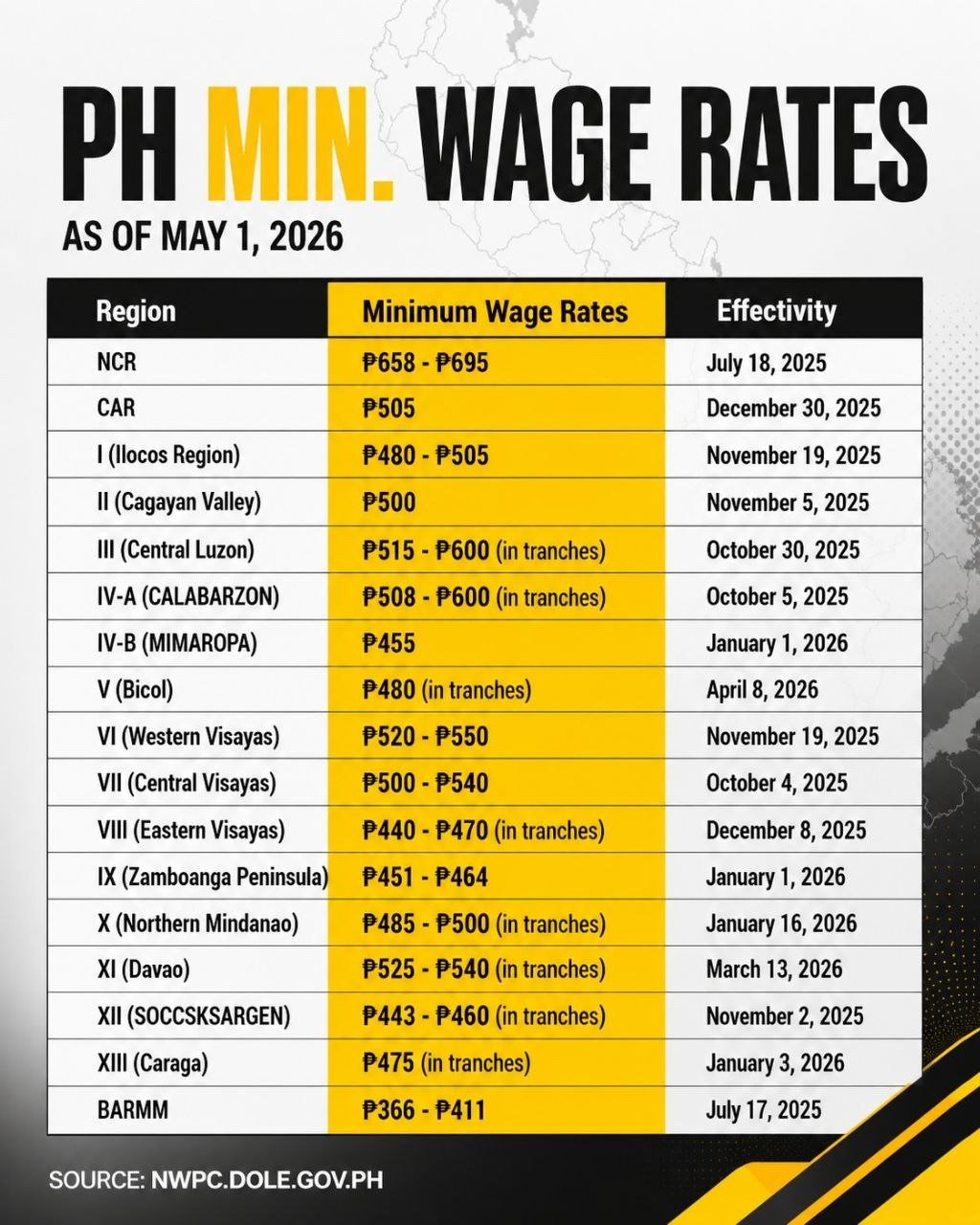
Current minimum wage standards across Philippine regions show considerable geographic variations, as reported by the National Wages and Productivity Commission for the May 1, 2026 period. These differences reflect local economic conditions and living cost considerations.
The National Capital Region continues leading wage scales with daily minimums ranging from ₱658 to ₱695, corresponding to elevated living expenses in metropolitan areas. Meanwhile, BARMM regions maintain lower brackets between ₱366 and ₱411, representing the national minimum threshold.
Visayas territories demonstrate intermediate compensation levels, with Western Visayas establishing ₱520 to ₱550 ranges and Central Visayas implementing ₱500 to ₱540 scales. These figures illustrate regional economic development patterns across island provinces.
Detailed Regional Compensation Standards
Administrative regions throughout the Philippines maintain distinct minimum wage frameworks effective May 1, 2026, creating a comprehensive national compensation structure.
Beyond NCR’s premium rates, the Cordillera Administrative Region establishes ₱505 daily minimums. The Ilocos Region operates within ₱480 to ₱505 parameters, while Cagayan Valley maintains uniform ₱500 standards.
Central Luzon demonstrates phased implementation approaches with ₱515 to ₱600 tranched structures. CALABARZON employs similar methodologies ranging from ₱508 to ₱600 in installments, contrasting with MIMAROPA’s consistent ₱455 rate.
Bicol Region applies ₱480 through graduated tranches, exemplifying systematic wage adjustment processes. Eastern Visayas maintains ₱440 to ₱470 ranges using similar phased approaches.
Southern Philippines Wage Framework
Mindanao territories exhibit diverse wage structures aligned with regional economic characteristics. Zamboanga Peninsula establishes ₱451 to ₱464 brackets, while Northern Mindanao implements ₱485 to ₱500 through tranched systems.
Major urban areas within the Davao Region command higher ₱525 to ₱540 ranges via installment structures. SOCCSKSARGEN applies ₱443 to ₱460 graduated rates, and Caraga maintains ₱475 through systematic tranches.
Regional wage disparities demonstrate varying development stages, cost considerations, and productivity metrics influencing compensation decisions across the Philippine archipelago.
Business Compliance Requirements
The labor department underscores that holiday compensation regulations ensure appropriate worker payment during regular holidays while establishing clear business obligations under national employment standards. Accurate calculation and prompt wage distribution remain essential compliance elements.
This advisory functions as both guidance and enforcement notification for businesses considering holiday pay circumvention. DOLE maintains comprehensive oversight systems ensuring compliance across diverse industry sectors and business categories.
Businesses must preserve detailed payroll documentation demonstrating proper holiday pay applications, including employee attendance records and approved leave documentation affecting compensation eligibility.
Employee Protection and Resources
Both workforce members and employers should consult official labor advisories and regional wage orders for accurate computation and implementation of holiday compensation and minimum wage standards. These documents provide authoritative guidance for complex payment situations.
Employees experiencing holiday pay violations may submit formal complaints to regional DOLE offices. The department operates investigation and enforcement systems ensuring proper compensation for affected workers.
This advisory demonstrates continued governmental efforts balancing employee welfare with business viability, establishing clear protective guidelines while providing employers specific calculation frameworks ensuring regulatory compliance.