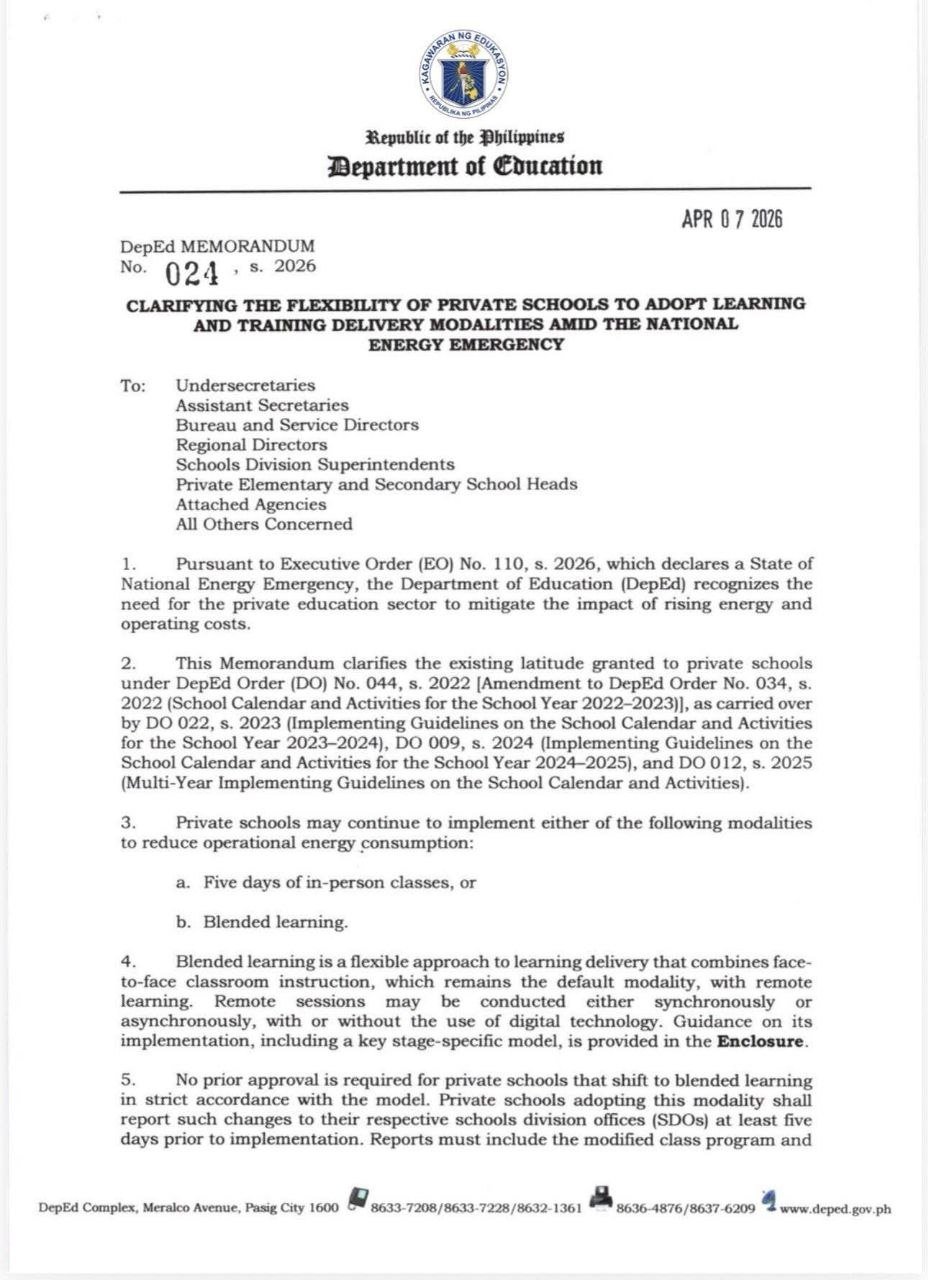
Education Secretary Sonny Angara has granted private educational institutions nationwide the authority to implement blended learning modalities without seeking prior approval from education officials, addressing mounting operational expenses amid the country’s ongoing energy emergency.
The authorization, detailed in Department of Education (DepEd) Memorandum No. 024, s. 2026 dated April 7, 2026, reinforces existing flexibility provisions under earlier department directives while specifically addressing energy consumption challenges faced by private schools.
Under the new guidelines, private institutions may maintain their standard five-day in-person class schedules or transition to blended learning formats designed to reduce energy usage through alternative instructional delivery methods.
Stay informed with our free weekly newsletter. No spam, unsubscribe anytime.
Implementation Guidelines and Requirements
The memorandum establishes blended learning as “a flexible approach to learning delivery that combines face-to-face classroom instruction, which remains the default modality, with remote learning components.”
Remote learning components may operate synchronously or asynchronously, incorporating digital technology as available. The department has provided implementation guidance along with key stage-specific models for institutional adoption.
Private educational institutions choosing to implement blended learning must notify their respective schools division offices (SDOs) no later than five days prior to implementation. Required documentation includes revised class schedules and detailed compliance plans demonstrating adherence to established learning standards.
Institutions seeking to modify the standard blended learning framework must obtain prior authorization from their designated regional office (RO), according to the memorandum specifications.
Energy Emergency Response Measures
These flexibility provisions directly address Executive Order No. 110, s. 2026, establishing a State of National Energy Emergency declared earlier this year. The DepEd recognizes the necessity for private education providers to address escalating energy and operational expenses.
The current memorandum expands upon established department directives implemented since 2022, including DepEd Order No. 044, s. 2022 and related orders extending through DepEd Order No. 012, s. 2025, which created comprehensive multi-year guidelines governing school calendars and institutional activities.
Private institutions are actively encouraged to utilize varied approaches for conducting in-service training programs, Learning Action Cells, and professional development initiatives aimed at reducing energy consumption.
Modified Professional Development Protocols
Training initiatives may utilize online platforms, asynchronous delivery methods, or hybrid formats to reduce physical transportation requirements and minimize on-site energy consumption, the guidelines specify.
Educational institutions must maintain quality assurance standards for professional development programs while ensuring they effectively meet the specific requirements of teaching staff and administrative leadership, the memorandum stresses.
Following Presidential Memorandum Circular No. 114, which mandates government agencies to implement energy conservation measures, private schools are encouraged to establish flexible work arrangements (FWA) for both teaching and administrative staff.
These arrangements must guarantee uninterrupted student learning experiences and maintain essential school services, as specified by DepEd requirements.
Oversight and Duration Specifications
Regional offices and schools division offices have been tasked with monitoring the implementation of these alternative modalities by private institutions within their respective areas of jurisdiction.
The flexibility provisions will continue operating exclusively during the duration of the State of National Energy Emergency, remaining active until the President officially terminates the emergency declaration.
Implementation begins immediately following memorandum approval and issuance, with comprehensive deployment scheduled 15 days after Official Gazette publication or publication in a nationally circulated newspaper.
Administrative Procedures and Communication Channels
Official memorandum copies will be filed with the Office of the National Administrative Register (ONAR) at the University of the Philippines Law Center, located in UP Diliman, Quezon City.
Educational institutions and interested parties may obtain additional information through the Private Education Office at DepEd Central Office via email correspondence sent to private.education@deped.gov.ph.
The Department of Education Central Office operates from the DepEd Complex on Meralco Avenue, Pasig City, maintaining several inquiry hotlines: 8633-7208, 8633-7228, 8632-1361, 8636-4876, and 8637-6209.
Historical Context and Prior Measures
This memorandum follows DepEd Memorandum No. 018, s. 2026, which established energy conservation protocols and flexible work arrangements within the Department of Education in compliance with Presidential Memorandum Circular No. 114.
The presidential circular mandated comprehensive energy conservation protocol adoption across all government agencies and instrumentalities responding to the national energy emergency situation.
Secretary Angara’s directive demonstrates the department’s ongoing commitment to maintaining educational excellence while addressing practical challenges created by the Philippines’ current energy crisis.
Private educational institutions retain considerable discretion in selecting appropriate approaches, with the department maintaining that traditional face-to-face classroom instruction continues as the preferred modality despite expanded blended learning availability.
The memorandum impacts thousands of private elementary and secondary institutions nationwide, providing essential resources for managing operational expenses while preserving educational quality throughout the continuing energy emergency period.
Stay informed — get Negros Oriental news weekly
Free newsletter, no spam. Unsubscribe anytime.


- 01
- 02
- 03
- 04