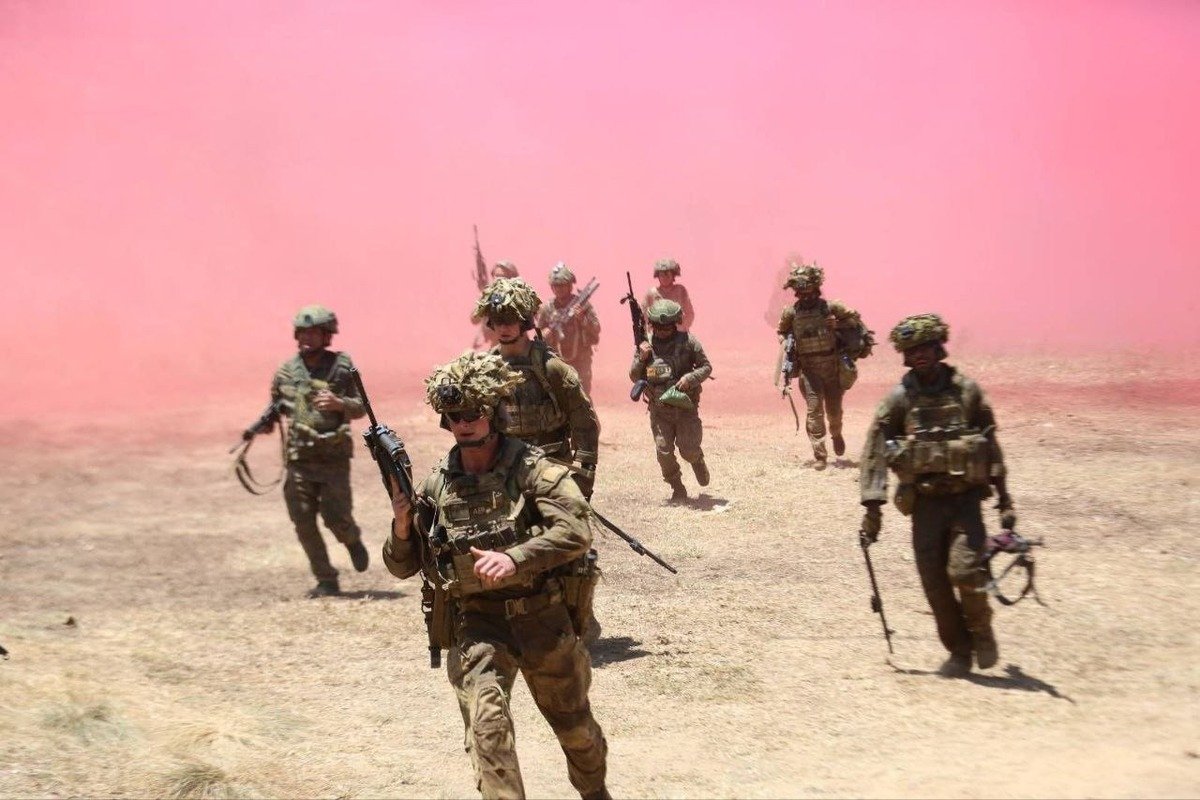
Soldiers from the Philippine Army and the Australian Army successfully defended a simulated coastline against a notional enemy assault during a joint military drill held on June 16, 2026, at Sitio Mainit, Barangay Balogo, Pasacao, Camarines Sur — the latest field activity under the ongoing bilateral military exercise known as Exercise Kasangga, which is set to formally conclude on June 19, 2026.
Multi-Domain Drill Puts Allied Forces to the Test in Pasacao
The coastal defense scenario required participating troops from both nations to mount a coordinated response across land, air, and maritime domains simultaneously. The exercise was structured to evaluate how effectively the two forces could operate together within a unified command structure while applying their respective military doctrines.
The Philippine Army’s 9th Infantry Division Public Affairs Office (9DPAO) said the drill was specifically designed to demonstrate the coordination, readiness, and operational effectiveness of both allied armies under conditions that simulate actual armed conflict. According to the 9DPAO, the activity challenged soldiers to employ their individual tactics, techniques, and procedures while functioning as part of an integrated, interoperable force — a key objective of the bilateral training program.
The exercise underscored the importance both armies place on developing the ability to synchronize movements, share situational awareness, and execute joint decisions quickly in complex, multi-domain environments — a capability increasingly relevant as security dynamics in the Indo-Pacific region continue to shift.
Australian Army Highlights Knowledge Transfer as Central to Participation
The Australian Army, in a statement issued in connection with Exercise Kasangga, described its involvement as extending well beyond standard tactical drills. The Australian side emphasized that its participation is part of a deliberate effort to share military knowledge, operational expertise, and institutional experience in the area of territorial defense with its Philippine counterparts.
Significantly, the Australian Army noted that its engagement directly supports the Philippine Army’s ongoing strategic reorientation toward external defense operations. This shift reflects the Philippines’ growing emphasis on asserting and protecting its sovereign rights and maritime entitlements, particularly in the context of ongoing territorial disputes in the region.
The Australian Army brings to this exchange considerable experience in conventional territorial defense and active participation in multinational security frameworks across the Indo-Pacific — making it a valuable partner for Philippine forces undergoing this institutional transition. The deepening defense ties between Manila and Canberra that Exercise Kasangga embodies are grounded in longstanding bilateral security agreements and shared strategic interests in preserving regional stability.
9th Infantry Division Works with Pasacao LGU on Civilian Safety Measures
Before the coastal defense drill commenced, the Philippine Army’s 9th Infantry Division undertook extensive coordination with the local government of Pasacao to protect the safety and welfare of residents living in areas adjacent to the designated exercise zone.
The 9DPAO confirmed that civilians residing in the immediate vicinity of the training area were temporarily relocated as a precautionary measure for the duration of the drill. Fishing activities within the designated exercise corridor were also suspended to prevent any risk of harm to local fishing communities during the simulated military engagement.
The Local Government Unit of Pasacao played an active and supportive role in both the evacuation process and the overall civilian safety management plan. The 9th Infantry Division cited this collaboration as a demonstration of effective civil-military coordination, noting that the active involvement of the LGU was essential to the safe and successful execution of the exercise.
These protective measures — temporary relocation of nearby residents and suspension of fishing operations — are consistent with standard safety protocols applied during military exercises conducted in or near populated coastal communities and economically active coastal waters.
About Exercise Kasangga: A Month of Bilateral Military Integration
Exercise Kasangga takes its name from the Filipino term meaning “ally” or “partner,” a title that reflects the spirit of the bilateral military engagement it represents. The month-long joint exercise brings together soldiers from the Philippine Army and the Australian Army to train across a variety of realistic and operationally challenging scenarios.
Throughout the exercise period, troops from both countries have participated in training activities designed to sharpen individual and collective military skills while deepening mutual understanding of each other’s operational procedures, tactical approaches, and command methods. The scenarios were deliberately crafted to push soldiers beyond routine training and expose them to the complexity of real-world operational demands.
According to the 9DPAO, the exercise represents the practical expression of the broader Australia-Philippines defense alliance — translating high-level strategic commitments into concrete, field-level military interoperability between the two armed forces.
Philippine Army’s Strategic Shift Toward External Defense Operations
Exercise Kasangga carries particular significance given the current trajectory of the Philippine Army’s institutional development. Over recent years, the military has been progressively recalibrating its strategic focus — moving away from internal security operations historically centered on counterinsurgency, and toward conventional external defense, particularly in response to territorial disputes and the imperative to protect the country’s sovereign maritime boundaries.
This strategic reorientation requires the Philippine Army to develop new doctrines, build relevant capabilities, and design training programs specifically aligned with conventional coastal and territorial defense. Bilateral exercises like Kasangga are critical platforms in this developmental process, giving Philippine soldiers direct exposure to the doctrines, techniques, and operational experiences of allied partner armies.
The Australian Army’s involvement, as noted in its official statement, is a direct contribution to this capacity-building effort — providing Philippine forces with insights drawn from Australia’s own extensive experience in conventional defense operations and its long-standing role in regional and multinational security arrangements.
Exercise Set to Close June 19 as PH-Australia Defense Ties Deepen
Exercise Kasangga is scheduled to formally conclude on June 19, 2026. The 9DPAO released photographs and video documentation of the June 16 coastal defense drill, offering a visual record of the scale and complexity of the joint activities conducted under the exercise program.
As the exercise approaches its conclusion, both the Philippine Army and the Australian Army are expected to conduct after-action reviews — structured assessments aimed at identifying lessons learned, evaluating areas requiring further development, and establishing a foundation for future joint training engagements between the two forces.
The exercise takes place against a backdrop of growing defense engagement between Manila and Canberra. Both governments have expanded their bilateral security cooperation frameworks in recent years as part of wider efforts to reinforce stability in the Indo-Pacific and uphold the international rules-based order that underpins regional security.
The 9DPAO confirmed that no casualties or incidents were recorded in connection with any of the exercise activities. Further official assessments from the Philippine Army’s 9th Infantry Division are anticipated following the formal close of Exercise Kasangga on June 19, 2026.
Photo credit: 9th Infantry Division Public Affairs Office (9DPAO), Philippine Army
Source: Originally reported by Fort Bonifacio-based Philippine Army public affairs release, as sourced from the 9th Infantry Division Public Affairs Office (9DPAO).