
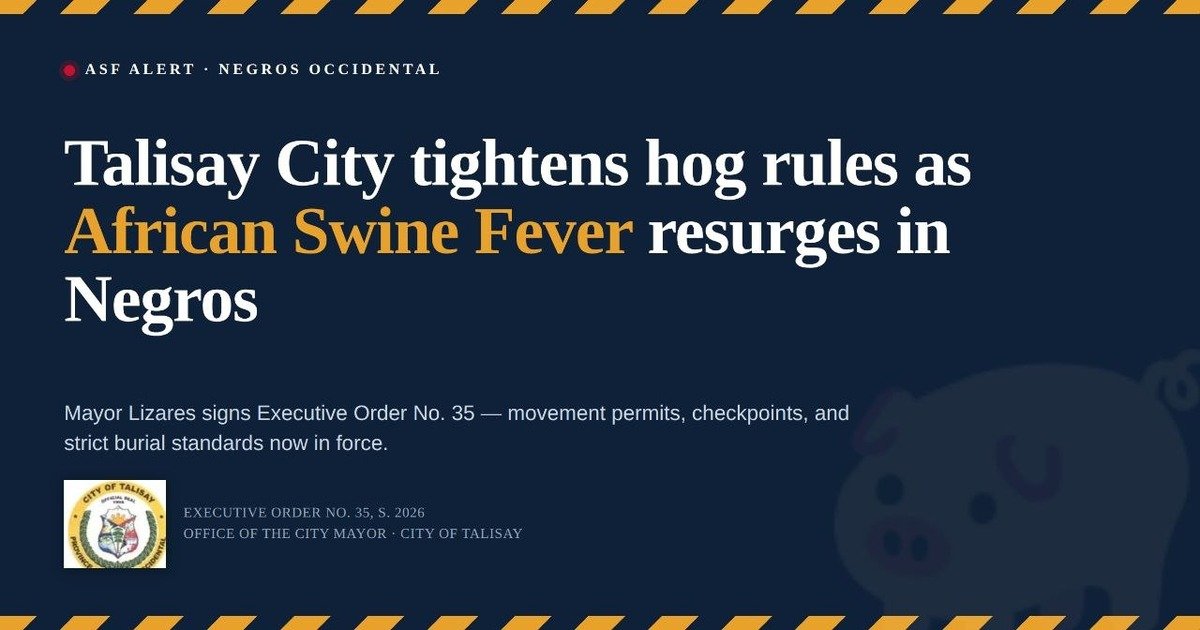
Hundreds of pigs have already died across Negros Occidental as African Swine Fever makes a renewed push through the province — and Talisay City is now among the local government units taking decisive action to stop the disease from spreading further within its boundaries.
The Talisay City government this week announced the immediate enforcement of Executive Order No. 35, Series of 2026, signed by Mayor Maria Rowena Guadalupe Lopez Lizares. The order puts in place comprehensive guidelines covering the movement, slaughter, transport, and disposal of hogs and pork products, and also addresses other Transboundary Animal Diseases (TADs) such as avian influenza.
Bureau of Animal Industry Confirms Active Outbreak in the Province
The issuance of the executive order comes on the heels of an official confirmation from provincial authorities that ASF has returned to Negros Occidental in force. Governor Eugenio Jose Lacson disclosed this week that laboratory testing conducted by the Bureau of Animal Industry confirmed active infections in several areas of the province, with the pig mortality rate recorded at 4.06 percent.
The municipality of San Enrique has suffered the worst losses, with more than 500 pigs reported dead spanning all 10 of its barangays, according to provincial government reports. Nearby municipalities Moises Padilla and La Castellana have already enacted outright bans on the entry of live pigs and pork products in a bid to prevent the disease from crossing into their territories.
Movement of Hogs Banned Without Proper Permits and Biosecurity Compliance
Under the provisions of EO No. 35, no hogs or pork products may leave Talisay City unless the animals come from commercial farms that meet either provincial or national biosecurity standards and are accompanied by duly issued movement permits. The executive order further provides that movement between barangays within the city is only allowed after inspection, documentation, and formal clearance issued by the City Veterinary Office.
Pork and hog products slaughtered within Talisay must remain within city limits for consumption, sale, or processing, unless national or provincial authorities explicitly authorize movement outside the city. Additionally, mandatory disinfection is required for all vehicles — whether incoming or outgoing — as well as livestock transport units and pigpens.
Carcass Disposal Protocols Set Under the Executive Order
One of the more detailed sections of EO No. 35 covers the handling and disposal of dead or contaminated animals. The city government is directed to designate a common mass-burial site and to mobilize hauling vehicles, excavation equipment, and a dedicated team to oversee burial and decontamination activities.
All carcasses must be buried to a minimum depth of six feet and treated with lime before the burial site is backfilled. Prior to transport, all body openings of carcasses must be sealed to prevent leakage, and hauling vehicles must be covered using leak-proof materials. Burial sites must also be secured to keep out scavenger animals and unauthorized individuals, the executive order states.
Order Covers All Players in the Local Swine Industry
The executive order casts a wide net in terms of who is covered. Hog raisers, traders, slaughterhouse operators, meat vendors, and transporters all fall under its scope. The City Veterinary Office is mandated to conduct continuous surveillance in coordination with barangay officials, while close coordination with the Department of Agriculture and the Bureau of Animal Industry is also required under the order.
An intensive information and awareness campaign targeting hog raisers and the general public is likewise prescribed, ensuring that those directly involved in the swine industry understand both the risks of ASF and their obligations under the new rules.
Penalties Await Those Who Violate the Order
Those who fail to comply with EO No. 35 or with related animal health laws face administrative, civil, or criminal penalties under applicable legislation, including the Provincial ASF Prevention Ordinance, according to the executive order itself. The city government did not elaborate on specific penalty amounts but noted that existing legal frameworks would apply.
No Human Infection Risk, But Economic Damage Can Be Devastating
Health authorities consistently note that ASF does not infect humans and presents no food safety risk from consuming properly handled pork products. The danger lies entirely in the economic destruction the disease inflicts on hog raisers and the wider agricultural economy.
The scale of that threat is well documented in Negros Occidental’s own recent history. During the 2023 outbreak, the province — once recognized as the country’s leading hog-producing region — lost close to 18,000 pigs to a combination of ASF and hog cholera, according to provincial records. That experience underscores why local governments across the province are acting swiftly this time around to prevent a repeat of those losses.
With multiple municipalities now enforcing entry bans and Talisay City tightening its internal controls, local officials are hoping that coordinated action across the province can contain the current resurgence before it inflicts comparable damage on an already battered sector.
Originally reported by: breakingnewsnegrosoriental.com