DUMAGUETE CITY — Three sitting district lawmakers from Negros Oriental are at the center of renewed public scrutiny as the House of Representatives moves toward a full plenary vote on whether to impeach Vice President Sara Duterte — a vote that, under the Constitution, must be entered into the public record.
The House Committee on Justice set the wheels in motion on Monday after unanimously approving both its committee report and a resolution outlining the Articles of Impeachment against Duterte. The unanimous committee decision clears the path for a floor vote where each member of the House must take a definitive, recorded position.
What the Constitution Requires
The 1987 Constitution sets a clear threshold: at least one-third of all House members must vote in favor of impeachment before the Articles can be forwarded to the Senate for a formal trial. Given the current House membership of 318, that threshold translates to a minimum of 106 affirmative votes.
If the lower chamber fails to reach that number, the impeachment effort dies at the House level. If it succeeds, the Senate would convene as an impeachment court — with senators acting as judges — and a two-thirds supermajority would be required to remove Duterte from office. The trial itself would be presided over by a Supreme Court justice and would involve the presentation of evidence, witness testimony, and formal legal arguments from both sides.
Spotlight on Negros Oriental’s Three Representatives
For voters in Negros Oriental, the names to watch are Rep. Emmanuel Iway of the 1st District, Rep. Ma. Isabel “Maisa” Sagarbarria of the 2nd District, and Rep. Janice Degamo of the 3rd District. Each of them will be required by law to cast a publicly recorded vote — meaning constituents will know exactly how their representative voted.
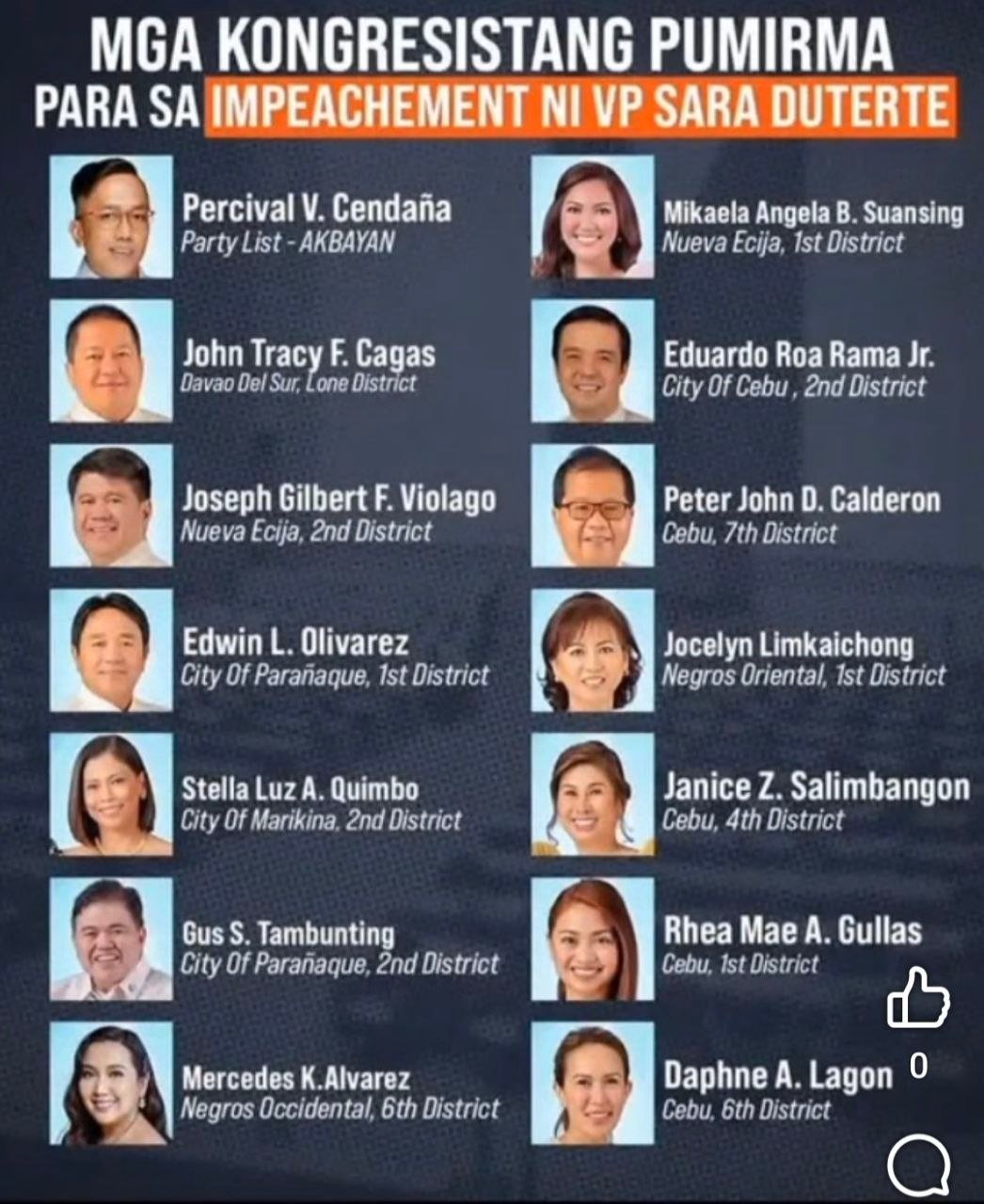
The stakes feel familiar. During the previous Congress, a similar impeachment push against Duterte resulted in a vote that sparked controversy at the provincial level. At that time, the 1st District was represented by then-Rep. Jocelyn Limkaichong, and the 2nd District by then-Rep. Manuel “Chiquiting” Sagarbarria — both of whom voted in support of the impeachment complaint against the vice president.
The 3rd District, meanwhile, was under the legislative caretakership of then-House Speaker Martin Romualdez, who was likewise counted among those who backed the impeachment move.
Backlash That Followed the Earlier Vote
That prior vote did not go without pushback. A segment of Negros Oriental residents and supporters of the vice president raised questions about whether the province’s lawmakers at the time were genuinely reflecting local public sentiment or simply following cues from national House leadership.
Allegations of political pressure and supposed inducements circulated in public discourse following the vote, though no verified findings have been established to support those specific claims. Nevertheless, the episode put a sharp spotlight on the persistent tension between local constituency preferences and the demands of national party politics — a tension that continues to shape how provincial representatives approach major legislative votes.
A Shifted Political Environment in 2025
The political terrain heading into this impeachment vote looks considerably different from the last. Negros Oriental now has an entirely new slate of district representatives following the 2025 elections. Iway, Sagarbarria, and Degamo are each making their respective marks in their districts, bringing fresh political identities to the question at hand.
The House itself has also undergone a leadership transition. Speaker Faustino “Bojie” Dy III has taken over from Romualdez, and how that shift in leadership affects internal party discipline remains to be seen. Some observers believe the change could give individual representatives more latitude to vote in accordance with local sentiment rather than strict party direction — though others caution that institutional pressures rarely disappear with a change of speakership.
What has not changed is the fundamental question facing the province’s lawmakers: will they vote according to their own assessment of the evidence and the will of their constituents, or will they align with the position of the House majority?
The Charges Against the Vice President
The impeachment complaints lodged against Duterte center on several serious allegations, including the alleged misuse of confidential funds, questions about unexplained wealth, and reported threats directed at top government officials. These accusations have been drawn from various investigations and from public statements attributed to or made by the vice president.
Duterte has firmly denied any wrongdoing. She has characterized the impeachment proceedings as politically driven, arguing that her actions in office have been lawful and consistent with her constitutional mandate. The controversy surrounding the use of confidential funds has been especially prominent, with critics raising concerns about transparency and accountability in how public resources allocated to the Office of the Vice President were spent.
Why the Recorded Vote Matters
The constitutional requirement for a recorded vote in impeachment proceedings means there is no political cover for any representative. Every yes, every no, and every abstention becomes part of the official public record — and, in practical terms, part of a lawmaker’s political legacy with their constituents.
For Iway, Sagarbarria, and Degamo, that reality carries weight. Their votes will be scrutinized not only in the immediate national conversation but also in the longer arc of Negros Oriental’s political history. How each of them chooses to vote — and how they explain that choice to their constituents — will likely resonate well beyond the conclusion of this particular proceeding.
The public and transparent nature of the vote also means that interest groups, civil society organizations, and ordinary voters across all three districts will have a clear benchmark against which to evaluate their representatives when future elections come around.
Broader Constitutional and National Significance
Impeachment is among the most consequential constitutional tools available for holding senior government officials accountable. The process demands careful examination of evidence and strict adherence to constitutional procedures, and its outcome carries implications that extend far beyond any single official or any single vote.
Should the House clear the 106-vote threshold, the case moves to a Senate trial that would dominate the national political landscape for months. Should it fall short, the process ends at the lower chamber — and the political fallout of that failure would be equally significant in its own right.
In Negros Oriental, as in provinces across the country, the impeachment vote represents one of those rare moments in which local representation and national constitutional governance directly intersect. How the province’s three district representatives navigate that intersection will be watched closely — by their constituents, by political observers, and by the public record itself.
Photo credit: House of Representatives