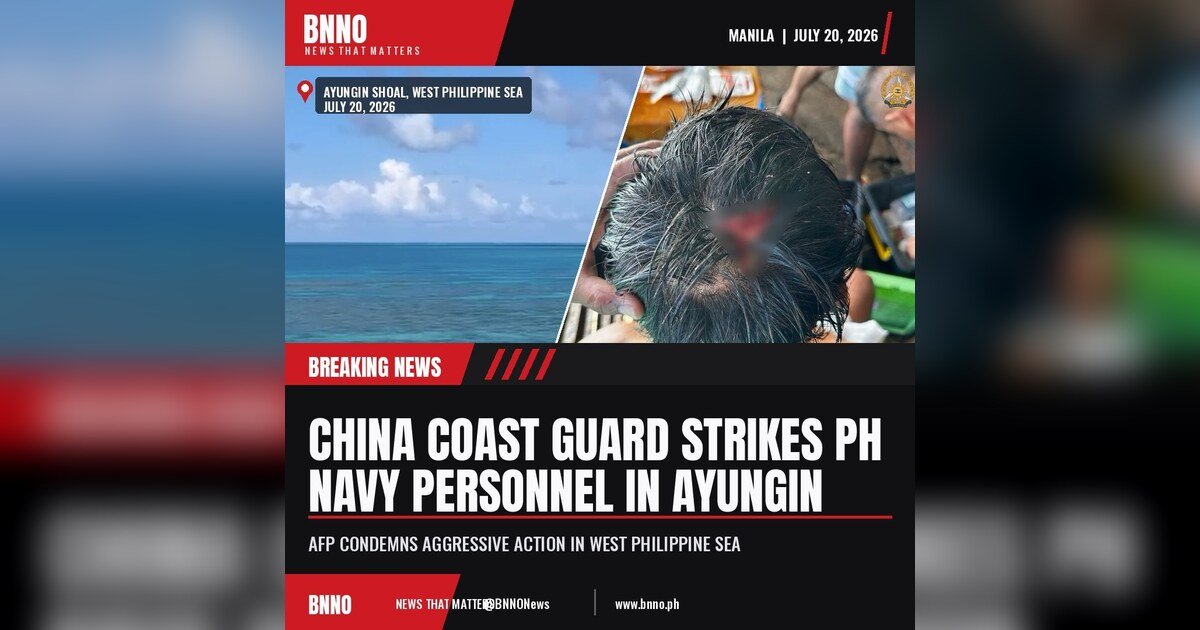
In what military officials are describing as a significant escalation in the West Philippine Sea, a member of the Philippine Navy was struck on the head with a wooden baton by a China Coast Guard crew member during a confrontation near BRP Sierra Madre at Ayungin Shoal on July 20. The Armed Forces of the Philippines also reported that one of its rubber boats was damaged during the encounter — making this one of the most direct instances of weaponized physical assault against Filipino servicemen in the disputed waters.
Chinese Personnel Approached BRP Sierra Madre Unlawfully
According to the AFP’s Public Affairs Office, a rigid hull inflatable boat carrying eight personnel from China Coast Guard vessel CCGV 21560 made an unlawful close-range approach toward the grounded warship BRP Sierra Madre. The Chinese crew circled the vessel and proceeded to document it through photographs and video footage.
The AFP said two Philippine rubber boats were deployed to intercept and push back the Chinese craft. Military officials described their personnel’s conduct throughout the encounter as calm and non-confrontational. It was the Chinese personnel who responded aggressively — striking a Philippine Navy sailor on the head with a wooden baton and inflicting damage on one of the Navy’s rubber boats in the process.
The AFP’s Public Affairs Office confirmed that the injured sailor was given immediate medical attention aboard the BRP Sierra Madre. As of the time of the AFP’s announcement, Western Command was still assessing whether the nature of the sailor’s injuries would necessitate a medical evacuation from the shoal.
AFP Condemns the Violence, Reaffirms Mandate at Shoal
The Armed Forces of the Philippines issued a strong condemnation of the incident, calling it a blatant disregard for the safety and lives of Filipino military personnel. Despite the violent response from Chinese forces, the AFP said its personnel remained professional and disciplined, operating within the Rules of Engagement during what it characterized as a lawful mission inside Philippine sovereign waters.
Col. Xerxes A. Trinidad, chief of the AFP Public Affairs Office, released the official statement, in which the military made its position unambiguous: no form of coercion or aggression will prevent the AFP from fulfilling its constitutional mandate. The military further stated that its presence and sustainment operations at Ayungin Shoal will continue without interruption.
The AFP also emphasized that the entire confrontation occurred within waters where the Philippines holds sovereign rights under international law — specifically within the country’s 200-nautical-mile exclusive economic zone.
AFP Calls on China to Stop Coercive Behavior in the West Philippine Sea
Beyond condemning the specific incident, the AFP used its statement to issue a broader call on the People’s Liberation Army, the China Coast Guard, and Chinese maritime militia forces to cease what it described as illegal, coercive, aggressive, and deceptive conduct in the West Philippine Sea.
The AFP also renewed its call for China to abide by the 2016 arbitral award — a ruling handed down by a tribunal constituted under the United Nations Convention on the Law of the Sea (UNCLOS) — which invalidated Beijing’s sweeping maritime claims and upheld the Philippines’ sovereign rights in the area. As the AFP noted in its statement, China has never recognized or complied with that ruling.
Background: BRP Sierra Madre and the Strategic Role of Ayungin Shoal
Ayungin Shoal — internationally referred to as Second Thomas Shoal — sits well within the Philippines’ exclusive economic zone, approximately 200 nautical miles from the mainland. The BRP Sierra Madre, a World War II-era landing ship, was deliberately run aground at the location in 1999 as a means of asserting and maintaining the Philippine territorial claim. A small rotating detachment of Marines is stationed aboard the vessel, which has become a focal point of tensions between Manila and Beijing.
Over the years, Philippine resupply and rotation missions to the BRP Sierra Madre have been repeatedly obstructed by Chinese forces through various means — including water cannon use, blocking maneuvers, and vessel collisions. The July 20 incident, however, stands apart from previous confrontations: the direct use of a physical weapon against a Filipino serviceman marks a notably more severe form of aggression than what has typically been documented in earlier episodes.
The incident has intensified calls from Philippine officials and military leadership for the international community to take note of China’s escalating behavior in waters that international law recognizes as falling under Philippine jurisdiction.
By the Numbers
- 8 — Chinese personnel aboard the rigid hull inflatable boat from CCGV 21560
- 2 — AFP rubber boats deployed to intercept the Chinese craft
- 1 — Philippine Navy sailor struck on the head with a wooden baton
- 1999 — year BRP Sierra Madre was deliberately grounded at Ayungin Shoal to assert Philippine territorial presence
- 200 nautical miles — extent of the Philippine exclusive economic zone within which the incident took place
- 2016 — year of the UNCLOS arbitral award affirming Philippine sovereign rights at the shoal, which China continues to reject
Why This Matters
The July 20 confrontation at Ayungin Shoal represents a documented escalation in the pattern of Chinese aggression in the West Philippine Sea, with the use of a weapon against a Filipino serviceman marking a qualitative shift beyond the water cannons and blocking maneuvers seen in previous incidents. The AFP’s explicit declaration that its operations at the shoal will continue regardless of Chinese pressure underscores Manila’s determination to defend its sovereign rights in the area. The incident also intensifies the Philippines’ long-standing demand for Beijing’s compliance with the 2016 UNCLOS arbitral ruling — a ruling China has consistently refused to acknowledge.
Source: AFP Public Affairs Office / breakingnewsnegrosoriental.com