
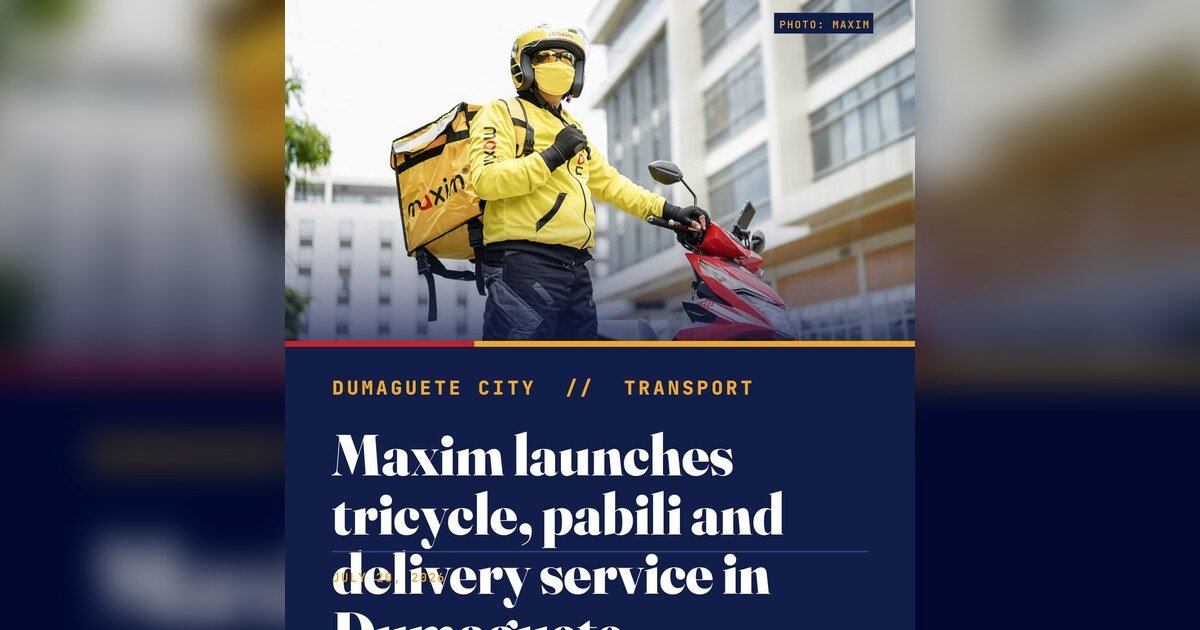
Dumaguete City’s tricycle commuters now have a new option for getting around town. Ride-hailing company Maxim has officially rolled out tricycle booking, pabili, and delivery services in the city, letting passengers request rides and errands directly through a smartphone app — with fares calculated upfront before the trip even begins, the company announced.
The platform marks a notable shift from the city’s longstanding street-hailing and terminal-queue model, where tricycle fares have traditionally been settled through informal negotiations between passengers and drivers.
How the App Works for Riders and Drivers
Under the Maxim system, according to the company, fares are determined automatically based on the passenger’s pickup and drop-off locations — removing the need for curbside haggling that has long been a fixture of Dumaguete’s tricycle culture. Passengers can be fetched directly from their door rather than having to walk to a designated terminal.
Driver-partners receive ride requests based on proximity to the booking location, a dispatch approach that Maxim says reduces unnecessary idle travel and cuts down on fuel use. Importantly, drivers retain the right to decline bookings and may continue serving their regular passengers along existing routes. The company described the arrangement as a supplement to — not a replacement of — a driver’s current operations.
For errand and delivery bookings, Maxim said fees start at PHP 10, covering items such as groceries, prepared meals, documents, and parcels.
Safety Tools Included in the Platform
Maxim said the app is equipped with a range of safety tools, including an SOS button, real-time trip tracking, masked calls and in-app messaging between riders and driver-partners, ride monitoring, and 24-hour customer support access.
The company noted that these safety features are consistent with the standards the Land Transportation Franchising and Regulatory Board (LTFRB) has applied to accredited transport network companies operating four-wheeled vehicles across the country.
Local Head Frames Launch Around Community Benefit
Shem Ehurango, head of Maxim Dumaguete, said the launch is aimed at improving daily life for both commuters and transport workers in the city.
“Maxim is committed to improving urban mobility and supporting the local economy in Dumaguete City. By providing accessible tricycle, pabili, and delivery services, we aim to make everyday transportation and errands more convenient while supporting local driver-partners and businesses,” Ehurango said, as quoted in the company’s announcement.
A Key Regulatory Distinction: The City Council Controls Tricycle Fares
A significant legal backdrop shapes this launch. Tricycle fares in Dumaguete City are not set by Maxim or by the LTFRB — they fall under the exclusive authority of the Sangguniang Panlungsod, or city council.
This is because franchising power over tricycles-for-hire was devolved from the LTFRB to local government units in 1992, under the Local Government Code. Section 458 of that code grants city councils the authority to issue, amend, suspend, or cancel Motorized Tricycle Operator’s Permits, to set and periodically revise fares following a public hearing, and to define service zones.
What this means in practice, according to the original report, is that the fare figures displayed on the Maxim app must conform to whatever rates the Dumaguete City council has officially approved. Additionally, the app’s doorstep pickup model must be reconciled with the permit system’s defined service zones — a regulatory question that only the city government has the authority to resolve.
Maxim’s Regulatory Path to This Point
The Dumaguete launch comes after a notable period of regulatory tension between Maxim and national transport authorities. In January 2023, the LTFRB publicly flagged Maxim for operating transport network vehicle services without proper accreditation, noting at the time that the platform was active in 41 cities and municipalities across the Philippines. The LTFRB coordinated with the Department of Information and Communications Technology to restrict access to the app and issued a public advisory against using it.
Maxim’s local operator, Taxsee Philippines Inc., later secured Transport Network Company accreditation from the LTFRB. The company has since been included in national pilot programs for motorcycle-taxi transport in Metro Manila and Cagayan de Oro, according to Maxim.
It bears noting, however, that the LTFRB’s accreditation covers only four-wheeled transport network vehicles. Tricycles remain entirely outside the board’s jurisdiction and under the authority of individual local government units — which means each city or municipality where Maxim offers tricycle services will need to independently address the regulatory fit.
Part of a Wider National Expansion
According to Maxim, the Dumaguete rollout is part of an ongoing expansion across the Philippines. The company says it has now established a presence in 23 cities in the country since first launching Philippine operations in Cebu in 2020, with Dumaguete among its most recent additions to that growing network.
What This Means on the Ground
For daily commuters in Dumaguete, the service introduces price predictability and convenient doorstep pickup in a city where tricycles serve as the dominant form of public transport. For tricycle operators, Maxim’s platform offers a new channel for securing bookings outside the traditional terminal queue system.
The broader unresolved question, as reported, is whether an app-driven dispatch and dynamic pickup model can fully align with a regulatory framework built around fixed service zones and city council-approved fare schedules — a determination that rests solely with the Dumaguete City government.
By the Numbers
- PHP 10 — minimum starting fee for pabili and delivery services
- 23 cities — total Philippine cities where Maxim now operates as of the Dumaguete launch
- 2020 — year Maxim began operations in the Philippines, starting in Cebu
- 41 cities and municipalities — scale of Maxim’s operations at the time of the January 2023 LTFRB accreditation warning
- 1992 — year tricycle franchising authority was devolved to local government units under the Local Government Code
Why This Matters
Tricycles are the backbone of Dumaguete City’s public transport network, and Maxim’s entry introduces a tech-driven booking model to a system long governed by informal fare negotiations and terminal-based queuing. The legal question of whether the app’s dynamic dispatch approach is compatible with the city council’s exclusive authority over tricycle fares and service zones has yet to be settled. How the Sangguniang Panlungsod responds will set a precedent for whether app-based tricycle services can achieve full regulatory standing in Dumaguete City.
Source: Breaking News Negros Oriental (breakingnewsnegrosoriental.com)