
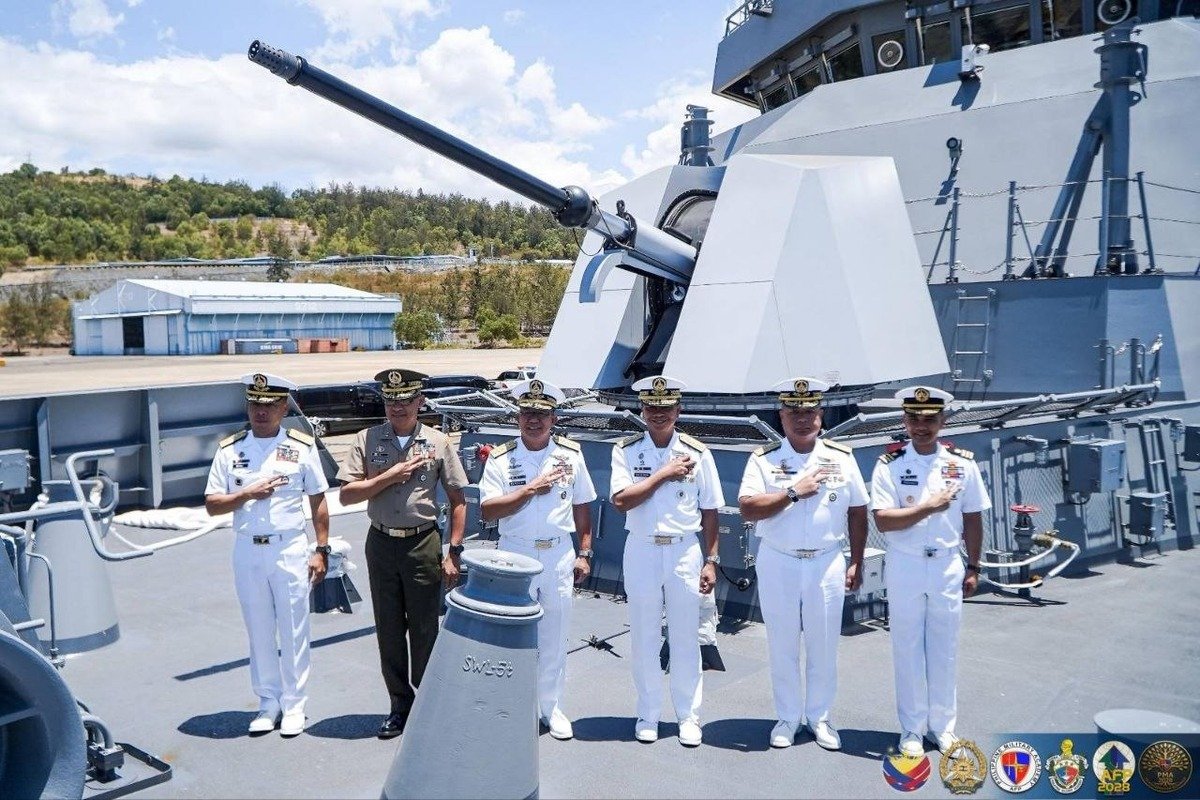
A new chapter in the Philippine Navy’s fleet expansion unfolded at Naval Operating Base-Subic in Zambales on May 8, 2026, as the vessel soon to be commissioned as BRP Rajah Lakandula (PS21) formally arrived on Philippine shores. Philippine Military Academy Superintendent Vice Admiral Caesar Bernard N. Valencia, PN, was named Guest of Honor and Speaker at the arrival ceremony, lending both institutional weight and personal historical significance to the occasion.
High-Ranking Naval Officials Gather at Subic for the Occasion
The arrival ceremony drew together some of the Philippine Navy’s most senior officers. Vice Admiral Jose Ma. Ambrosio Q. Ezpeleta, PN, Flag Officer in Command of the Philippine Navy, personally welcomed Vice Admiral Valencia upon his arrival at the event. Also in attendance were flag officers of the Philippine Fleet, led by Rear Admiral Joe Anthony C. Orbe, PN.
The assembly of senior naval leadership at Subic Bay was itself a statement of the ceremony’s importance. The formal reception of the Philippines’ second offshore patrol vessel under an active multi-ship acquisition program represents a concrete milestone in the country’s efforts to build a more capable and credible maritime defense force.
The PMA’s Public Affairs Office noted that Vice Admiral Valencia’s role as guest of honor acknowledged not only his current position as PMA Superintendent but also his longstanding and formative contributions to naval acquisition efforts stretching back nearly a decade.
About the BRP Rajah Lakandula (PS21)
The incoming vessel, designated PS21 within the Philippine Navy’s fleet numbering system, was constructed by HD Hyundai Heavy Industries, one of South Korea’s most prominent and globally recognized shipbuilding firms. Upon formal commissioning, it will bear the name BRP Rajah Lakandula — continuing a long-standing naval tradition of honoring the memory of historical Filipino leaders and national figures through ship naming.
The BRP Rajah Lakandula is the second of six offshore patrol vessels being procured under the Philippine Navy Offshore Patrol Vessel Acquisition Project, commonly referred to as the OPVAP. This acquisition effort falls under the Second Horizon of the AFP Modernization Program — a legislatively mandated, phased undertaking designed to provide the Armed Forces of the Philippines with more advanced equipment and platforms suited to the country’s evolving security environment, particularly in the maritime domain.
With two vessels now delivered, four additional units remain outstanding under the OPVAP’s six-ship procurement target. The AFP Modernization Program draws its legal and budgetary authority from Republic Act 10349 as amended, which provides the framework for phased capability upgrades across all branches of the AFP, including the acquisition of surface combatants, aircraft, and other major defense articles.
Vice Admiral Valencia’s Foundational Role in the OPVAP
Vice Admiral Valencia’s presence at the arrival ceremony carried a dimension beyond his current rank and office. He served as the inaugural Chairman of the Defense Acquisition System Assessment Team for the OPVAP — a role he assumed in 2017, approximately nine years before the second vessel under that very program arrived at Subic Bay under his watch as PMA Superintendent.
His involvement in shaping the Philippine Navy’s modern surface fleet extends across multiple major acquisition programs. He previously served as Team Leader of Technical Working Groups and Project Management Teams for both the Frigate Acquisition Project — which resulted in the Jose Rizal-class Frigates — and the Corvette Acquisition Project, which produced the Miguel Malvar-class Frigates.
These assignments collectively position Vice Admiral Valencia as one of the principal architects of the Philippine Navy’s contemporary surface warfare capability. His presence at the PS21 arrival ceremony, therefore, represented a personal and institutional closing of a long arc that began nearly a decade earlier in the planning rooms of the defense acquisition process.
Valencia Calls Arrival an “Institutional Evolution” of the Navy
Delivering his message before assembled naval officers and guests, Vice Admiral Valencia placed the significance of the event in terms that went well beyond standard military ceremony. He described the occasion as a moment of institutional transformation rather than a routine equipment handover.
“Today, we are not just witnessing the arrival of a new vessel; we are experiencing institutional evolution of our Navy,” Vice Admiral Valencia said during the ceremony.
He also addressed the vessel’s deeper meaning within the context of Philippine sovereignty and maritime rights, drawing a direct connection between the Navy’s growing hardware capabilities and the country’s firm national security posture.
“Our duty is to safeguard the very dignity of our nation. When this ship sails… we are telling the world that while we are a peace-loving nation, our resolve to protect what is ours is as deep as the trenches of the Philippine Sea,” Vice Admiral Valencia stated.
His remarks underscored a recurring theme in the AFP’s modernization narrative — that the acquisition of new platforms is inseparable from the Philippines’ commitment to defending its sovereign maritime zones, particularly in the West Philippine Sea, where the country maintains active territorial and jurisdictional claims against competing claimants.
PMA’s Broader Engagement with AFP Modernization
The Philippine Military Academy, headquartered at Fort General Gregorio H. Del Pilar in Baguio City, is the country’s foremost military academic institution and the principal source of commissioned officers for the AFP. While its core mandate centers on officer education and development, the involvement of its superintendent in major AFP acquisition milestones reflects a broader institutional alignment with national defense modernization priorities.
According to the PMA’s Public Affairs Office, Vice Admiral Valencia’s participation in the PS21 arrival ceremony was consistent with the Academy’s institutional support for initiatives that enhance AFP capabilities in addressing maritime and security challenges facing the country. The PMA’s leadership, in this light, plays a role not only in producing the officers who will crew and command these vessels, but also in shaping the strategic and acquisitions frameworks that determine what those officers will be working with.
South Korean Shipbuilder at the Center of the Acquisition
HD Hyundai Heavy Industries, the South Korean firm contracted to deliver the OPVAP vessels, ranks among the world’s largest and most established shipbuilders. The company carries a proven record in supplying naval and coast guard vessels to multiple nations and has demonstrated experience in constructing patrol-class ships suited to both blue-water and littoral operational environments.
The selection of HD Hyundai Heavy Industries for the OPVAP followed a formal acquisition process overseen by the Department of National Defense and the AFP. Technical working groups — including those that Vice Admiral Valencia led during earlier phases of his career — were central to defining the vessel specifications and evaluation standards that ultimately guided the procurement decision.
Fleet Expansion Continues as Navy Builds Toward Credible Defense
The arrival of the BRP Rajah Lakandula (PS21) at Naval Operating Base-Subic on May 8, 2026 adds another platform to a Philippine Navy surface fleet that has grown considerably in recent years. Together with the Jose Rizal-class Frigates and the Miguel Malvar-class Corvettes acquired under earlier AFP Modernization Program horizons, the OPVAP vessels represent the continued build-out of a more capable and layered Philippine naval force.
As the remaining four OPVAP vessels work their way through production and delivery, the Philippine Navy’s surface combat capability is expected to continue expanding — a development the AFP frames as essential to the country’s ability to assert and protect its maritime zones in an increasingly contested regional security environment.