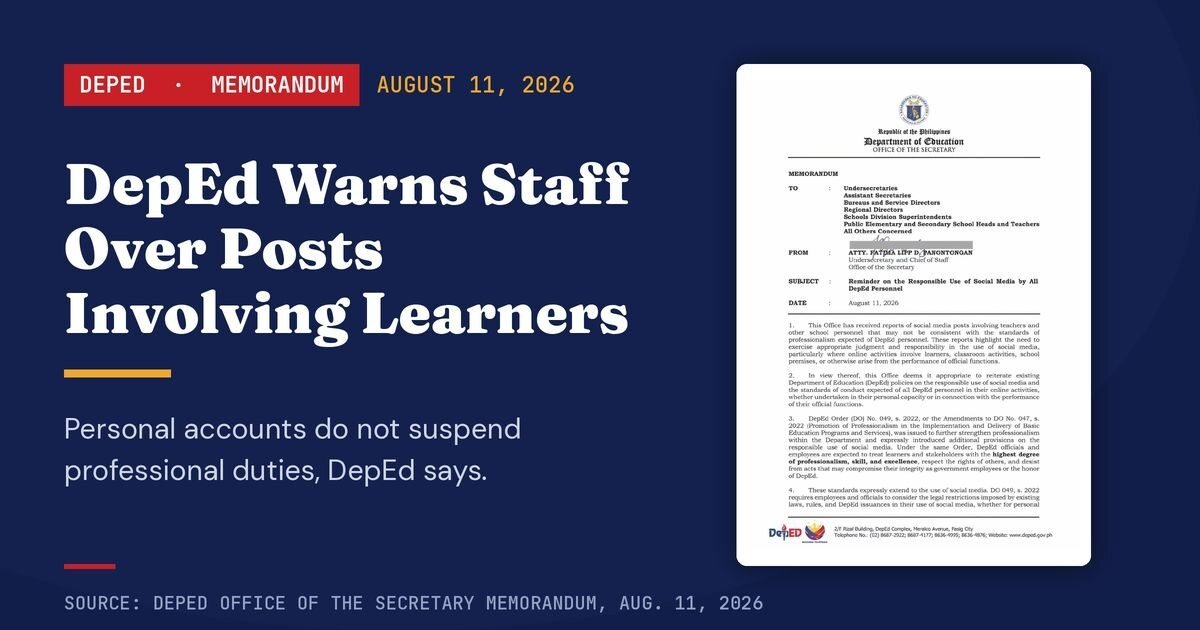
A memorandum circulating across every level of the Philippine public school system is putting teachers and non-teaching staff on notice: posting content about students, classrooms, or school premises on a personal social media account does not place that content beyond the reach of professional and ethical standards.
The Department of Education issued the reminder on August 11, 2026, through a memorandum signed by Undersecretary and Chief of Staff Atty. Fatima Lipp D. Panontongan, acting for the Office of the Secretary. According to DepEd, the directive was addressed to the entire DepEd hierarchy — from undersecretaries and assistant secretaries down to individual public school teachers — and came with an order for immediate dissemination at all levels.
What Triggered the Memo
DepEd said the Office of the Secretary had received reports of social media posts made by teachers and other school personnel that appeared inconsistent with the professional standards the department expects of its workforce. Rather than naming specific individuals, schools, or posts, and without announcing any investigation or pending sanctions, the department framed the memorandum as a restatement of existing policy — a reminder, not a new rule.
The underlying message, according to DepEd, is that reports of problematic posts point to a gap in how some personnel understand the limits of their online conduct when it intersects with their official roles.
The Personal-Account Exemption That Does Not Exist
One of the memorandum’s clearest points, as stated by DepEd, is that operating under a personal social media handle does not automatically exempt personnel from professional accountability. The department said this is especially true when the content in question identifies the poster as a DepEd employee, involves learners, touches on classroom activities, or pertains to school premises.
Particularly significant is the line the department drew around using school life for personal online content. DepEd said personnel must refrain from repurposing classroom activities or learners’ participation — things captured in the course of official work — into personal social media material when doing so could compromise professional responsibilities or expose learners to public scrutiny, ridicule, harassment, or controversy. Discussions of public matters and current events may still serve legitimate educational purposes, the department noted, but that carve-out has boundaries.
Teachers Held to a Higher Standard
The memorandum singles out teaching personnel and others who have direct, regular contact with students. DepEd explained that teachers occupy positions of trust, and that the authority and influence they exercise over minors requires them to maintain appropriate professional boundaries — even in the digital space. When content features students under a teacher’s supervision, or uses the classroom or school grounds as a backdrop for personal online output, the department said sound professional judgment must govern every decision to post.
Three Department Orders Back the Policy
The memorandum does not stand on its own. DepEd cited three existing department orders as its legal foundation.
The first is DepEd Order No. 049, series of 2022, which amended DO 047 of the same year. According to DepEd, that order introduced the department’s core provisions on responsible social media use, requiring personnel to exercise caution before sharing posts, to refrain from spreading rumors or false information, and to avoid online attacks against colleagues or actions that disparage the department.
The second is DO 006, series of 2026 — the Guidelines on Ensuring a Safe and Motivating Learning Environment, issued in March 2026. DepEd said this order explicitly extends learner-protection measures into virtual environments, including prohibitions on the unauthorized use or disclosure of learners’ personally identifiable information through social media. Its Annex G, the department noted, establishes that violations by teaching, teaching-related, and non-teaching personnel constitute grounds for administrative disciplinary action, and requires schools to withhold learner information from any public forum unless the learner and parent or legal guardian have given explicit consent, or unless legal mandate or essential school functions require it.
A third order, DO 007, series of 2026, which contains the department’s Media Management Guidelines, was also cited — though DepEd acknowledged those guidelines generally do not govern personal social media use. The department said personal accounts may nonetheless fall within the scope of regulation when they appear to carry official DepEd communications or when their content adversely affects the image, reputation, or operations of the department and its personnel.
DO 049 Had Previously Drawn Criticism
When DO 049 was released in 2022, it was not without controversy. Critics raised concerns that certain provisions — particularly those covering language deemed disparaging toward the department — could have a chilling effect on teachers’ freedom of expression. DepEd clarified at the time that the order was never intended to suppress legitimate criticism or prevent employees from airing grievances, and it urged staff to use internal channels when raising concerns. The department also stressed that teachers were not being banned from social media, and that the order was about maintaining proper boundaries in the teacher-learner relationship.
The August 2026 memorandum takes the same stance, according to DepEd, closing with a call for personnel to exercise professionalism, prudence, and sound judgment in all online activity — whether personal or connected to official duties — and to ensure that any content involving students, classroom activities, or school premises is grounded in legitimate educational purposes.
By the Numbers
- August 11, 2026 — date of the Office of the Secretary memorandum, with an order for immediate dissemination to all DepEd levels
- DO 049, s. 2022 — amended DO 047, s. 2022; established DepEd’s foundational responsible social media use provisions
- DO 006, s. 2026 — issued March 2026; extends learner-protection to virtual settings; Annex G sets administrative disciplinary action as the consequence for violations
- DO 007, s. 2026 — Media Management Guidelines; allows regulation of personal accounts when they carry official DepEd communications or damage department reputation
Why This Matters
The memorandum carries real professional consequences for the entire DepEd workforce, from central office officials to classroom teachers in public schools nationwide, by making explicit that online conduct involving learners falls within the scope of administrative accountability. With Annex G of DO 006, s. 2026 establishing administrative disciplinary action as a formal sanction for violations, personnel who post learner-related content without proper consent now face documented professional risk — not merely an informal warning. The policy also reinforces a broader principle: that public school teachers, by virtue of the trust and authority vested in them over minors, are held to a standard of online behavior that exceeds what is expected of private individuals.
Source: Originally reported by DepEd issuance and Philippine education news wire reports