
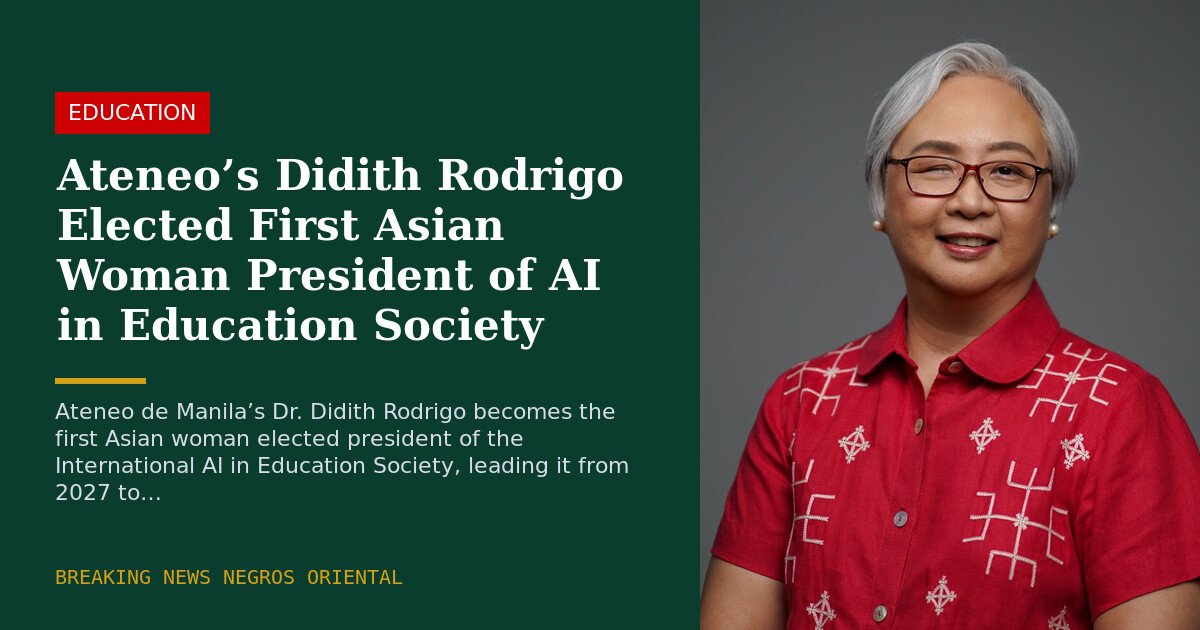
For the first time in its history, the International Artificial Intelligence in Education (IAIED) Society will be led by an Asian woman — and she is Filipino. Dr. Maria Mercedes “Didith” T. Rodrigo of Ateneo de Manila University was elected to the society’s presidency, the university announced in a press release dated October 15, 2026.
A Historic Election
Ateneo de Manila University called the election a milestone for the institution and for the Philippines. Dr. Rodrigo has been affiliated with the IAIED Society since 2007, representing nearly two decades of involvement in global AI-education research, according to the university’s Research Communications Section.
Her presidential term is set to run from 2027 to 2029.
About the IAIED Society
According to Ateneo de Manila University, the IAIED Society has a membership exceeding 1,500 researchers drawn from 40 countries. The society brings together specialists working at the crossroads of computer science, education, and psychology, and counts scholars from institutions such as Carnegie Mellon University, the University of Pennsylvania, University College London, and the University of Hong Kong among its ranks.
Who Is Dr. Didith Rodrigo?
Dr. Rodrigo holds a faculty position in the Department of Information Systems and Computer Science (DISCS) at Ateneo de Manila University. She also heads the university’s Laboratory for the Learning Sciences and co-heads the Ateneo Virtual, Augmented and Mixed Reality Lab.
Her research interests cover AI in education, learning analytics, and educational games. A central theme in her work, the university noted, is AI and equity — examining how teachers, students, and schools in countries like the Philippines can realistically access and benefit from artificial intelligence tools.
The Ateneo press release noted that Dr. Rodrigo considers the AIED community deeply formative to her career and views the presidency as an opportunity to give back to the network that has supported her work.
Research on AI in Philippine Classrooms
A notable strand of Dr. Rodrigo’s recent work focuses on how AI is — and is not — being used in Philippine public schools. In 2024, she collaborated with fellow researcher May Marie P. Talandron-Felipe on a study conducted in partnership with the Second Congressional Commission on Education (EDCOM 2).
The study gathered interviews from 48 Philippine public-school teachers. As reported by Ateneo de Manila University, the findings revealed that while teachers showed genuine interest in AI tools, they also cited limited familiarity with how to use them effectively, inadequate equipment, and unreliable internet connectivity as significant obstacles.
Based on those findings, Rodrigo and Talandron-Felipe called for sustained teacher training, appropriate technological tools, and the continued involvement of human judgment in decision-making — conditions the university describes as essential for deploying AI meaningfully in resource-constrained classrooms.
By the Numbers
- 1,500+ members in the IAIED Society
- 40 countries represented in the society’s membership
- 48 Philippine public-school teachers interviewed for the 2024 EDCOM 2 study
- 2007 — the year Dr. Rodrigo first joined the IAIED Society
- 2027–2029 — her term as IAIED Society president
Why This Matters
With Dr. Rodrigo’s election, a Filipino researcher will lead an international society spanning 40 countries — the first Asian woman ever to do so. Her body of work, including the 2024 interviews that documented the real barriers facing public-school teachers, directly confronts the gap between AI’s promise and the practical limitations faced by under-resourced educational systems.
Source: Ateneo de Manila University Research Communications Section
Photo: Ateneo de Manila University (CC BY-NC-ND 4.0)
Related stories