
Standfirst: NORECO II publishes a rotational interruption schedule and the word people miss is possible. It is a contingency, not a plan — and understanding the difference tells you whether to expect an outage at all.
Service areas verified 30 August 2026. Rotation groups are deliberately not listed below: they are set per advisory and change, so the only reliable source for your group is the advisory itself.
The schedule is conditional
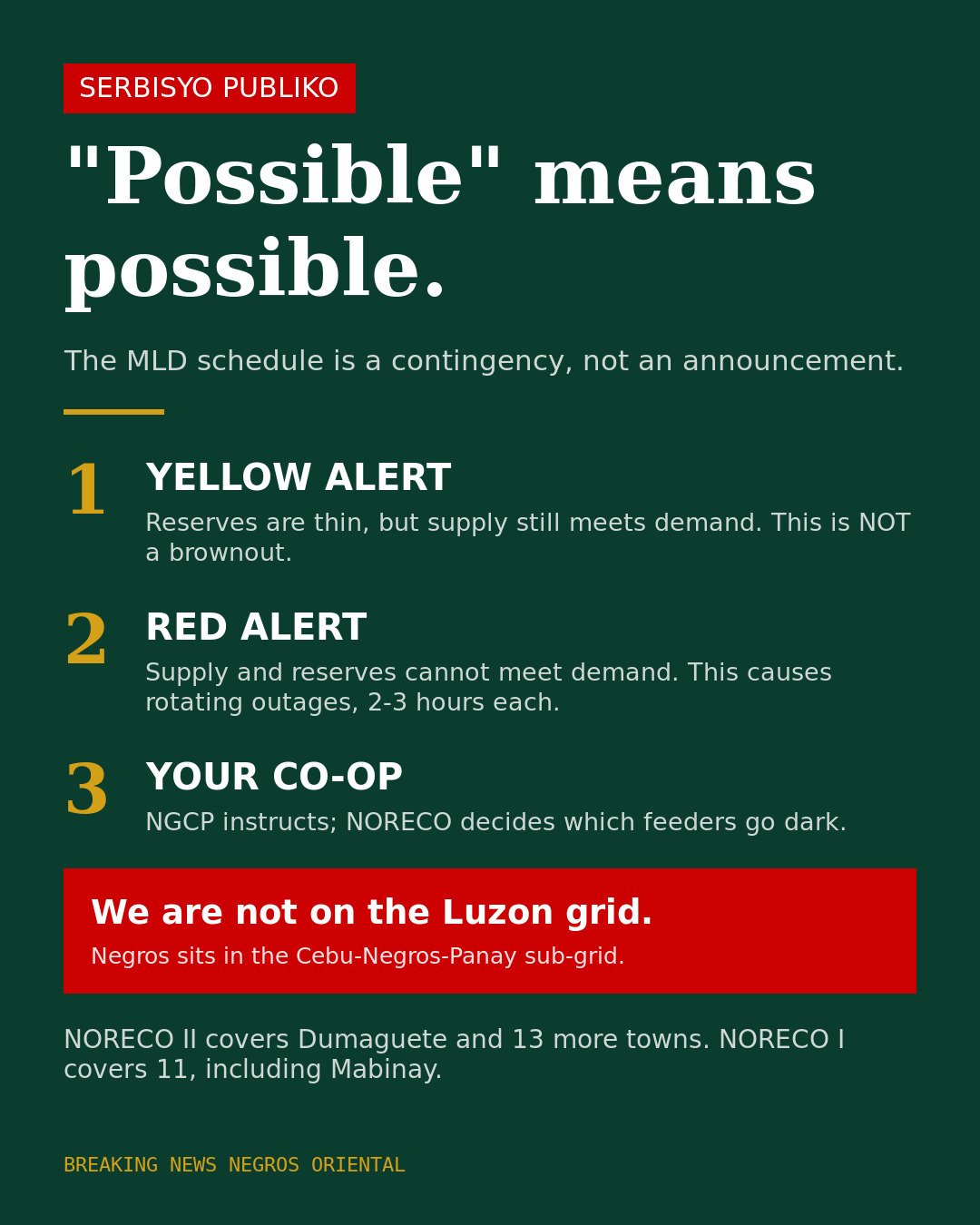
When you see a NORECO II advisory headed “possible schedule in the event of Manual Load Dropping”, it is not announcing an outage. It is publishing what would happen if the National Grid Corporation of the Philippines instructs the cooperative to shed load.
If NGCP does not issue that instruction, the schedule does not run. This is the single most common misreading, and it is why people report a brownout that never came.
Yellow alert and red alert are not the same thing
These two terms drive everything, and they are routinely confused.
Yellow alert means the grid’s operating reserve — the spare capacity held back in case a plant trips offline — has fallen below the safe margin. Supply still meets demand. A yellow alert is not a brownout and does not by itself cause one. It means the system has little room to absorb another failure.
Red alert is the highest level, declared when available supply and operating reserves are together insufficient to meet demand. This is the condition that leads to load dropping.
So: yellow is a warning about margin. Red is a shortfall. Only red produces rotational outages.
One important confusion to avoid. “Red alert” is used by two different agencies here and means two unrelated things. The NGCP red alert above is about electricity supply. A red alert raised by civil defence — the Office of Civil Defense–Negros Island Region, or the provincial and municipal disaster offices — is about a hazard such as a storm, flooding or Kanlaon’s activity, and is the kind that leads to class suspensions and evacuations.
A civil-defence red alert over the Negros Island Region does not mean a brownout is coming, and an NGCP red alert does not mean classes are suspended. Check which agency issued it before assuming what it affects.
What Manual Load Dropping actually is
Manual Load Dropping, or MLD, is the deliberate cutting of power to selected areas on a rotating basis, ordered so that demand falls back into line with supply. It exists to stop a partial shortfall becoming a total grid collapse, which takes far longer to recover from than a scheduled interruption.
Distribution utilities — NORECO II here — are instructed to shed a specified amount of load. They meet that instruction by rotating outages between groups of feeders, which is why your barangay appears in a group with a time window.
Each rotation typically runs about two to three hours, depending on grid conditions.
How to read the advisory
- “Possible” — contingent on an NGCP instruction that may not come.
- Group number — which rotation block your area sits in. Groups are defined per advisory rather than fixed, so read them off the current notice rather than assuming last month’s grouping still holds.
- Time window — the block during which your group would be dropped, not a guarantee it will be dropped for the whole window.
Which cooperative is yours
Negros Oriental is served by two cooperatives, and following the wrong one means missing your own advisories.
NORECO II covers 14 cities and municipalities: Dumaguete City, Sibulan, Valencia, Bacong, Dauin, Zamboanguita, Siaton, Santa Catalina, Bayawan City, Basay, Pamplona, Amlan, San Jose and Tanjay City. Facebook: facebook.com/NORECO2Official · Website: noreco2.com.ph
NORECO I covers 11: Bais City, Manjuyod, Bindoy, Ayungon, Tayasan, Jimalalud, La Libertad, Vallehermoso, Guihulngan City, Canlaon City and Mabinay. Facebook: the Negros Oriental I Electric Cooperative page, “Basta Maayong Serbisyo NORECO UNO” · Website: noreco1.com
The split is not simply north and south. NORECO II runs down the eastern coastal belt from Tanjay through Dumaguete and around to Bayawan and Basay in the southwest; NORECO I takes the north and the interior, including Mabinay.
Both post advisories to Facebook first. The grid operator, NGCP, publishes its own alerts, but for a household the cooperative’s page is the operative one: NGCP instructs, the cooperative decides which feeders go dark.
We are not on the Luzon grid
National coverage of brownouts is usually about Luzon, which is a separate system. Negros sits in the Cebu–Negros–Panay (CNP) sub-grid, and our alerts move independently.
In one recent instance NORECO II relayed an NGCP request to reduce demand on 8 August 2026 between 6:01 p.m. and 10:00 p.m., citing limited generation in the CNP sub-grids — a demand-reduction appeal, which sits a step below load dropping.
A red alert over Luzon is not a reason to expect a brownout in Dumaguete. A CNP alert is.
Why the water sometimes goes too
An outage can take your water with it. Pumping stations run on electricity, so a power interruption in the wrong place can cause a water service interruption in areas that are not themselves without power. If you lose water during a brownout, the two are probably connected. The utility here is Metro Dumaguete Water, and its free Pahibalo Text Advisory will tell you before the tap does — see our separate guide to water interruptions in Dumaguete.
Practical response
Charge devices and store water before the earliest window in the schedule, not at the start of your own group’s window — if load dropping begins, earlier groups go first and the queue can move.
Treat the published window as the outer bound of the disruption rather than a fixed appointment.
Sources: NGCP grid alert definitions and load-dropping advisories; NORECO II public advisories including the 8 August 2026 CNP demand-reduction notice; NORECO I public advisories; Department of Energy distribution-utility records; prior Breaking News Negros Oriental reporting on NORECO II interruptions and the May 2026 southern Negros Oriental transmission failure.