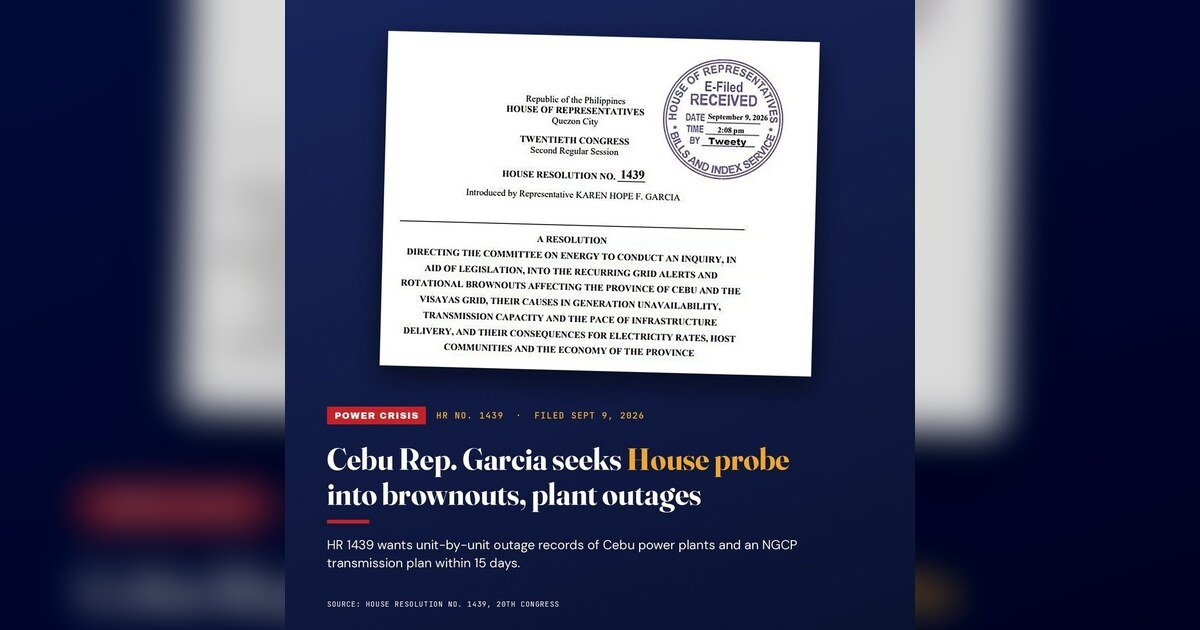
Electricity consumers across Cebu and the broader Visayas region may finally get congressional attention on the persistent brownouts and climbing power rates that have disrupted daily life throughout 2026. Cebu Third District Representative Karen Hope F. Garcia formally filed House Resolution No. 1439 on September 9, 2026, calling on the House Committee on Energy to conduct a full legislative inquiry into the causes and consequences of the Visayas power supply crisis.
According to SunStar, the resolution was electronically submitted to the House Bills and Index Service at 2:08 p.m. on September 9 — coinciding with the very day the National Grid Corporation of the Philippines (NGCP) declared a red alert over the Visayas grid that ran from 1 p.m. to 10 p.m., with a yellow alert extending until 11 p.m. that evening.
What the Resolution Seeks to Investigate
HR 1439 frames its inquiry around three interconnected problem areas: the unavailability of generation capacity, the adequacy and pace of transmission infrastructure, and the downstream effects on electricity rates and local economies. Garcia said in a social media statement that the investigation would compel power plant operators and grid managers to account for what is actually happening inside their facilities — and whether the costs of those failures are being shouldered by ordinary electricity consumers.
“The public deserves complete transparency and accountability. We need to establish the ground truth behind these blackouts,” Garcia said, as quoted in her official statement.
The representative warned that should electricity rates climb from the current ₱11 per kilowatt-hour to nearly ₱19 per kWh — a scenario that recent industry reports have raised — households would effectively be absorbing the financial consequences of operational failures and inadequate planning by power companies.
By the Numbers
- 94 yellow alerts recorded on the Visayas grid from January to September 4, 2026, per NGCP data cited in HR 1439
- 31 red alerts recorded over the same period
- 8 generating plants on forced outage as of September 4, with 17 others operating at derated capacity
- Approximately 815.8 megawatts unavailable to the Visayas grid on September 4; 818.9 MW unavailable on September 7
- 971 MW of generation capacity reported unavailable by NGCP’s head of System Operations–Visayas on September 4
- Cebu’s system peak demand stands at approximately 1,400 MW, based on Department of Energy five-year statistics
- The transmission grid grew by only 8 percent from 2009 to 2022 — from 19,425 to 21,027 circuit-kilometers
- 37 transmission projects flagged by the Energy Regulatory Commission on June 14, 2023, with delays ranging from 21 to 2,561 days
- 175 show-cause orders issued by the DOE to generation companies in 2026 over reporting violations
- Host community financial benefit raised from ₱0.01 to ₱0.03 per kWh effective January 2026 under DOE Department Circular No. DC2025-10-0023
- Visayan Electric’s residential rate held at ₱14.90 per kWh in July 2026 instead of the projected ₱17.59, following an ERC-approved deferment
Toledo City Power Plants at the Heart of the Crisis
Much of the resolution’s scrutiny falls on Toledo City, which sits within Garcia’s congressional district and hosts two major baseload power facilities — plants operated by Therma Visayas Inc. (TVI) and Cebu Energy Development Corp. (CEDC). HR 1439 documents a series of forced outages and capacity deratings in 2026 involving these facilities.
As cited in the resolution, CEDC Unit 1 (rated at 82 MW) returned to service on September 5, 2026. However, as of September 7, NGCP’s dispatch records listed TVI Unit 1 (169 MW) as completely unavailable, while TVI Unit 2 was running at a derated output of only 146.2 MW. Panay Energy Development Corp. Unit 3, with a rated capacity of approximately 150 MW, was also offline. On September 7, the grid entered red alert status between 6 p.m. and 7 p.m., with yellow alerts covering the periods from 3 p.m. to 6 p.m. and again from 7 p.m. to 9 p.m. Rotational brownouts in parts of Cebu that day stretched to approximately 2.5 hours.
The resolution further notes that Cebu accounts for roughly half of the entire Visayas grid’s electricity demand, based on NGCP’s own statements, making supply disruptions in the province a system-wide concern rather than a local one.
NGCP Transmission Delays Under the Microscope
HR 1439 directs the Energy Committee to require NGCP to submit a written acceleration plan for transmission projects serving Cebu within 15 days of receiving the committee’s directive. The plan must detail each project’s critical path, outstanding permits and rights-of-way, the specific parties accountable for each approval, and the earliest realistic completion date.
The Energy Regulatory Commission (ERC) has previously penalized NGCP for delays on several key projects, including the Cebu–Negros–Panay 230 kV Backbone, the Cebu–Lapu-Lapu Transmission Project, and the Naga (Cebu) Substation Upgrading. The Cebu–Leyte 230 kV Interconnection Lines 3 and 4 Project carries phased completion targets of 2031, 2033, and 2035, while the existing Leyte–Cebu interconnection link carries only about 200 MW per circuit. Imports from Mindanao during the recent crisis were limited or unavailable.
Rate Relief, Billing Adjustments, and Cooperative Protections
The inquiry would also examine consumer-side financial impacts. The ERC approved a billing deferment for Visayan Electric’s July 2026 customers, holding the residential rate at ₱14.90 per kWh rather than allowing a projected ₱17.59 rate to take effect — with the difference to be collected in future billing cycles. HR 1439 asks the committee to determine whether electric cooperatives across Cebu could receive similar relief, and what financial support mechanisms — including assistance from the National Electrification Administration — would be needed to prevent cooperative operations from being impaired.
The resolution also directs a review of the ERC’s August 13, 2026 order, which found erroneous Line Rental charges in the Wholesale Electricity Spot Market and required the recomputation of affected billing settlements going back to June 26, 2021.
Legislative Options and Generation Company Accountability
Among the policy outcomes the inquiry may produce is a statutory framework requiring mandatory outage reporting by generation companies, public disclosure of restoration timelines, and escalating sanctions for repeated or prolonged non-compliance. The DOE has already issued 175 show-cause orders to power generators in 2026 and has publicly discussed a three-strike approach that could ultimately result in recommendations for blacklisting companies with repeated violations after due process.
The inquiry would also consider measures to expedite transmission buildout and to protect critical facilities — including hospitals, water utilities, and evacuation centers — from being subjected to manual load dropping during grid emergencies.
Additionally, HR 1439 directs a review of whether generation companies in Garcia’s district are properly remitting and allocating funds under Section 66 of the Electric Power Industry Reform Act (EPIRA), covering the Electrification Fund, Development and Livelihood Fund, and Environment Enhancement Fund — obligations that were strengthened when the per-kWh host community benefit was raised from ₱0.01 to ₱0.03 effective January 2026.
Other Visayas Representatives Join the Push
Garcia’s filing is part of a widening legislative response to the Visayas power supply problem. According to SunStar, Negros Oriental Third District Rep. Janice Degamo had earlier filed House Resolution 1114 in June, seeking an Energy Committee inquiry specifically into the region’s recurring grid alerts, power interruptions, and sudden plant shutdowns.
Deputy Speaker Alfredo Abelardo Benitez of Bacolod has pursued a separate investigation through the House Committee on Visayas Development. Inquirer.net reported that brownouts in some parts of the region have ranged from roughly one hour to as long as nine hours. Negros Occidental Third District Rep. Javier Miguel Benitez has announced plans to file a resolution addressing, among other concerns, the ₱1.04 per kWh charge consumers pay for backup power, as reported by The Manila Times.
The DOE has set a target of resolving the persistent grid alerts before the Christmas season. The Cebu Provincial Government, meanwhile, has scheduled an energy summit for October 7, 2026. Copies of HR 1439 are to be furnished to the DOE, the ERC, NGCP, and other relevant agencies and market operators.
Why This Matters
The Visayas power supply crisis — marked by 94 yellow alerts and 31 red alerts in under nine months — reflects systemic gaps in both generation reliability and transmission infrastructure that have direct consequences for millions of electricity consumers. If left unaddressed, the risk of further rate escalation from ₱11 toward ₱19 per kWh would place a severe financial burden on households and businesses already absorbing the costs of rotational brownouts. Congressional scrutiny through HR 1439 and parallel resolutions signals legislative intent to establish accountability mechanisms, pursue structural reforms, and prevent the continued pass-through of operational failures to consumers.
Source: SunStar
Related stories