Military forces from the Philippines, United States, Australia, and New Zealand conducted an intensive coastal defense demonstration on April 27, 2026, showcasing integrated amphibious assault countermeasures at Aborlan’s Apurawan Beach Landing Site in Palawan.
The comprehensive training operation, designated as Counter-Landing Live Fire Exercise West (CLLFX-West) under Exercise Balikatan 41-2026, focused on neutralizing simulated enemy amphibious assault scenarios targeting Philippine shorelines. Participating forces demonstrated advanced techniques for identifying, disrupting, and eliminating hostile maritime landing attempts through coordinated multi-service operations.
The Philippine Marine Corps’ 3rd Marine Brigade spearheaded the exercise, welcoming senior military leadership from participating nations to observe sophisticated littoral warfare tactics crucial for regional maritime security.
Comprehensive Defensive Framework Demonstrated
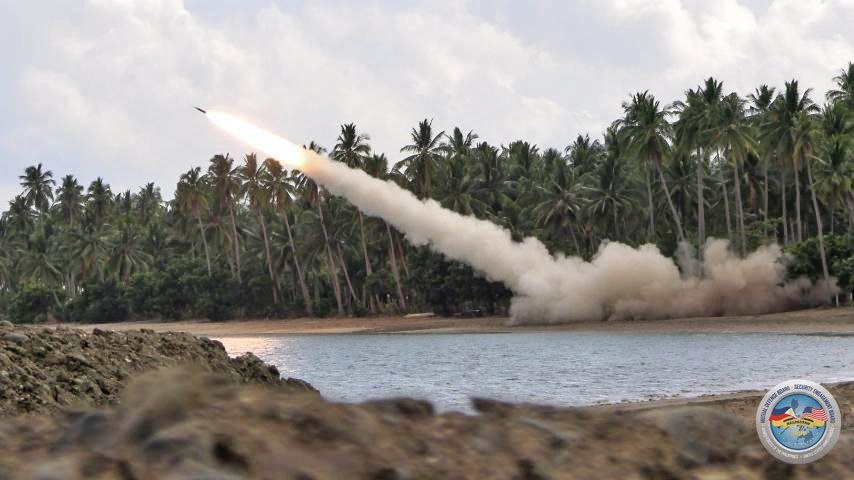
Operations featured an integrated defensive strategy combining aerial, terrestrial, and indirect fire systems across multiple operational domains. Philippine Air Force FA-50 fighter aircraft delivered air interdiction missions, while United States forces showcased High Mobility Artillery Rocket System (HIMARS) long-range strike capabilities.
Coordinated ground operations integrated artillery batteries, mortar teams, light armored reconnaissance vehicles, and anti-tank weapon systems. Precision engagement protocols supported by intelligence gathering assets created an overlapping defensive umbrella specifically designed to counter seaborne assault threats.
Infantry weapons platforms and heavy machine gun positions formed integral components of the defensive matrix, illustrating seamless cooperation between Philippine military branches and international allied forces operating in complex coastal terrain. The demonstration emphasized synchronized coordination between domestic and foreign military units under challenging littoral operational conditions.
Senior Military Officials Witness Training Operations
AFP Chief of Staff General Romeo S. Brawner Jr. attended the live fire demonstration alongside other senior defense leaders. Western Command Commander Vice Admiral Alan M. Javier also observed the proceedings, emphasizing the exercise’s critical importance for Philippines’ coastal defense preparedness.
Distinguished international observers included U.S. Army 25th Infantry Division Commander Major General James Bartholomees and U.S. Joint Task Force Balikatan 2026 Commander Major General Thomas Savage. U.S. Navy Expeditionary Strike Group THREE Commander Rear Admiral Brent DeVore participated as an honored guest.
The assembly of high-ranking military officials from multiple allied nations emphasized the training exercise’s vital role in reinforcing regional security alliances and showcasing collaborative maritime defense capabilities.
Civilian Protection Operations Integrated
Military planners incorporated humanitarian assistance scenarios through simulated Non-Combatant Evacuation Operations (NEO) at Sitio Bubusawin and Sitio Long Point locations. This training component illustrated military capability to maintain defensive operations while simultaneously safeguarding civilian populations.
Collaborative community engagement initiatives were executed with Aborlan municipal government and Barangay Apurawan officials, showcasing the AFP’s comprehensive mission encompassing both national defense and civilian assistance responsibilities. These activities demonstrated successful integration of military operations with local community cooperation.
The civilian protection element reflected contemporary military strategic thinking that prioritizes population safety during security operations, showing how modern armed forces balance defensive readiness with community support obligations.
Marine Leadership Outlines Coordinated Defense Principles
Philippine Balikatan 41-2026 Spokesperson Marine Colonel Dennis Hernandez articulated the training exercise’s strategic value for protecting national coastlines through unified operational procedures. Colonel Hernandez emphasized demonstrated capabilities for threat identification, engagement, and elimination through combined response mechanisms.
“This Counter-Landing Live Fire Exercise showcases our ability to protect Philippine territories through synchronized, multi-service operations in coastal environments,” Colonel Hernandez declared. He stressed how combining firepower from terrestrial, aerial, and naval sources enables rapid response to potential shoreline security breaches.
Colonel Hernandez noted that effective beach defense demands complete integration among military services and international partnerships rather than depending on isolated units or single operational domains. The training demonstrated how precision timing, rapid deployment, and coordinated overwhelming force protect coastal populations and national sovereignty.
Regional Maritime Security Implications
The Palawan training location holds considerable strategic value for regional maritime security given its geographic proximity to South China Sea shipping lanes. The site offers realistic training conditions for coastal defense scenarios while demonstrating allied dedication to maintaining regional stability.
Exercise Balikatan 41-2026 continues decades of military partnership between the Philippines and allied nations, emphasizing improved interoperability and joint operational effectiveness. The counter-landing component specifically targets modern security challenges within maritime operational environments.
Multi-national involvement illustrates how regional partnerships address sophisticated security situations requiring coordinated responses from diverse military services and international allied forces. Such training exercises develop mutual confidence and operational familiarity necessary for effective emergency response capabilities.
Sophisticated Military Technology Integration
Training operations featured integration of cutting-edge military systems from all participating nations, including advanced artillery platforms, precision-guided ordnance, and synchronized air-ground tactical operations. U.S. HIMARS deployment showcased extended-range strike capabilities complementing Philippine defensive installations.
Philippine FA-50 fighter aircraft delivered close air support and interdiction missions, demonstrating seamless integration between airborne assets and ground-based defensive systems. Multi-platform coordination illustrated modern combined arms methodologies for coastal protection operations.
Anti-tank weapon systems and light armored vehicles provided mobile defensive capabilities, while artillery and mortar installations delivered sustained fire support coverage. This weapons system integration demonstrates modern military capacity to establish comprehensive defensive networks utilizing diverse technological assets.
Photo credit: Photo courtesy of Philippine Armed Forces Public Affairs Office
Related stories