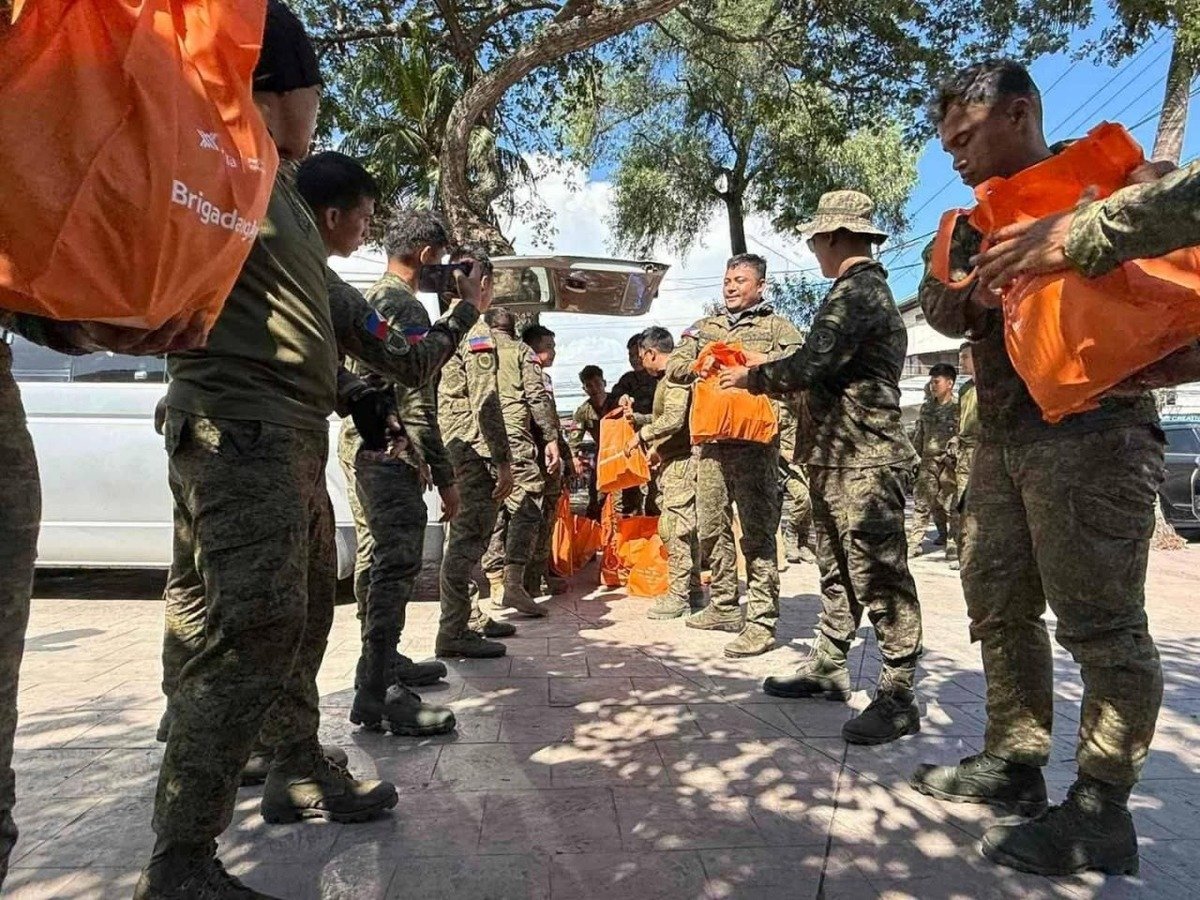
Two days after a powerful magnitude 7.8 earthquake rocked Mindanao on June 8, 2026, the Philippine Army had mobilized at least 253 active personnel across affected areas as of June 10, with more than 600 additional soldiers prepared to join operations at a moment’s notice.
Colonel Louie G. Dema-ala, Chief Public Affairs of the Philippine Army, confirmed in an official statement that the deployment includes a specialized 18-member Urban Search and Rescue (USAR) team conducting Search, Rescue and Retrieval (SRR) operations at a collapsed supermarket in Barangay Calumpang, General Santos City. Several individuals remain unaccounted for beneath the rubble at that site, according to Colonel Dema-ala’s statement.
The combined force committed by the Army to the disaster response now exceeds 860 personnel — the 253 currently deployed plus 607 on stand-by alert — reflecting the breadth and severity of the damage wrought by one of the strongest earthquakes to strike the Philippines in recent memory.
USAR Team Digs Through Collapsed Supermarket in General Santos
The collapsed commercial structure in Barangay Calumpang, General Santos City, has emerged as one of the most critical sites in the ongoing response effort. The Philippine Army’s USAR team began operating at the location on June 10, 2026, deploying technical equipment and trained rescue specialists to work through the debris in search of trapped survivors or the remains of those reported missing.
Urban Search and Rescue units are specifically trained for operations inside structurally compromised buildings, using methods and tools designed to safely navigate unstable rubble while minimizing further risk to both rescuers and potential survivors. The June 10 deployment at the Calumpang supermarket marks a continuation of efforts initiated immediately after the June 8 seismic event.
General Santos City, a major urban center within the Soccsksargen region of Mindanao, sustained considerable structural damage from the earthquake. As a magnitude 7.8 event — classified as a major earthquake under international seismological standards — the June 8 quake was powerful enough to compromise buildings across wide swaths of the region, particularly older structures not built to modern earthquake-resistance standards.
Air Evacuation Brings Four Rescued Residents Off Balut Island
The geographic complexity of the disaster response became evident in a separate operation involving Balut Island, located at the southernmost tip of Davao Occidental. Army troops and coordinating units carried out an air casualty evacuation (CASEVAC) to transport four rescued residents from the remote island to medical facilities on the mainland.
According to the Philippine Army’s public affairs office, Balut Island’s isolated location made aerial evacuation the most practical and timely option for moving the survivors. The CASEVAC operation highlights the logistical demands of responding to a disaster that spans not only dense urban areas like General Santos City but also far-flung island communities where road access is nonexistent and maritime travel may be disrupted by post-quake conditions.
Davao Occidental falls within the broader impact zone of the June 8 earthquake, and the inclusion of island communities such as Balut in the Army’s operational scope underscores how widely the effects of the magnitude 7.8 quake have been felt across Mindanao’s diverse geography.
AFP Named Lead Agency for All Search and Rescue Operations
The Office of Civil Defense (OCD) has formally designated the Armed Forces of the Philippines (AFP) as the lead agency overseeing all Search and Rescue operations in the wake of the June 8 earthquake, the Philippine Army’s public affairs office reported. This formal designation grants the AFP coordination authority over multiple government agencies, local government units (LGUs), and civilian response teams operating throughout the affected zones.
The arrangement is consistent with protocols established under the National Disaster Risk Reduction and Management Act, which outlines the AFP’s responsibilities in large-scale disasters necessitating a unified military and civilian response. By centralizing coordination under the AFP, the OCD aims to prevent duplication of efforts and ensure that rescue teams and resources are deployed where they are needed most urgently.
The Philippine Army stated it is working in close coordination with national government agencies and LGUs to ensure that search and rescue operations at collapsed buildings proceed without delay, and that displaced families are reached with humanitarian assistance as quickly as possible.
Over 860 Soldiers Committed to Ongoing Disaster Response
With 253 personnel actively engaged in the field and 607 additional troops on stand-by alert as of June 10, 2026, the Philippine Army has dedicated a combined force of more than 860 soldiers to the Mindanao earthquake response. According to the Philippine Army, the stand-by contingent can be rapidly deployed should new distress signals emerge, additional collapsed structures be identified, or previously inaccessible areas become reachable as conditions on the ground evolve.
The scale of the military commitment reflects how seriously authorities are treating the disaster. At magnitude 7.8, the June 8 earthquake ranks among the most powerful to hit the Philippines in recent years. Earthquakes of that magnitude are capable of causing catastrophic damage to infrastructure — collapsing buildings, severing roads, and knocking out utility services — particularly in communities where older construction methods were used.
Disaster response protocols recognize the first 72 hours following a major earthquake as the most critical window for locating and extracting survivors. The Army’s sustained operations on June 10 — precisely 48 hours after the initial quake — align with that standard, as rescue teams work urgently to find anyone still alive beneath collapsed structures.
Coordination with LGUs Targets Aid for Displaced Families
The Philippine Army’s role in the Mindanao disaster response extends beyond search and rescue. According to Colonel Dema-ala’s statement, the Army is also coordinating with local government units to ensure that families displaced by the earthquake receive humanitarian assistance in a timely manner.
Collapsed homes, damaged infrastructure, and disrupted utility services commonly force large numbers of residents into evacuation centers or makeshift temporary shelters in the aftermath of major seismic events. The Army’s involvement in aid distribution complements ongoing rescue work, ensuring that communities affected by the quake are not left without support while rescue operations remain active.
Colonel Dema-ala’s June 10 statement did not include a specific count of displaced households or detail the exact nature of the aid being delivered. Updated figures on casualties, displaced persons, and damage are expected to be released by the OCD and relevant national agencies as assessments are completed across the affected areas.
Philippines’ Position on the Ring of Fire Compounds Quake Risk
The Philippines lies along the Pacific Ring of Fire, a zone of intense tectonic activity that makes the country one of the most earthquake-prone nations on Earth. Mindanao in particular has a documented history of major seismic events, several of which have resulted in significant casualties, widespread infrastructure destruction, and prolonged humanitarian emergencies — especially in remote communities where emergency services are slow to arrive.
The June 8, 2026 earthquake at magnitude 7.8 is a stark reminder of that persistent vulnerability. As operations continue and the full scope of damage is determined, the Philippine Army’s Public Affairs Office has committed to releasing further updates as developments unfold on the ground.
As of the June 10, 2026 statement from Colonel Dema-ala, the 18-member USAR team remained actively engaged at the Barangay Calumpang supermarket site in General Santos City, pressing forward through the debris in the hope of bringing survivors — or answers — to the families of those still missing.
Photo credit: Photo from S7, 525 CEBn, CER / Philippine Army
Source: Originally reported by breakingnewsnegrosoriental.com / wire reports
Related stories