
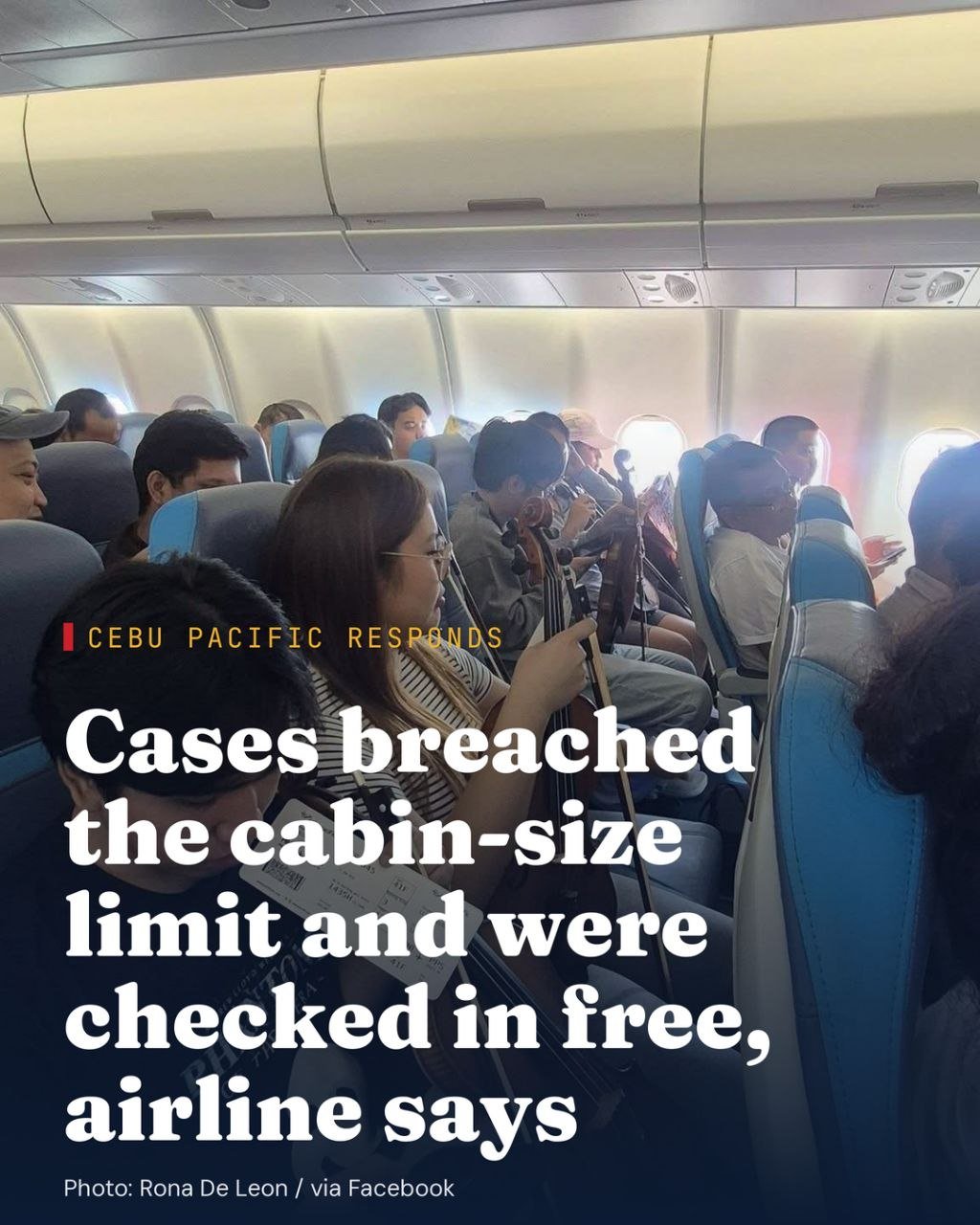
A confrontation at a Ninoy Aquino International Airport boarding gate has placed budget carrier Cebu Pacific at the center of a growing public controversy, after nine musicians from the Manila Symphony Orchestra were compelled to carry their violins without protective cases aboard a June 17, 2026 flight — one instrument reportedly shielded by nothing more than cling film.
The episode has since exploded across social media, sparking sharp criticism from the Philippine arts community, cultural advocates, and ordinary passengers who say the airline’s handling of professional musicians and their instruments was deeply misguided.
What Happened at the NAIA Boarding Gate
According to a Facebook post by MSO violinist Rona De Leon, the nine orchestra members were stopped by Cebu Pacific ground staff just before boarding their flight on June 17. Airline personnel told the musicians that their hard-shell violin cases were too large to be brought into the aircraft cabin under the carrier’s standard hand-carry baggage rules.
De Leon wrote in her post that the group had traveled on numerous domestic and international carriers in the past — always with their instruments — and had never been turned away at the gate over case dimensions until this incident. She described it as an unprecedented experience for the orchestra.
Images shared alongside De Leon’s account showed musicians holding their bare, unprotected violins in the boarding lounge. One violin, according to the post, was wrapped in cling film as makeshift protection. Those photographs spread rapidly across platforms, drawing immediate and widespread reaction.
Cebu Pacific’s Explanation and Defense
The airline issued a formal response on June 18, 2026, defending the conduct of its airport personnel. Cebu Pacific said in a statement that all nine musicians were ultimately permitted to board and completed their journey as originally scheduled, and that no one had been denied travel.
The carrier explained that some of the violin cases fell within its standard cabin hand-carry limit of 56 by 36 by 23 centimeters and were allowed into the cabin without issue. For the cases that exceeded those measurements, Cebu Pacific said it offered what it described as a practical workaround: the oversized empty cases were checked into the cargo hold at no additional charge, while the violins themselves were permitted as hand-carry items.
Cebu Pacific maintained in its statement that this arrangement ensured all passengers could continue their trip without paying extra fees, framing the outcome as a reasonable resolution to a policy conflict at the gate.
Airline Says Instruments Were Not Pre-Booked as Special Baggage
A central element of Cebu Pacific’s position is that none of the MSO passengers had pre-registered their instruments as special baggage before the flight. The airline noted that it provides a Special Baggage booking option at the time of ticket purchase, intended for travelers carrying oversized or non-standard items — including musical instruments — that cannot be accommodated under normal cabin allowances.
Cebu Pacific advised passengers in its statement that using this advance booking option is the correct procedure to guarantee cabin space for such items and avoid gate-level complications. The airline did not address whether its ground staff had clearly communicated this policy to the musicians during the incident, nor whether the Special Baggage option is prominently displayed when passengers purchase tickets.
MSO Declares It Will No Longer Book With the Carrier
De Leon’s Facebook post also carried a clear declaration: the Manila Symphony Orchestra intends to stop flying with Cebu Pacific following this experience. She described the airline’s handling of the situation as unacceptable given the nature of the instruments at stake.
The decision carries weight. Professional-grade violins — particularly those belonging to members of an ensemble with the MSO’s standing — can be worth tens of thousands of dollars, and in exceptional cases, far more. For working musicians, keeping an instrument in the cabin during air travel is not a preference but a professional necessity. Cargo holds expose instruments to physical impact, temperature extremes, and rough handling that can cause irreparable damage.
Founded in 1926, the MSO describes itself as the longest-surviving artistic institution in the Philippines and one of the oldest continuously operating orchestras in Asia, according to the orchestra’s own public communications. The public nature of the dispute has given it added resonance within the country’s cultural community.
A Broader Policy Problem for Philippine Performing Artists
The NAIA gate incident has reignited a longstanding debate about how Philippine low-cost carriers accommodate professional musicians on domestic routes. Arts advocates argue that standard cabin baggage dimension rules, while practical for most travelers, are inadequate for professionals whose instruments are both fragile and essential to their livelihood.
This friction between budget airline operational policies and the needs of touring artists is not confined to the Philippines. Carriers around the world have faced comparable disputes, and a number of international airlines have responded by creating formal instrument-in-cabin policies — allowing small string instruments to be stored in overhead bins, or permitting musicians to purchase an additional seat for their instrument, provided safety requirements are met.
In the Philippines, where orchestras and performing ensembles travel domestically with increasing frequency for regional concerts and cultural engagements, the absence of a clear, standardized instrument policy across local carriers has become a recurring source of friction. The MSO incident has amplified calls from within the industry for the Civil Aeronautics Board or other relevant government bodies to consider establishing minimum national standards for how musical instruments are handled on Philippine domestic flights.
Online Reaction Keeps Pressure on the Airline
The rapid viral spread of De Leon’s post and the accompanying photographs continued to generate significant public attention as of June 18, 2026. Musicians, educators, cultural workers, and members of the general public filled comment sections and shared threads criticizing the airline’s response as tone-deaf given the artistic and monetary value of the instruments involved.
Many online commenters drew direct comparisons to airline policies elsewhere in Asia, Europe, and North America, where established carriers have made formal accommodations for musicians traveling with instruments — either through dedicated overhead bin policies or the option to reserve an adjacent seat for the instrument at a reasonable fare.
As of the date of Cebu Pacific’s statement on June 18, no further official communication had been issued by the airline, and no announcement of any policy review or change had been made in connection with the incident.
Advice for Passengers Traveling With Instruments on Cebu Pacific
Based on Cebu Pacific’s June 18 statement, the airline recommends that any passenger planning to travel with a musical instrument that may exceed standard cabin dimensions declare and book that item under the Special Baggage option at the time of reservation. According to the carrier, completing this step in advance secures a designated space for the item and reduces the risk of complications when boarding.
Cebu Pacific has not announced any adjustments to its existing baggage policies as a result of the MSO dispute, nor has it signaled whether it will review how its gate staff handle passengers traveling with professional musical instruments in the future.
Originally reported by: wire reports