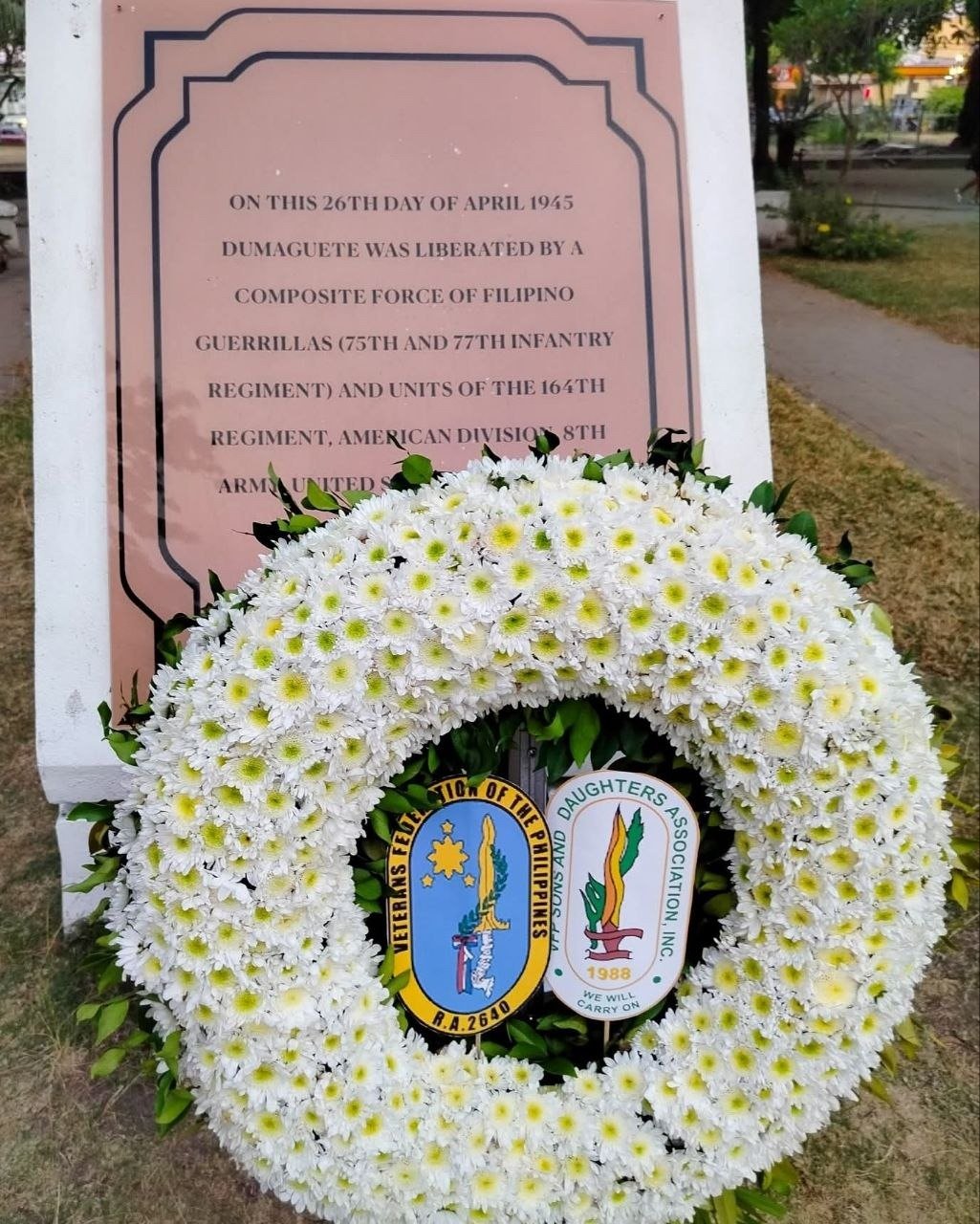
A solemn ceremony at Quezon Park on Sunday, April 26, 2026, commemorated eight decades since Dumaguete City’s freedom from Japanese Imperial forces, as community members gathered at 7:00 a.m. to remember the Filipino guerrillas and American troops whose joint efforts ended nearly three years of occupation on that same date in 1945.
The morning observance brought together the community’s remaining connections to that pivotal historical moment — widows and widowers of World War II veterans, post-war service members, and descendants of those who fought. These families transformed the official ceremony into an intimate remembrance, as generations touched by war gathered on the very ground their ancestors helped liberate.
Joint Operation Brought City’s Freedom
A collaborative military effort between Filipino guerrilla forces and United States Army units achieved Dumaguete’s liberation. The commemorative marker at Quezon Park records: “On this day 26th of April 1945 Dumaguete was liberated by a composite force of Filipino guerillas (75th and 77th Infantry Regiment) and units of the 164th Regiment, American Division, 8th Army, United States.”
Historical records show that on April 26, 1945, surviving elements of the 164th Infantry Regiment landed at Sibulan, approximately five miles north of Dumaguete, where they met with a Reconnaissance Troop from the 40th Division before launching their assault within two days against the 1,300-member Japanese garrison positioned in strategic hill locations around the city.
Col. Salvador Abcede commanded the 7th Military District guerrilla forces, which approached from the southern direction and joined the American battalions in the successful campaign to recapture the provincial seat.
Occupation Began in 1942
The liberation on April 26, 1945, brought closure to an ordeal that started almost three years before. Japanese Imperial forces had arrived in Dumaguete on May 26, 1942, following the Philippines’ fall, leading to the swift surrender of the entire Negros Oriental Province.
Opposition to the occupying forces persisted through guerrilla organizations operating from mountain strongholds, where numerous local civilians had sought refuge from enemy patrols. During this period, young men throughout Dumaguete and the broader Negros Oriental region enlisted in clandestine resistance movements.
Notable among these fighters was Maj. Galicano L. Sibala, who completed his business administration degree at Silliman University in 1941 and served as an advanced cadet officer in the university’s ROTC program. Like countless young Filipinos of his era, he was called to service during World War II and eventually commanded United States Armed Forces in the Far East (USAFFE) units operating in Negros Oriental.
Fighting Continued Beyond Liberation Date
Although April 26 represents Liberation Day, military conflict in southern Negros persisted for additional months. Extended combat followed as two American battalions from the 164th Infantry Regiment, supported by local 7th Military District guerrillas, tracked Japanese forces into remote areas.
Significant combat operations lasted until May 28, 1945, when Japanese defensive positions in the hills were overrun and Filipino guerrilla units took over cleanup duties. American forces from the 164th Infantry Regiment ceased their pursuit of Japanese troops by mid-June 1945, having received orders to deploy to Cebu for potential operations against Japan itself.
The final Japanese holdouts in Zamboanguita’s remote areas surrendered on September 22, 1945, following news of Japan’s official capitulation on September 2, 1945.
Honoring Veterans and Rebuilders
Sunday’s commemoration acknowledged both the valor of military personnel who secured the city’s freedom and the determination of families who reconstructed Dumaguete from wartime devastation. The post-liberation generation confronted destroyed infrastructure, displaced communities, and the enormous challenge of reconstruction — efforts that established the foundation for today’s thriving provincial capital.
The ceremony emphasized how families who survived the occupation and subsequent rebuilding phase contributed to the city’s recovery. Their sacrifices extended far beyond military service to encompass years of reconstructing homes, enterprises, and community organizations damaged or destroyed during three years under enemy control.
New Generation Inherits Unity Legacy
As the 81st anniversary observance ended, organizers stressed that the cooperation which freed Dumaguete in 1945 — combining Filipino and American, military and civilian, guerrilla and conventional forces — represents the city’s most valuable heritage.
With living World War II veterans now almost entirely gone, the duty of remembrance has officially transferred to their spouses, children, and grandchildren. The presence of these family members at Sunday’s ceremony showed their ongoing dedication to preserving the memory of those who served.
Provincial Capital’s Strategic Liberation
Dumaguete’s liberation carried special significance as Negros Oriental’s provincial capital. The successful cooperation between American military units and Filipino guerrilla forces established a template for similar liberation campaigns throughout the Philippines during World War II’s closing months.
The participation of local educational institutions, especially Silliman University through its ROTC program, demonstrated how academic communities supported the war effort and ultimate liberation of their city.
The commemoration functioned as both historical remembrance and an appeal to current and future generations to preserve the cooperative spirit and bravery that defined the liberation campaign. Organizers stressed that wartime values — unity among diverse groups, courage against overwhelming odds, and dedication to freedom — remain applicable to modern challenges.
As ceremony participants left Quezon Park, the enduring message was evident: the unified spirit that brought freedom to these shores eight decades ago continues to inspire Dumaguete City, and the memory of those who fought, died, and rebuilt will endure.