
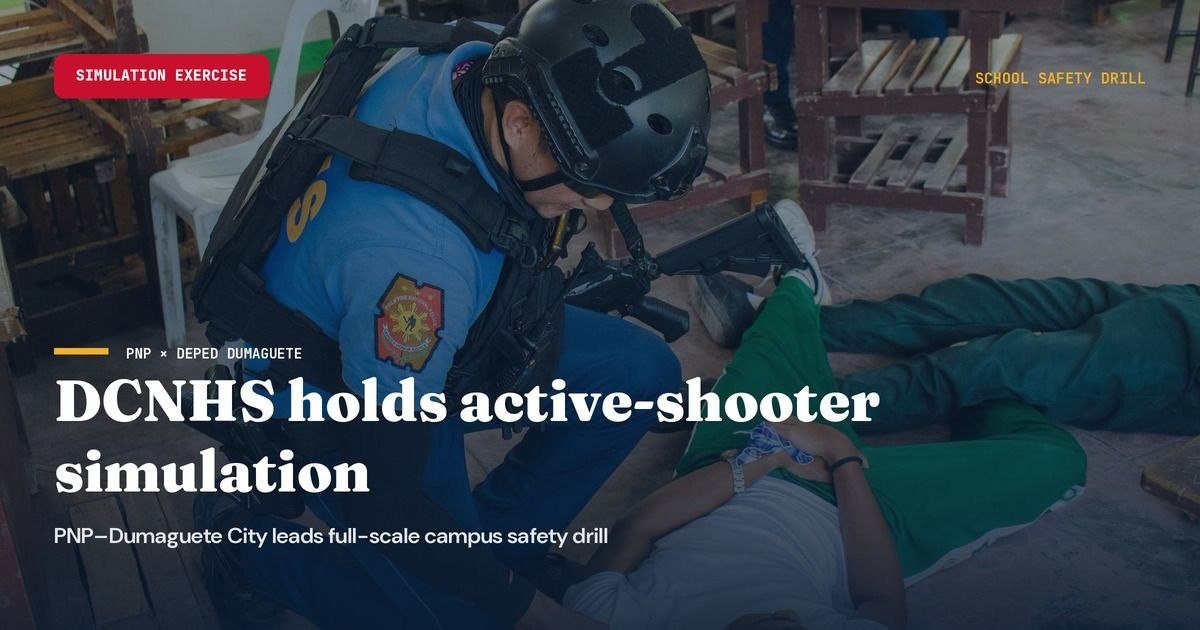
Following a deadly shooting at a Tacloban City public high school last month, Dumaguete City National High School (DCNHS) staged a full-scale emergency simulation on its grounds alongside the Philippine National Police–Dumaguete City — putting students, teachers, and staff through a live test of how the school community would respond to an armed threat on campus.
How the Drill Was Structured
The exercise was designed in two phases. Participants first attended a formal briefing covering threat recognition and step-by-step emergency response procedures, according to the Schools Division Office of Dumaguete City. That orientation was then immediately followed by a live simulation meant to stress-test those same protocols in real time — exposing coordination gaps and response weaknesses that no classroom lecture or written policy can reliably uncover on its own.
The combined format allowed learners, classroom teachers, non-teaching personnel, and other stakeholders to experience not just what they are supposed to do in an emergency, but whether they can actually execute those steps when confronted with a realistic, high-pressure scenario.
DCNHS Principal III Dr. Claudio A. Sun Jr. led the school’s participation in the drill, while PNP–Dumaguete City Chief of Police P/Col. Don Richmon T. Conag headed the police component of the exercise, the Schools Division Office confirmed.
Division Leadership Behind the Initiative
The activity falls under the school safety and emergency-preparedness program of the Schools Division Office of Dumaguete City, which is headed by Schools Division Superintendent Dr. Edmark Ian L. Cabio, CESO VI. The division framed the drill as part of a sustained commitment to keeping schools secure — not a one-time reaction to a single incident, but an ongoing institutional effort.
The exercise was also anchored in DepEd Negros Island Region’s PEACE Initiative — Powering Empathy, Acceptance, and Connection Every Day — a framework that situates physical school safety within a broader culture of caring, connection, and resilience. Under this approach, security measures are not treated as standalone protocols but as expressions of a school community’s collective responsibility to protect every learner and member of its personnel.
Tacloban Shooting Prompted a National Response
The immediate trigger for the DCNHS drill, and for similar exercises being rolled out in schools across the Philippines, was a shooting on June 22 at San Jose National High School in Tacloban City. According to reports from the Department of Education, the attack left three students dead and approximately 20 others wounded. It was carried out by two minor students and stands as one of the rarest incidents of its kind in Philippine school history.
The scale and nature of the Tacloban attack prompted swift action from the highest levels of government. President Ferdinand Marcos Jr., Education Secretary Sonny Angara, and PNP leadership all issued directives ordering schools nationwide to tighten campus entry and exit controls, conduct security assessments, and increase the visibility of law enforcement around school perimeters, the Department of Education reported.
DepEd Pushes Broader Safety Overhaul
While the Department of Education has characterised the Tacloban incident and related cases of school violence as isolated events, the department has publicly acknowledged that existing safety policies need stricter implementation and that schools must build closer ties with parents and local law enforcement agencies.
Among the measures being institutionalised nationwide, according to DepEd, are formal school safety audits, regulated entry and exit procedures, routine bag inspections, and formalised coordination arrangements between school administrators and local police units. The DCNHS drill was explicitly designed to build and validate precisely those kinds of readiness capacities at the ground level.
A Culture of Vigilance and Shared Responsibility
In the aftermath of the drill, the Schools Division Office of Dumaguete City extended its gratitude to the leadership of DCNHS, PNP–Dumaguete City, partner agencies, and all participants who took part in the exercise. Officials described the collaboration as a reflection of the kind of shared accountability that must underpin school safety going forward.
School officials said the drill embodies DepEd’s vision of learning environments that go beyond academic instruction — spaces where every student can grow in surroundings built on empathy, acceptance, genuine connection, and the assurance of physical safety. That vision, they said, requires active participation not just from administrators and security forces, but from every member of the school community.
By the Numbers
- 3 — Students killed in the June 22 shooting at San Jose National High School, Tacloban City
- ~20 — Number of other individuals wounded in the same Tacloban campus attack
- 2 — Minor students identified as the perpetrators of the Tacloban shooting
- June 22 — Date of the Tacloban City school shooting that triggered the nationwide campus security directive
Why This Matters
The Dumaguete City National High School drill is a direct, on-the-ground response to what the Department of Education has described as the deadliest campus shooting in recent Philippine memory, translating a national government directive into practiced emergency readiness at the school level. Live simulation exercises like this one are critical precisely because they surface real coordination failures and response gaps that written protocols and orientation lectures alone cannot detect. More broadly, the exercise demonstrates that keeping schools safe now demands active collaboration among education authorities, local law enforcement, and the entire school community — a shared responsibility model that DepEd is working to institutionalise across the country.
Source: Breaking News Negros Oriental / Schools Division Office of Dumaguete City