After more than a decade of absence, the social networking site that once defined Filipino digital culture has made an unexpected return to the country. Friendster officially relaunched in April 2026 as a completely reimagined mobile platform, targeting users who have grown weary of algorithm-driven social media experiences.
This revival comes through Friendster Labs Inc., which has taken the brand in an entirely new direction. The 2026 iteration abandons the features that made the original platform famous among Filipino millennials, instead focusing on intimate social circles formed through face-to-face interactions.
Revolutionary Design Philosophy
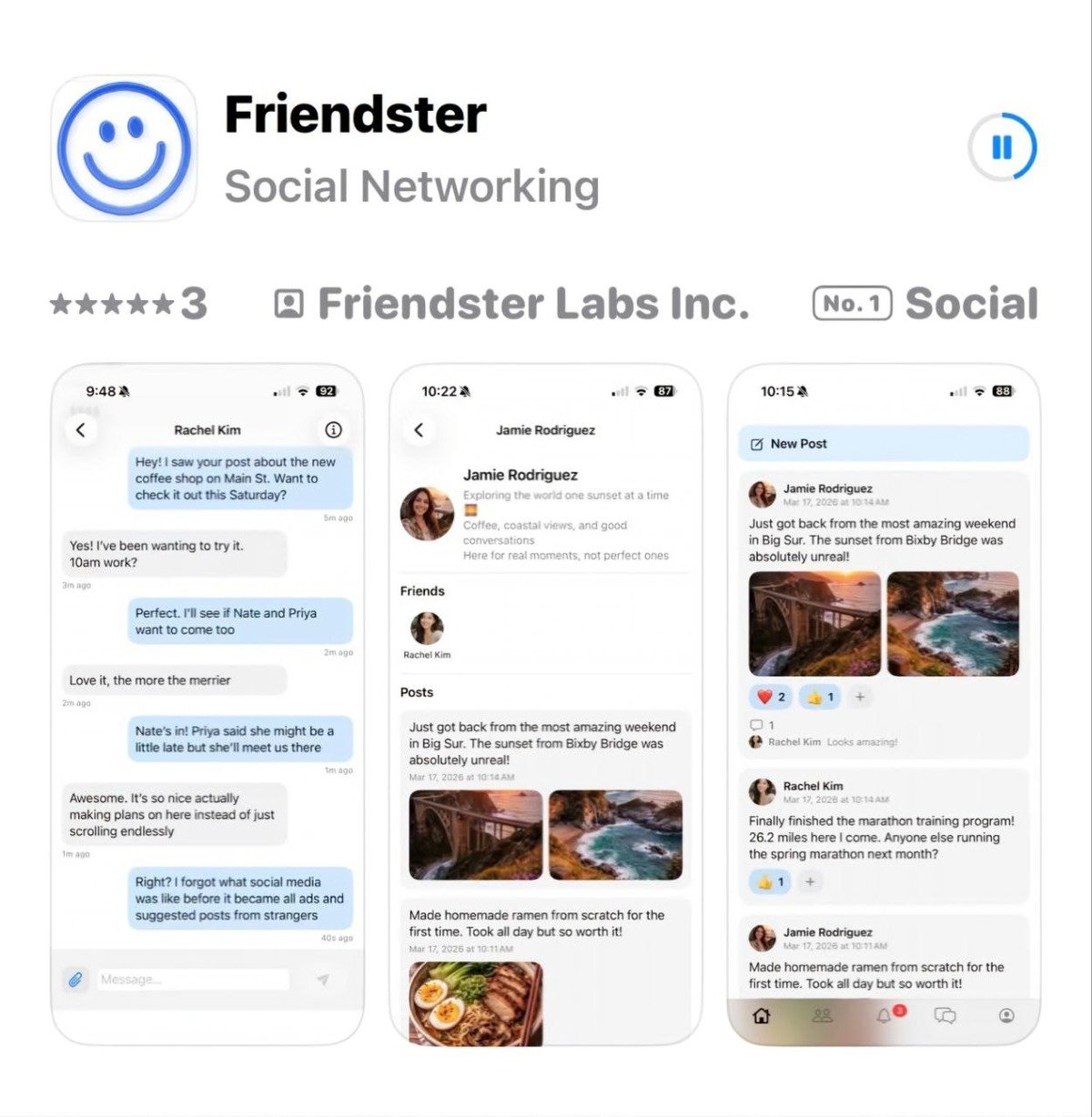
The reimagined platform deliberately rejects modern social media conventions. Users will find no targeted advertisements, sponsored posts, or engagement-optimized content feeds. Posts appear in simple chronological order, showing updates from actual friends without algorithmic interference.
Perhaps the most striking departure from contemporary social networking involves how users connect with others. The platform eliminates online friend requests entirely, requiring both parties to be physically present in the same location. Users must tap their smartphones together while running the application to establish connections.
This proximity-based system allows the network to expand organically through real-world social interactions. Users can view content and send messages to friends-of-friends, but the core network remains deliberately small and intentional.
Carson’s rebuilt version operates exclusively through iOS mobile applications, with no web browser access or Android compatibility currently available.
Acquisition and Development Background
Domain investor and programmer Mike Carson purchased the Friendster.com domain and associated trademark rights in 2025 for approximately USD 30,000. According to Carson’s development blog, the acquisition was finalized through Bitcoin payments and advertising revenue exchanges from domain portfolios.
The new ownership brought complete platform reconstruction rather than restoration of previous features. None of the original Friendster data, which disappeared when the service shut down in 2015, has been recovered or integrated into the current version.
Carson has emphasized that the 2026 Friendster intentionally abandons viral growth strategies in favor of sustainable, community-focused social networking.
Historical Impact on Filipino Internet Culture
Between 2003 and 2009, Friendster dominated Filipino social media landscapes, establishing the Philippines as one of its largest global user bases alongside other Southeast Asian markets. The platform preceded Facebook’s regional expansion, serving as the primary social networking destination for Filipino internet users.
Internet cafés throughout major cities like Manila, Cebu, and Bacolod regularly filled with students customizing their profiles after school. The practice of requesting testimonials, known colloquially as “pa-testi naman,” became embedded in Filipino online vocabulary.
Profile personalization represented early digital self-expression, with users investing considerable time in HTML modifications, background music selection, and elaborate layout designs. These customization features functioned as primitive personal branding tools in Filipino digital communities.
Facebook’s aggressive Southeast Asian market penetration around 2009 coincided with Friendster’s decline, as users migrated to the more feature-rich and mobile-compatible platform during the smartphone adoption period.
Access Requirements and Limitations
The iOS-exclusive launch creates significant barriers for Philippine market penetration, where Android devices maintain overwhelming market dominance across all economic demographics. This restriction immediately excludes the majority of potential Filipino users from accessing the platform.
Profile creation emphasizes minimalism over the elaborate customization that characterized the original platform. Users cannot embed HTML code, add background music, insert animated graphics, or recreate the aesthetic elements that defined early 2000s social networking culture.
Network building requires coordinated physical meetings between users. The platform prevents contact importing from other social networks, automated friend suggestions, or bulk connection processes that users expect from contemporary platforms.
New users must create profiles from scratch, as no historical data from the original Friendster has been preserved or made available for restoration.
Market Challenges and Technical Constraints
The physical proximity requirement for adding friends contradicts established Filipino social media behaviors, which prioritize rapid network expansion and viral content sharing across platforms like Facebook, TikTok, and Instagram.
Carson has not announced monetization strategies beyond potential premium features in future updates. The advertisement-free model raises questions about long-term financial sustainability as operational costs increase with user growth.
The platform’s anti-viral design philosophy conflicts with user expectations shaped by algorithmic content discovery and engagement-driven feeds on mainstream social networks.
No development timeline has been provided for Android compatibility, despite Android’s market dominance in the Philippines and other key Southeast Asian territories where Friendster historically maintained strong user bases.
Privacy and Security Features
Friendster Labs Inc. has committed to avoiding third-party data sales, positioning privacy protection as a competitive advantage against larger social media corporations. The platform explicitly rejects engagement-farming tactics and rage-inducing content strategies employed by mainstream networks.
Users should verify the application’s authenticity before downloading, as previous Friendster revival attempts included phishing schemes in 2022. The legitimate application appears in Apple’s App Store under Friendster Labs Inc., with a 6.5 MB file size and 13+ age rating.
Long-term Prospects and User Adoption
The Friendster brand carries substantial nostalgia value among Filipino millennials, potentially driving initial download numbers based on historical attachment alone. However, sustained engagement depends on users’ willingness to coordinate in-person meetings for network building.
Success metrics remain unclear, as traditional social media growth indicators like viral sharing and rapid user acquisition contradict the platform’s intentionally limited design philosophy.
The 2026 Friendster relaunch represents a strategic gamble that user fatigue with contemporary social media will create demand for simpler, more intentional online communities, despite sacrificing convenience and viral growth potential that define modern social networking expectations.
Photo credit: Courtesy of Friendster Labs Inc.