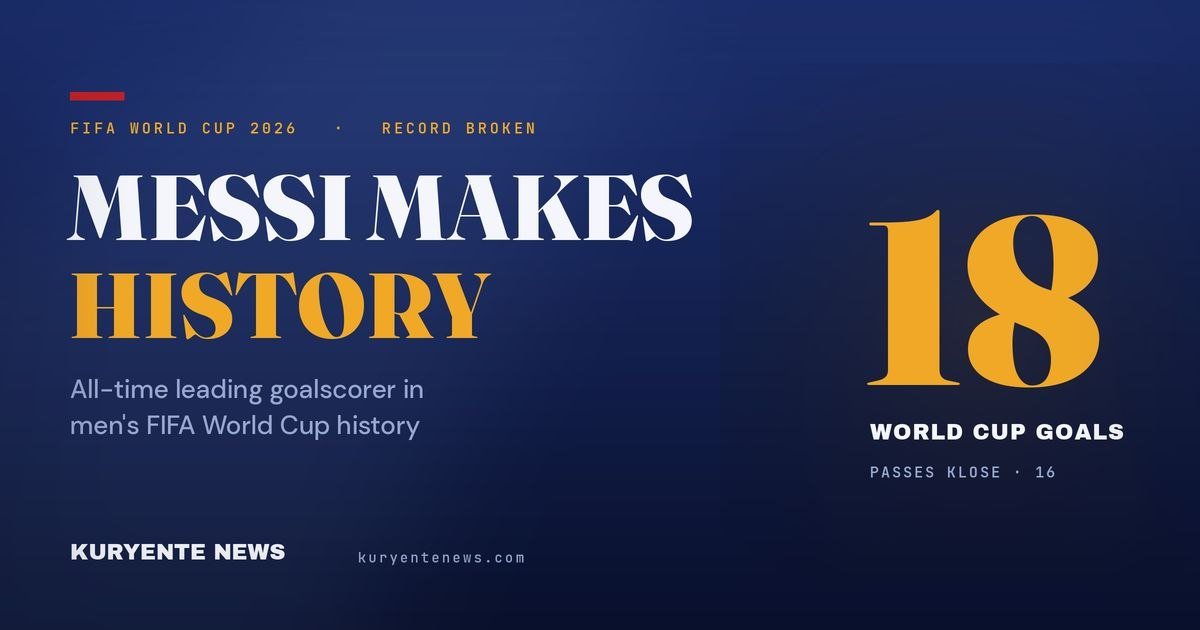
A 38-year-old man from Rosario playing in his sixth FIFA World Cup just rewrote the record books — again. Lionel Messi netted twice in Argentina’s 2-0 group-stage victory over Austria at Dallas Stadium in Arlington, Texas on Monday, June 23, 2026 (Philippine time), bringing his all-time FIFA World Cup goal tally to 18 and cementing his place as the tournament’s greatest individual scorer in the history of the competition.
The Record Falls in the 38th Minute
For much of the first half, it appeared the historic moment might be delayed. Argentina were awarded a penalty kick as early as the ninth minute, offering Messi the chance to draw level with Germany’s Miroslav Klose, who had held the men’s World Cup scoring record at 16 goals for 12 years. According to match officials and widely circulated broadcast footage, Messi stuttered in his approach and dragged the spot-kick wide of the bottom-right corner — a rare and costly miss that handed Austria a reprieve.
The European side took full advantage of the reprieve, pushing hard for the opening goal and subjecting Argentina to sustained pressure. Goalkeeper Emiliano “Dibu” Martínez was called into action on several occasions as Austria attempted to capitalise on their good fortune.
It was not until the 38th minute that Messi finally delivered. Receiving a cutback from Facundo Medina, he swept a first-time finish into the bottom corner with his favoured left foot — drawing level with Klose’s record of 16 goals at 16, then surpassing it entirely. The Argentine contingent inside Dallas Stadium erupted at the moment the ball crossed the line. A second goal, added deep in stoppage time, sealed both the win and a new benchmark of 18 World Cup goals.
Six World Cups, Two Decades, One Record
The magnitude of Monday’s achievement is inseparable from the sheer length of time it took to build. Messi scored his first World Cup goal on June 16, 2006, against Serbia and Montenegro in Germany — he was 18 years old at the time. That goal came exactly 20 years to the day before the match against Algeria on June 16, 2026, in which he completed the first hat-trick of his World Cup career, drawing level with Klose at 16 goals.
FIFA records confirm that Messi entered the 2026 tournament with 13 World Cup goals spread across five previous editions — 2006, 2010, 2014, 2018, and 2022. He has scored all five of Argentina’s goals at the current edition of the tournament and leads the competition’s individual scoring chart going into the knockout rounds.
By appearing in the 2026 tournament, FIFA confirmed that Messi became the first male player in history to compete in six FIFA World Cups, having featured in every edition from 2006 to 2026. His appearance against Austria was his 28th at the tournament, extending his own record for the most matches played by any individual at the World Cup.
Beyond the Men’s Game: A Record for All Time
The significance of Messi’s 18th goal is not limited to the men’s competition. According to FIFA statistics, the previous all-time World Cup scoring record across both the men’s and women’s tournaments was held by Brazil’s Marta, who had scored 17 goals across her career. Messi’s brace against Austria lifted him above that combined benchmark, making him the highest-scoring World Cup player of all time — regardless of competition or gender.
He also joined an exclusive group of players to have scored in six consecutive World Cups, alongside France’s Just Fontaine and Brazil’s Jairzinho, according to historical tournament records.
Physical and Personal Challenges Behind the Scenes
Reports circulating during the tournament indicate that Messi has been managing a hamstring concern throughout Argentina’s campaign. Sources close to the Argentine delegation have also indicated that his father is currently recovering from a health issue in Argentina, lending an added emotional weight to an already significant few weeks for the captain.
Those around him noted Messi was visibly moved following Argentina’s opening win over Algeria on June 16, the night he scored the hat-trick that first brought him within reach of Klose’s record. His composure in putting away the record-breaking goal against Austria — immediately following the missed penalty — drew widespread admiration from commentators and observers present at the stadium.
Adding further context to the timing of the achievement, Messi turns 39 years old on Wednesday, June 25, 2026 — two days after the record fell — making this one of the more remarkable birthday-week performances in the history of international sport.
What Messi Said After the Final Whistle
Speaking to reporters following Argentina’s victory, Messi focused his remarks on the collective effort rather than the individual milestone.
“Beyond anything, I’m so happy for the win. It was huge, tough and difficult. All matches in this World Cup are very even, very intense. I’m enjoying this moment and craving to enjoy it with my teammates.”
Argentina midfielder Alexis Mac Allister also addressed those who had questioned whether the squad could perform without over-relying on their ageing captain.
“If anyone thought this group was better off without Leo, today it became clear that Leo is the most important of them all.”
Argentina Advances; Eyes on Back-to-Back Title
The victory over Austria secured Argentina’s berth in the knockout rounds of the 2026 FIFA World Cup. According to tournament records, the defending champions are now pursuing what would be a historic back-to-back World Cup title — a feat no nation has managed since Brazil’s consecutive triumphs in 1958 and 1962.
Messi guided Argentina to their 2022 World Cup triumph in Qatar, ending a 36-year wait for the country’s third world championship. He is an eight-time Ballon d’Or winner and his nation’s all-time leading international goalscorer.
Mbappé the Most Likely Future Challenger
With Messi’s record now at 18 goals, attention has shifted toward who could realistically threaten that tally in the years ahead. France forward Kylian Mbappé, currently 27 years old, sits fourth on the all-time men’s World Cup scoring list with 14 goals from just 15 matches, according to FIFA records — a strike rate that positions him as the most credible long-term challenger.
However, analysts note that Mbappé would need to net at least five more World Cup goals to draw level with Messi’s current tally, requiring continued participation and performance across future tournaments before the mark can realistically be threatened.
With Argentina still in contention and the knockout stages just beginning, Messi retains the possibility of adding further to his tally — and potentially lifting a second consecutive World Cup trophy before what most observers expect to be the conclusion of his international career.
Source: Originally reported by wire reports / FIFA match records and broadcast sources