A province-wide citizen perception poll covering all cities and municipalities of Negros Oriental has produced a ranked list of more than 60 local councilors rated by residents on five governance dimensions during the January-to-March 2026 period, with the highest scorer reaching 91.70 percent and the tenth-tier group landing at 87.95 percent — a gap of under four percentage points across the entire top-ten field.
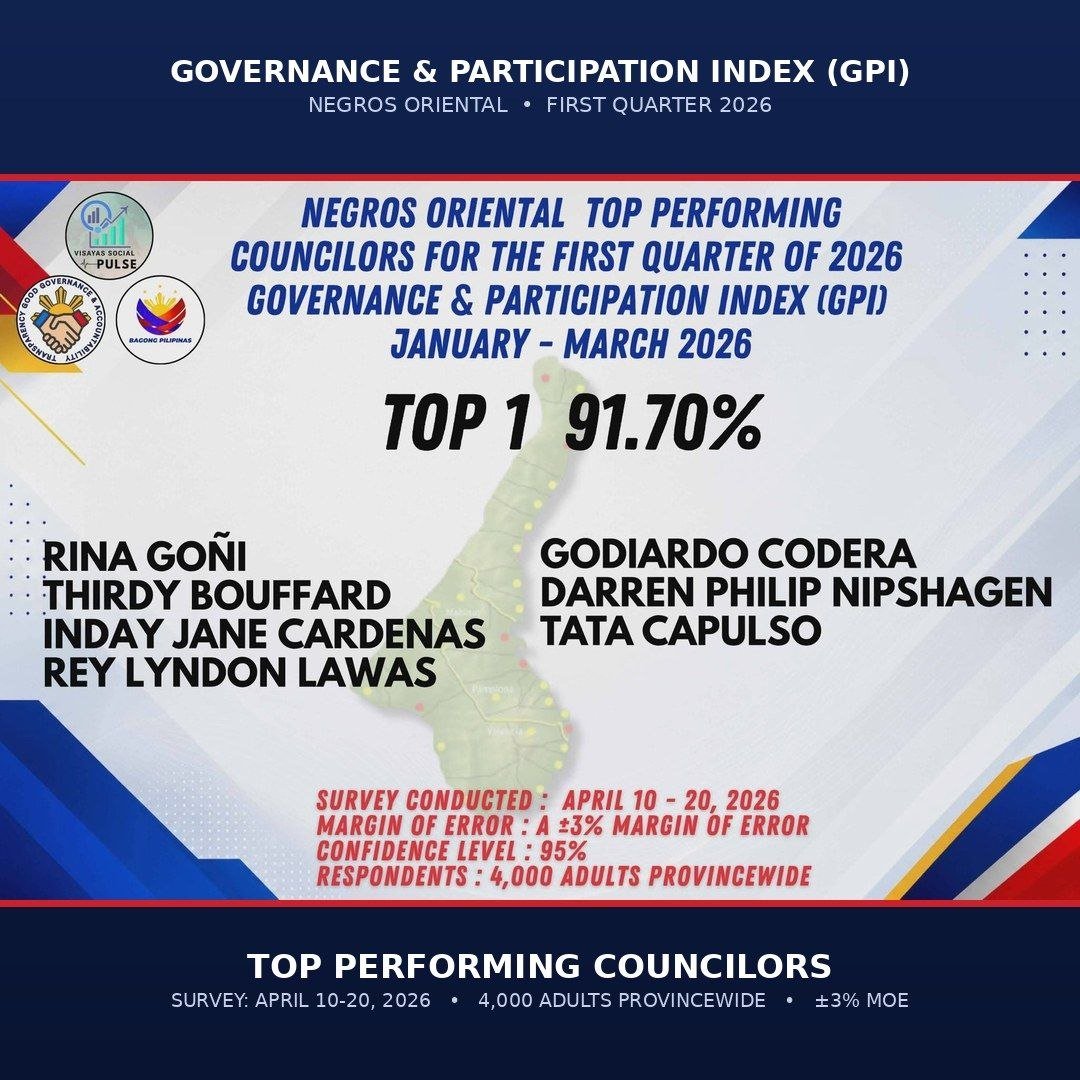
The poll was carried out jointly by Transparency, Good Governance and Accountability Advocates and Visayas Social Pulse under a framework called the Governance and Participation Index, or GPI. According to the two organizations, fieldwork ran from April 10 to 20, 2026, drawing responses from 4,000 adult participants selected from across Negros Oriental’s cities and municipalities. The margin of error is plus or minus three percent at a 95-percent confidence level, the groups stated in their published materials.
How the GPI Scoring Framework Works
According to Transparency, Good Governance and Accountability Advocates and Visayas Social Pulse, the Governance and Participation Index is built around citizen perception rather than institutional audits or self-submitted performance reports. The framework measures officials against five indicators: service delivery, accessibility, transparency, responsiveness, and constituent participation.
Trust ratings also factor into the scoring. The survey groups defined these as a gauge of how strongly constituents believe their elected officials act with integrity and genuine concern for public welfare. These trust measures are weighed alongside visibility metrics and project delivery assessments, the organizers explained.
In a statement published alongside the survey results, Transparency, Good Governance and Accountability Advocates and Visayas Social Pulse said: “Performance without trust is incomplete. The councilors who ranked highest this quarter are those who delivered results while earning the confidence of the people. That is the standard of leadership Negrosanons deserve.”
The two groups emphasized that respondents were drawn from every city and municipality in the province, which they described as producing a broadly representative picture of constituent opinion across Negros Oriental.
Three Key Findings Highlighted by the Organizers
Transparency, Good Governance and Accountability Advocates and Visayas Social Pulse identified three standout observations from the first-quarter data. The first finding was that the highest-ranking councilors earned their positions primarily through strong scores in efficient delivery of priority programs spanning peace and order, health services, education, livelihood support, and infrastructure initiatives advanced through legislation.
The second notable finding was that respondents expressed elevated confidence in officials perceived as accessible, open about public funds, and quick to respond to community concerns. High performance marks and strong trust ratings consistently appeared together among the leading officials, the groups reported.
Third, the survey organizers noted that participation came from respondents in all cities and municipalities of the province — a point they cited as evidence that the rankings reflect a genuinely representative cross-section of opinion rather than concentrated input from any single area.
Complete Ranked List: Top 1 Through Top 10 for Q1 2026
The following tier rankings and percentage scores are as published by Transparency, Good Governance and Accountability Advocates and Visayas Social Pulse in their official survey materials. Officials are listed by tier as released, without assignment to specific local government units.
Top 1 — 91.70%: Rina Goñi, Thirdy Bouffard, Inday Jane Cardenas, Rey Lyndon Lawas, Godiardo Codera, Darren Philip Nipshagen, and Tata Capulso.
Top 2 — 91.15%: Marife Cordova, Mikle Abing, Atty. Dino Abiera, Clark Serion, Jonah Alar, and Reynaldo Tuanda Jr.
Top 3 — 90.70%: Atty. Jim Gara, Harmon Balbon, Monika Gustillo, Charles Delmo, and Gino Mijares.
Top 4 — 90.25%: Bongbong Tadifa, Arnold Labe, Rene Gargoles, and Cocoy Nuico.
Top 5 — 89.75%: Aurelia Abayda, Bingbing Arbolado, Anna Mariot Ortega, Atty. RJ Banquerigo, Rap Rap Andaya, Rosemarie Tinguha, and Mark Aurelia.
Top 6 — 89.40%: Kim Opada, EJ Uy, Chester Lim, Clem Banua, Dingdong Ang, Gerald Jun Borromeo, and Woodtamm Maquiling.
Top 7 — 89.10%: JV Imbo, Glivin Gabate, Nestle Villacampa, Jonathan Dingal, Florante Partosa, and Jose Manuel Montebon.
Top 8 — 88.80%: Edmar Bigay, Franklin Esmeña, Elsie Dagoy, Glendon Nochefranca, and James Bryan Solitana.
Top 9 — 88.25%: Lisa Tinaco, Elma Zanisi, Sheila Ruiz, Jeffrey Villegas, Melbourne Bustamante, and Stanley Fortugaleza.
Top 10 — 87.95%: Megio Bimbong, Edwin Omoso, Pristine Abrio, Bruce Marquita, and Atty. Mark Banquerigo.
Scores across all ten tiers span from the 91.70-percent peak at the top position down to 87.95 percent at the tenth tier — a spread of fewer than four percentage points, which the survey materials indicate reflects a competitive and closely grouped field of high-performing local legislators for the January-to-March period.
GPI Positioned as Non-Partisan, Independent Accountability Mechanism
According to the published statement from both organizing groups, the GPI survey is designed to operate as an independent, non-partisan, and data-driven tool. Its stated purpose, as described by Transparency, Good Governance and Accountability Advocates and Visayas Social Pulse, is to give citizens a structured and formal channel through which they can evaluate the elected officials representing them at the local legislative level, promoting accountability, transparency, and participatory governance across the province.
The survey organizers did not disclose which specific cities or municipalities each ranked councilor represents. Published materials list officials by name and tier only, without identifying the local government units to which they belong.
It is worth noting that the GPI’s citizen perception methodology differs substantially from government-administered performance systems such as the Department of the Interior and Local Government’s Seal of Good Local Governance program, which relies on institutional compliance indicators rather than public sentiment scores.
Transparency, Good Governance and Accountability Advocates and Visayas Social Pulse have not, as of the time this report was prepared, released information regarding their organizational structure, funding sources, or prior survey publications.
Second Batch of Rankings and Next Survey Cycle Still Awaited
The current release, according to the two survey groups, covers only the Top 1 through Top 10 performing councilors for the first quarter of 2026. A follow-up report presenting the Top 11 to Top 20 results is expected to be released separately, though the organizers have not announced a specific date for that publication.
No details were made available by Transparency, Good Governance and Accountability Advocates and Visayas Social Pulse regarding the schedule for the second-quarter 2026 survey cycle, nor whether any changes to the GPI methodology are planned for future rounds. All rankings and figures cited in this report are drawn directly from materials released by the survey organizers.
Originally reported by: breakingnewsnegrosoriental.com