
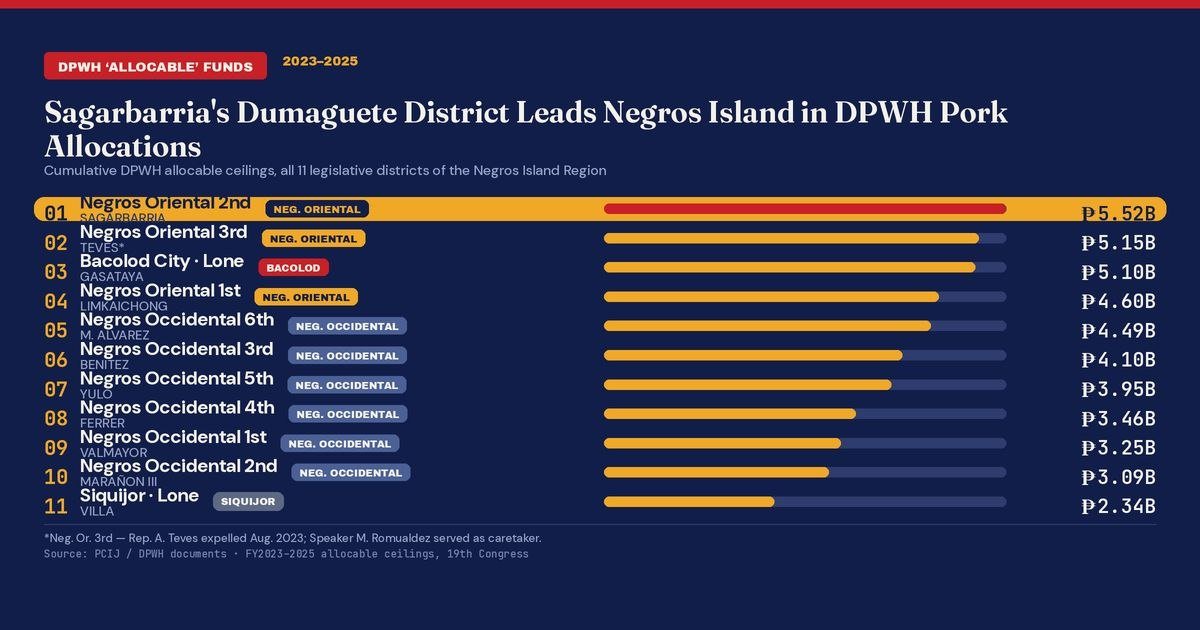
Documents obtained and verified by the Philippine Center for Investigative Journalism (PCIJ) reveal a striking imbalance in how the Department of Public Works and Highways distributed discretionary infrastructure funds across Negros Island’s 11 legislative districts between 2023 and 2025 — with the smaller, less populous Negros Oriental sweeping three of the top four positions in the regional ranking.
At the top of the list stands the 2nd District of Negros Oriental, which covers Dumaguete City and is represented by Rep. Manuel “Chiquiting” Sagarbarria. The district was assigned an allocable ceiling of approximately 5.52 billion pesos over the three-year period — the highest figure recorded for any single legislative district in the entire Negros Island Region, according to the PCIJ.
Understanding DPWH “Allocables”
The phrase “allocable funds” entered widespread public discourse during congressional hearings into a flood-control fund scandal that erupted earlier this year. Within DPWH’s internal budget framework, the PCIJ explained, allocables refer to discretionary spending ceilings assigned on a per-district basis — money that sitting legislators can direct toward infrastructure projects of their preference.
The People’s Budget Coalition and other critics have characterised this mechanism as pork barrel spending under a different name. Unlike the lump-sum appropriations that the Supreme Court struck down in 2013, the current system places the ceiling-setting power with the executive branch while leaving lawmakers with substantial discretion over actual project selection. Critics argue this arrangement is politically motivated and lacks sufficient transparency.
At the national level, the PCIJ reported that total DPWH allocable funds amounted to nearly 1.2 trillion pesos across the same three-year window. The two congressional districts receiving the largest national shares were Ilocos Norte’s 1st District, held by Rep. Sandro Marcos, and the district linked to House Speaker Ferdinand Martin Romualdez.
How All 11 Negros Island Districts Ranked
Based on PCIJ data, the cumulative allocable ceilings for the region’s 11 districts from 2023 to 2025 fell in the following order:
- Negros Oriental 2nd District (Rep. Sagarbarria) — approximately 5.52 billion pesos
- Negros Oriental 3rd District — approximately 5.15 billion pesos
- Bacolod City lone district (Rep. Greg Gasataya) — approximately 5.10 billion pesos
- Negros Oriental 1st District (Rep. Jocelyn Limkaichong) — approximately 4.60 billion pesos
- Negros Occidental 6th District (Rep. Mercedes Alvarez) — approximately 4.49 billion pesos
- The remaining five Negros Occidental districts — ranging downward to approximately 3.09 billion pesos, the lowest figure recorded for Rep. Alfredo Marañon III’s 2nd District
- Siquijor lone district (Rep. Zaldy Villa) — approximately 2.34 billion pesos, placing last among all regional districts
A Smaller Province With a Larger Slice
The numbers reveal what the PCIJ described as a striking inversion of conventional expectations. Negros Oriental — the smaller, less densely populated half of the island — dominated the top of the regional fund distribution rankings. All three of its congressional districts individually outranked every single district in Negros Occidental, a province with a considerably larger population and double the number of legislative seats.
The PCIJ drew a parallel to a national pattern it had also documented: Ilocos Norte’s 1st District, representing fewer than 320,000 constituents, was allocated nearly twice the DPWH allocable funds of Rizal’s 1st District — the most populous constituency in the country, with some 1.2 million residents. In both cases, the PCIJ data suggests that population size and measurable development need do not reliably predict how allocable ceilings are set.
Sagarbarria’s Role on the Appropriations Committee
According to his published biography and campaign materials, Rep. Sagarbarria held the position of vice chairperson of the House Committee on Appropriations — the legislative body principally responsible for shaping the annual national budget. The committee’s chairperson during the 19th Congress was Ako Bicol Rep. Elizaldy “Zaldy” Co, who has since become a central figure in an ongoing investigation into flood-control fund insertions.
A vice chairmanship on the Appropriations Committee places a lawmaker in direct proximity to the processes through which district-level budget allocations are determined. The PCIJ documents show that Sagarbarria’s district received the highest allocable ceiling in the entire Negros Island Region during the period in which he held that committee post.
The 3rd District and the Speaker’s Caretaker Role
The circumstances surrounding the Negros Oriental 3rd District add another layer to the picture. Its elected representative, Arnolfo “Arnie” Teves Jr., was expelled from the House of Representatives in August 2023 — the first sitting congressman to be removed since 1986 — in connection with the assassination case involving Governor Roel Degamo. During periods when Teves was under suspension, Speaker Romualdez served as caretaker of the district.
Despite that high-profile caretakership, the PCIJ data shows the 3rd District’s allocable ceiling of roughly 5.15 billion pesos still fell below Sagarbarria’s 2nd District figure of approximately 5.52 billion pesos.
Billions Allocated, Yet Infrastructure Gaps Persist
The PCIJ report situates these figures against a troubling backdrop. Even as billions of pesos in DPWH discretionary funds were directed toward Negros Oriental’s three districts over three years, the provincial government has separately pursued a 5.8-billion-peso loan package intended to finance medical infrastructure — including a district hospital, a proposed “medical city,” and solar street lighting.
According to the PCIJ, Negros Oriental currently has no international airport and no international seaport, and residents have characterised upland road networks as deteriorating and poorly maintained. The pronounced gap between the volume of discretionary infrastructure funds recorded on paper and the state of public works visible on the ground has prompted scrutiny over whether allocable ceilings ultimately translate into completed projects — and, if not, where the money goes.
By the Numbers
- ~5.52 billion pesos — Negros Oriental 2nd District (Rep. Sagarbarria) allocable ceiling, 2023–2025; highest in the Negros Island Region
- ~5.15 billion pesos — Negros Oriental 3rd District allocable ceiling; district was caretakered by House Speaker Romualdez during part of the period
- ~5.10 billion pesos — Bacolod City lone district (Rep. Gasataya)
- ~4.60 billion pesos — Negros Oriental 1st District (Rep. Limkaichong)
- ~3.09 billion pesos — lowest allocable among Negros Occidental districts (Rep. Marañon III, 2nd District)
- ~2.34 billion pesos — Siquijor lone district (Rep. Villa); last-ranked in the region
- ~1.2 trillion pesos — total DPWH allocable funds distributed nationwide over the three-year period, per PCIJ
- 5.8 billion pesos — provincial loan package sought for health and medical infrastructure during the same period
- 11 — total legislative districts in the Negros Island Region covered in the PCIJ analysis
Why This Matters
The PCIJ findings bring to light documented questions about the criteria governing the distribution of nearly 1.2 trillion pesos in national DPWH discretionary funds — specifically whether allocations reflect population size and infrastructure need, or instead track political positioning within the legislative budget process. The fact that Negros Oriental’s 2nd District, whose representative served as vice chairman of the House Appropriations Committee, received the largest regional share warrants closer examination of how these ceilings are determined.
The contrast between the volume of recorded allocable funds and the province’s acknowledged infrastructure deficits — including absent international transport links, deteriorating rural roads, and a multi-billion-peso loan sought for basic health facilities — underscores the need for stronger accountability mechanisms to ensure that DPWH allocable ceilings result in tangible, completed public works that serve constituents.
Source: Philippine Center for Investigative Journalism (PCIJ)