A powerful pyroclastic density current from Mayon Volcano, recorded at around 5:38 in the afternoon of May 2, 2026, sent law enforcement agencies into high gear across Albay province, as the Philippine National Police (PNP) launched an expanded emergency response to protect thousands of residents living within the volcano’s reach.
The volcanic surge — referred to locally as “uson,” a Bicolano word conveying danger — triggered an immediate and coordinated reaction from police units, who moved quickly to establish ground operations across communities most vulnerable to pyroclastic flows, ashfall, and other life-threatening hazards associated with the eruption activity.
Rapid Police Mobilization Across Albay
Police Regional Office 5 (PRO 5) wasted no time in deploying officers to critical points throughout the affected province. Among their first priorities was traffic management along major road arteries, ensuring that lanes remained clear for emergency vehicles responding to the disaster and for convoys carrying evacuees away from danger zones.
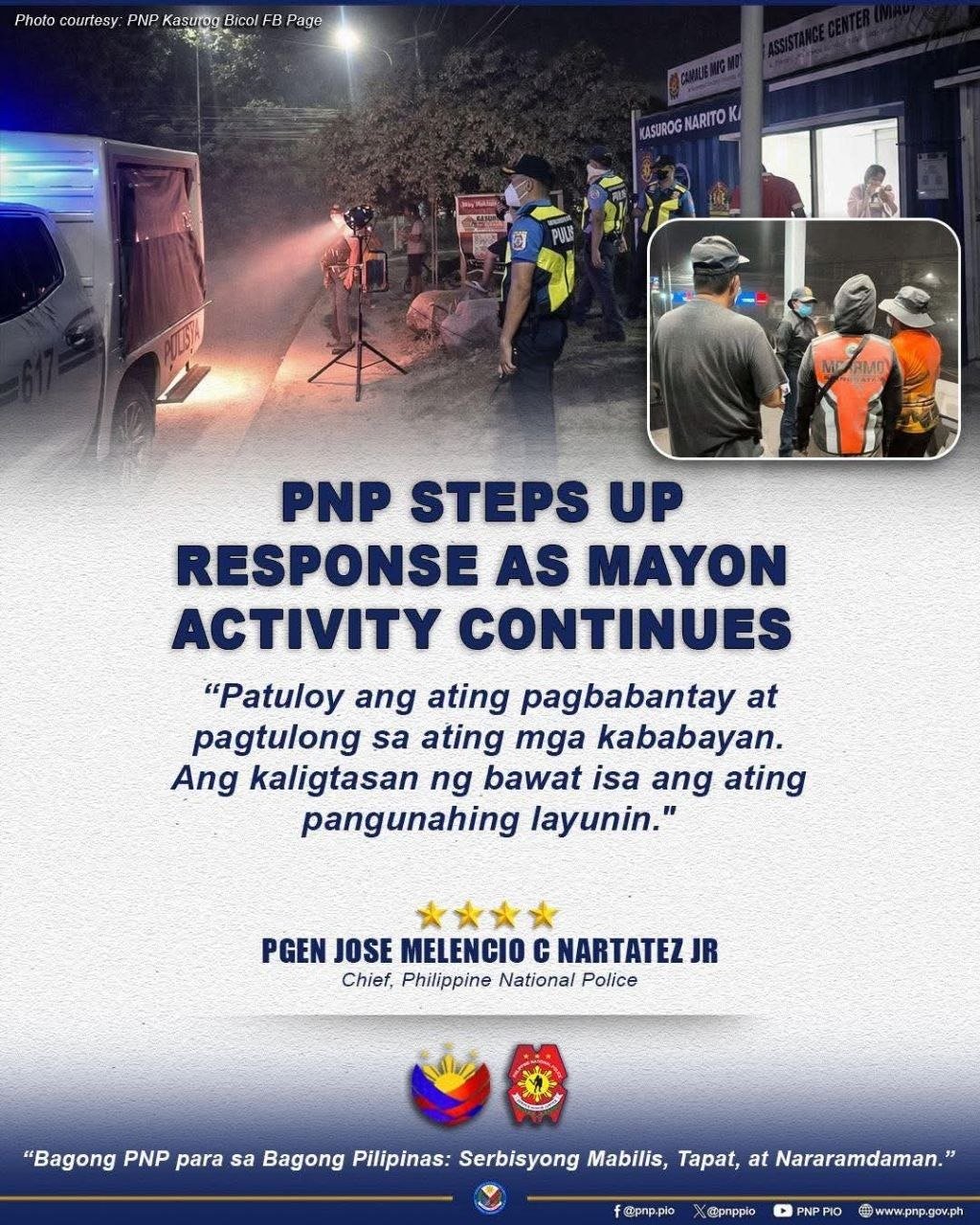
Beyond traffic control, officers have assumed broader roles that go well beyond conventional law enforcement duties. Police personnel have been actively distributing protective face masks to residents in ashfall-affected communities and providing health advisories on how to minimise exposure to volcanic debris and deteriorating air quality — a hands-on, community-centred approach consistent with the demands of an ongoing volcanic emergency.
The presence of uniformed officers has been substantially increased throughout the region, with checkpoints established at key access points to prevent civilians from entering areas designated as immediate danger zones. These measures are intended not as restrictions on movement alone, but as life-saving safeguards for residents who may be unaware of rapidly shifting volcanic conditions.
Coordinated Multi-Agency Disaster Response
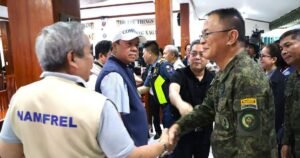
The PNP has worked closely alongside local government units, the Office of Civil Defense, and various disaster response organisations to build a unified response framework. This coordination covers evacuation procedures, search and rescue operations, and the distribution of relief supplies to displaced families throughout the affected municipalities.
Police officers have been assigned to evacuation centres to assist local officials in maintaining order and ensuring the safety of residents who have been compelled to abandon their homes. Security at temporary shelters forms part of a broader logistical effort to accommodate and protect those most directly affected by the volcanic threat.
A notable development in the escalating response is the activation of the KASUROG Disaster Emergency Assistance Response (D.E.A.R.) Team — a specialised PNP unit equipped with additional resources and expertise for large-scale humanitarian emergencies. The team’s deployment signals a significant upgrade in the organisation’s operational capacity on the ground.
High-Risk Municipalities Under Sustained Police Operations
PNP Chief Police General Jose Melencio C. Nartatez Jr. confirmed that focused police operations would be sustained in several municipalities identified as facing the greatest risk from continued volcanic activity. The towns of Camalig, Guinobatan, and Ligao City have been specifically named as priority areas due to their proximity to Mayon Volcano.
Officers stationed in these localities are working hand-in-hand with municipal officials, gathering real-time situational data and relaying it to regional command centres to support dynamic decision-making as conditions on the ground evolve. Their presence also enables faster response should evacuation orders be expanded beyond current boundaries.
The strategic deployment of personnel in these high-risk zones serves a dual purpose: maintaining community security while keeping open the channels of communication and support that are essential during a fast-moving disaster scenario.
PNP Chief Issues Statement on Public Safety
Police General Nartatez issued an official statement on May 2, 2026, reaffirming the PNP’s commitment to the welfare of communities threatened by Mayon’s ongoing volcanic activity. In his message, he called on the public to heed official advisories and stay away from areas identified as hazardous by authorities.
“Patuloy ang ating pagbabantay at pagtulong sa ating mga kababayan. Ang kaligtasan ng bawat isa ang ating pangunahing layunin. Hinihikayat namin ang publiko na sumunod sa abiso ng mga awtoridad at umiwas sa mga delikadong lugar,” Police General Nartatez stated.
The statement underscores the organisation’s pledge to continuous monitoring and active assistance for affected Filipinos. Public safety, the police chief stressed, remains the singular and non-negotiable priority of all personnel deployed in the emergency operations zone. He appealed for full public cooperation with government directives as the volcanic situation remained fluid.
Health Protocols and Safety Recommendations for Residents
Alongside its security functions, the PNP has been at the forefront of disseminating public health guidance in the affected areas. Residents have been advised to remain indoors during active ashfall to reduce the risk of respiratory complications from inhaling fine volcanic particulates.
Where venturing outside is unavoidable, the use of protective masks is strongly recommended, particularly during heavy ashfall episodes when air quality can deteriorate to hazardous levels within a short period. The police-led distribution of masks to residents reflects a proactive stance on community health, treating volcanic hazard management as inseparable from public welfare.
Authorities have also stressed the importance of monitoring updates from official government sources. Given that conditions around an active volcano can shift dramatically and with little warning, staying informed through verified channels is considered essential for personal and family safety.
Response Guided by ‘Bagong PNP’ Service Framework
The emergency operations in Albay are being carried out under the principles of the “Bagong PNP para sa Bagong Pilipinas” reform framework, which promotes the ideal of “Serbisyong Mabilis, Tapat at Nararamdaman” — service that is swift, sincere, and genuinely felt by the people being served.
That philosophy is clearly visible in the manner with which the PNP has approached the Mayon Volcano crisis — not merely as a law enforcement challenge, but as a humanitarian obligation requiring empathy, flexibility, and sustained effort across multiple fronts.
As volcanic activity continues to pose a credible threat to communities across Albay, the PNP has committed to maintaining its heightened operational posture for as long as necessary. Personnel on the ground remain ready to adapt their strategies in line with developing conditions, guided always by the safety and welfare of the residents who depend on them during one of the most difficult periods their communities have faced.
Photo credit: Photo courtesy of PNP-PIO