
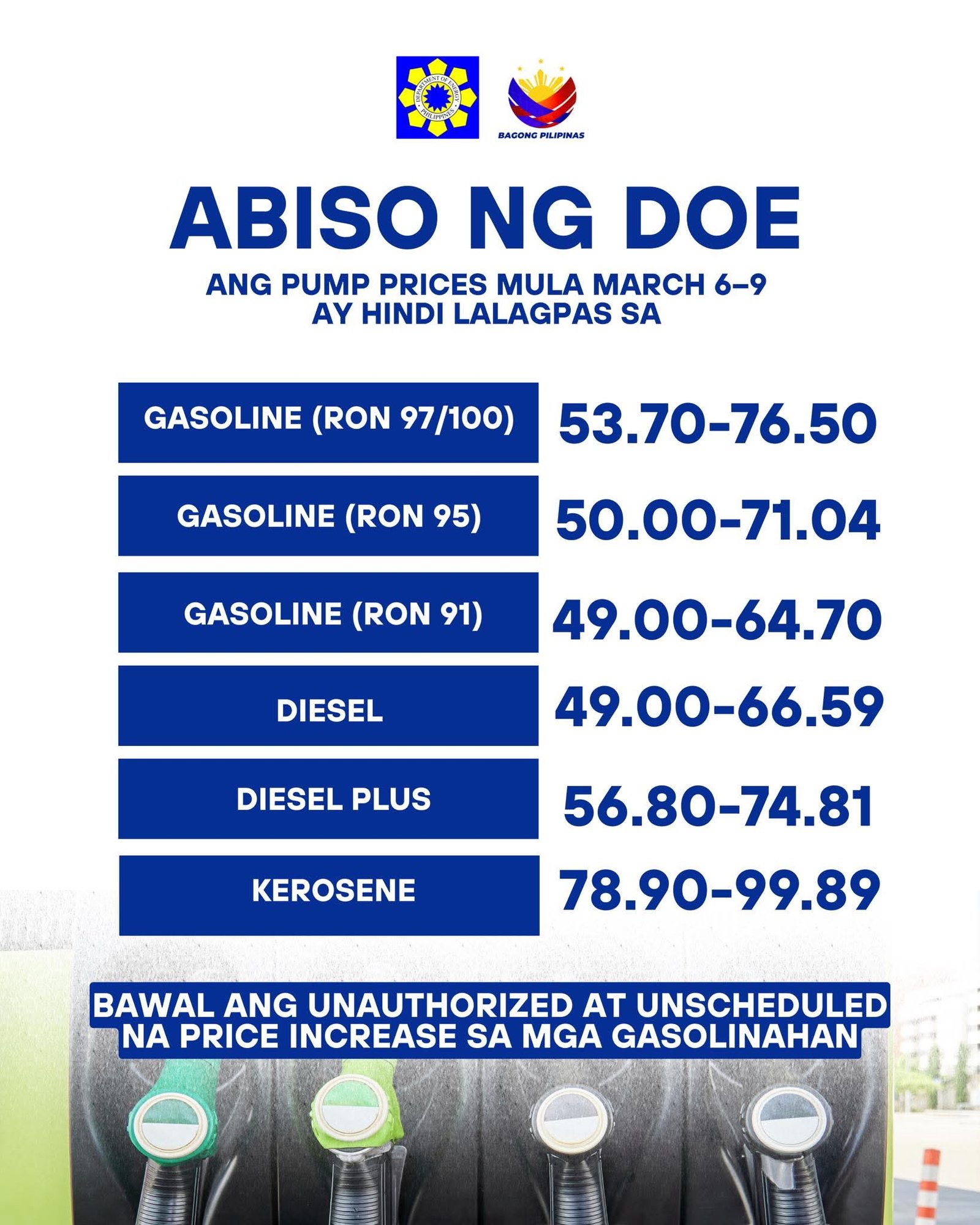
MANILA — Philippine energy regulators have warned gasoline retailers and oil companies against imposing unauthorized fuel price increases ahead of scheduled adjustments, as authorities intensify monitoring of pump prices across the country.
The Department of Energy (DOE) said it had coordinated with the Philippine National Police (PNP) to inspect gasoline stations after reports emerged that some outlets had already raised prices several days before the official adjustment period.
Officials confirmed that one fuel station in Tagum City, Davao del Norte, had prematurely raised diesel prices by more than ₱8 per liter. The station increased its price from ₱64.85 to ₱73.20 per liter, according to the DOE.
Authorities ordered the station to immediately restore prices to the proper level.
“The DOE remains committed to protecting consumers, ensuring fair market practices, and maintaining public confidence in the country’s energy supply system,” the agency said in a statement.
Fuel retailers in the Philippines are required to implement price adjustments only on scheduled days. Under Department Circular No. DC2019-05-0008, oil companies must notify the DOE no later than 3 p.m. on the day before any price adjustment takes effect. Changes are typically implemented every Tuesday and must remain in effect for seven days.
Violating these rules could lead to serious penalties, including the suspension or cancellation of a company’s permit to operate in the downstream oil industry. Stations could also lose their certificates of compliance or standard compliance certificates issued by regulators.
Despite the warning, complaints from motorists have begun surfacing online in various parts of the country, suggesting that several retailers may have already increased fuel prices ahead of schedule.
In Laguna province, a motorcycle rider told reporters that a gasoline station in Santa Rosa City had raised pump prices by roughly ₱10 per liter. The rider, who asked not to be identified, said he had intended to fill his fuel tank before the anticipated price surge but was surprised by the early increase.
With prices expected to climb further in the coming week, the motorist said he might temporarily switch to using his bicycle instead of his motorcycle.
Energy officials say the surge in local fuel prices is being driven largely by international developments. Global oil markets have experienced sharp volatility amid escalating conflict in the Middle East, raising fears of potential disruptions in supply.
According to industry sources, the ongoing regional tensions have pushed freight and premium costs higher than usual, forcing oil companies to adjust domestic pump prices.
Local fuel prices have already been rising for the past 10 consecutive weeks, though previous increases had generally ranged from only a few centavos to less than ₱2 per liter. Analysts say the next round of adjustments could be significantly larger than recent changes.
Part of the concern stems from supply chain pressures linked to the Middle East conflict, which has heightened uncertainty in global oil markets.
China’s decision to halt new fuel export contracts has added further strain on regional supply. China supplies roughly 30 percent of the Philippines’ diesel imports, making the country a critical component of the Philippine fuel supply chain.
Despite the uncertainty, government officials have urged the public not to panic.
Energy Secretary Sharon Garin assured consumers that the Philippines currently has enough petroleum reserves to meet demand for about two months under normal consumption levels.
“There is no reason for panic buying,” Garin said. “The country has adequate fuel supply, and government agencies are actively monitoring the situation to ensure that the public is protected.”
Still, the government is taking precautionary steps to reinforce national fuel stocks. Authorities are exploring the purchase of roughly one million barrels of diesel from international partners including South Korea, Japan, Singapore, Malaysia and Indonesia.
Officials say these purchases are intended to strengthen the country’s energy security should global supply disruptions worsen.
At the same time, the Department of Agriculture (DA) is preparing financial assistance programs to help farmers and fishers cope with rising fuel costs.
Agriculture Assistant Secretary Arnel de Mesa said the government is preparing to release up to ₱150 million in fuel subsidies within the next one to two weeks.
The first tranche of ₱100 million will be distributed through coordination with the Development Bank of the Philippines and accredited financial technology providers. The remaining ₱50 million will be requested from the Department of Budget and Management.
Approximately 15,000 farmers and 28,000 fishers are expected to benefit from the program.
Under the subsidy plan, qualified farmers will receive ₱5,000 each, while eligible fishers will receive ₱3,000. Priority will be given to individuals who have not received previous fuel assistance from the government.
Recipients must be registered in the Registry System for Basic Sectors in Agriculture and must use agricultural machinery that meets environmental standards.
Beneficiaries will receive fuel subsidy cards that can be used to purchase petroleum products from accredited gasoline stations.
In addition to fuel subsidies, the government said eligible rice farmers would also receive ₱5,000 in financial assistance under the ₱30-billion Rice Competitiveness Enhancement Fund.
The fund is financed through tariffs collected from imported rice and is intended to help improve farmer productivity and income.
Meanwhile, the DOE said it continues to encourage the public to report suspected violations involving petroleum sales, including hoarding, refusal to sell fuel, or price manipulation.
Authorities said public vigilance will be crucial in ensuring compliance as the country braces for the economic impact of rising global oil prices.