
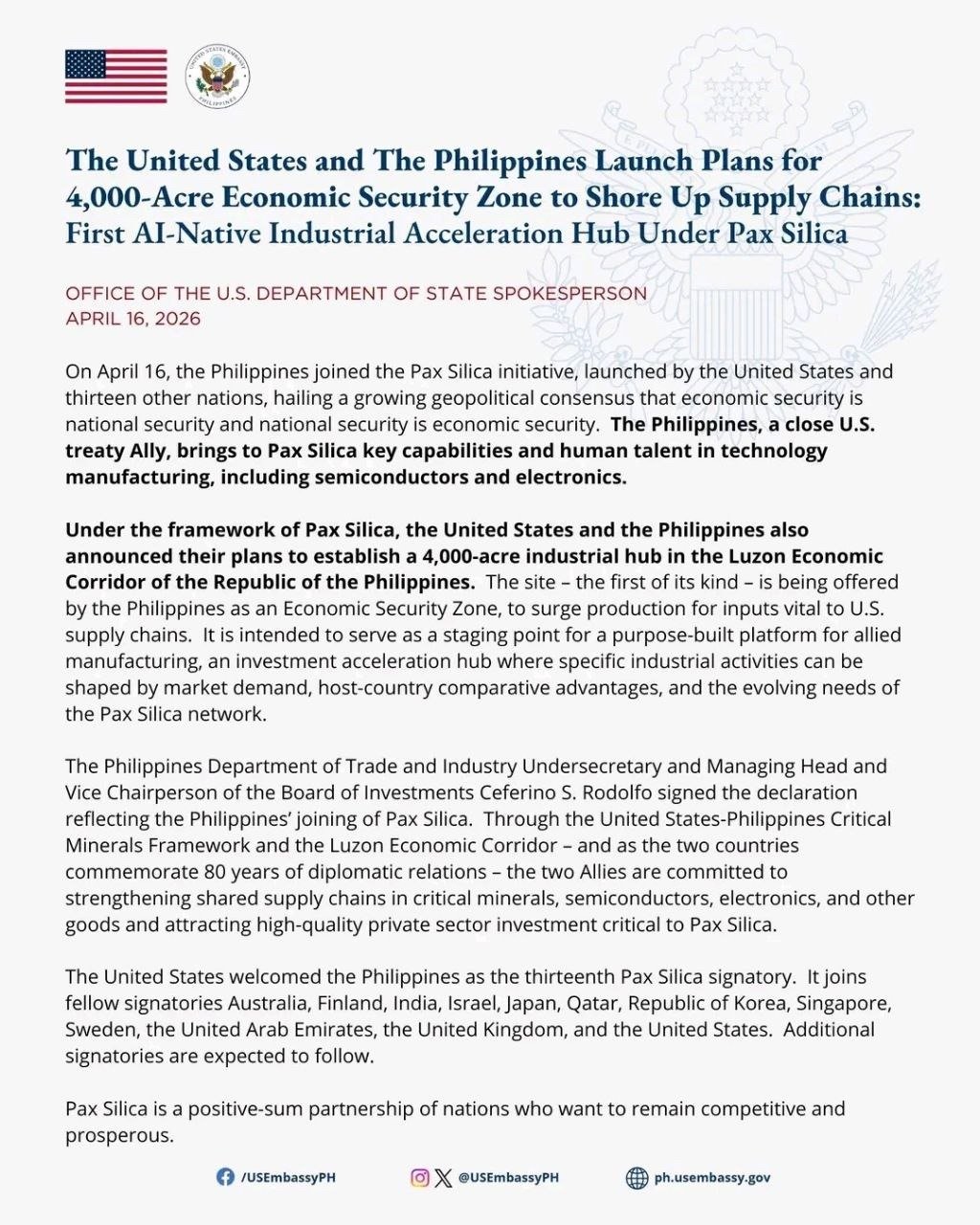
A transformative economic partnership between Manila and Washington reached a pivotal moment on April 16, 2026, as the Philippines formally entered the Pax Silica alliance, simultaneously announcing the creation of an unprecedented 4,000-acre manufacturing complex within the strategic Luzon Economic Corridor.
This landmark agreement positions the Philippines as the 13th member of the United States-spearheaded initiative, which fundamentally operates on the core belief that robust economic foundations directly translate to enhanced national security capabilities.
Revolutionary Manufacturing Complex Takes Shape
The forthcoming Economic Security Zone represents an entirely new concept within the Pax Silica architecture—an artificial intelligence-integrated industrial acceleration center engineered to dramatically increase output of components essential to American supply networks. This expansive 4,000-acre development will capitalize on the Philippines’ advantageous positioning throughout the broader Indo-Pacific theater.
Jacob Helberg, serving as Under Secretary of State for Economic Affairs, revealed that this installation will function as a deliberately constructed platform supporting allied production capabilities. The facility’s particular industrial focus areas will be determined through market dynamics, the host nation’s inherent competitive strengths, and the changing requirements of the expanding Pax Silica consortium.
During the April 16 signing ceremony, Philippines Department of Trade and Industry Undersecretary Ceferino S. Rodolfo, who also serves as Managing Head and Vice Chairperson of the Board of Investments, formally executed the accession documents bringing the Philippines into the Pax Silica framework.
Collaborative Administration and Operational Framework
A shared governance model will guide the Economic Security Zone’s operations, with American and Philippine officials collaborating to establish suitable developmental frameworks that promote sovereign coordination and mutual advantages as the initiative expands.
This manufacturing hub is engineered to merge American institutional expertise and legal systems—encompassing internationally binding agreements, clear regulatory frameworks, and specialized dispute resolution mechanisms—with improved access to the Philippines’ capable workforce, natural mineral wealth, energy infrastructure, and critical Indo-Pacific geographical positioning.
The State Department’s official announcement describes the Enhanced Operational Certainty approach as establishing innovative standards for international economic collaboration, delivering manufacturers and investors unparalleled operational security and process transparency.
Critical Resources and Strategic Position
The Philippines contributes substantial resources to the Pax Silica alliance, especially regarding critical minerals fundamental to contemporary supply networks. The archipelago nation possesses considerable deposits of nickel, copper, chromite, and cobalt—resources becoming increasingly crucial for technology production, encompassing semiconductors and electronic components.
The Luzon Economic Corridor’s designation acknowledges the Philippines’ youthful and technically proficient labor force, combined with its strategic location at the intersection of major Indo-Pacific commercial pathways. This corridor initiative represents a unified, high-impact investment approach targeting essential sectors including logistics, energy systems, digital connectivity, and sophisticated manufacturing processes.
The comprehensive strategy seeks to elevate Luzon into a more economically integrated and prosperous region while generating significant returns for American capital and reinforcing the broader alliance structure.
Growing Coalition of Economic Partners
With the Philippines’ inclusion, the Pax Silica initiative now encompasses a diverse coalition dedicated to economic resilience and supply chain security. The current membership roster features Australia, Finland, India, Israel, Japan, Qatar, the Republic of Korea, Singapore, Sweden, the United Arab Emirates, the United Kingdom, and the United States.
State Department sources indicate that several additional nations are anticipated to join this framework in upcoming months, demonstrating increasing global recognition of economic security’s role in comprehensive national defense planning.
Officials characterize this alliance as a “mutually beneficial coalition of nations committed to maintaining competitiveness and prosperity,” highlighting cooperative approaches rather than zero-sum competition among democratic allies.
Milestone in Eight Decades of Partnership
This announcement coincides with the United States and Philippines marking their 80th anniversary of formal diplomatic ties, underscoring the resilient foundation of their bilateral relationship. The Economic Security Zone signifies a meaningful advancement in this partnership, extending beyond conventional security arrangements toward comprehensive economic collaboration.
Building upon the established United States-Philippines Critical Minerals Framework and the Luzon Economic Corridor initiative, both countries are dedicated to reinforcing integrated supply chains across critical minerals, semiconductors, electronics, and additional strategic commodities while drawing substantial private sector investment.
Foundation for Continental Manufacturing Network
Officials envision the Luzon Economic Security Zone as the cornerstone of an extensive industrial network extending across multiple continents. State Department representatives outline their vision of developing “an interconnected system of integrated production facilities, transportation networks, and coordinated financial mechanisms spanning allied countries.”
This integrated strategy aims to evolve Pax Silica industrial policy beyond individual bilateral arrangements into a comprehensive framework capable of challenging and eventually replacing the centralized supply chains that currently dominate international commerce.
This systematic approach represents a fundamental transition toward decentralized, resilient supply networks that can endure geopolitical challenges and economic disruptions while preserving competitive benefits for member nations.
Semiconductor Production and Advanced Technology
The Philippines’ Pax Silica membership builds upon the country’s established competencies and human resources in advanced technology production, particularly within semiconductor and electronics manufacturing sectors. These industries are fundamental to modern supply chains and represent areas where the Philippines has cultivated substantial expertise and workforce development.
The Economic Security Zone will build upon these current capabilities while delivering infrastructure and investment structures necessary to expand production capacity and attract additional high-technology manufacturing operations throughout the region.
Government officials expect this zone will function as a blueprint for comparable projects throughout the Pax Silica network, illustrating how allied countries can cooperate in building resilient, competitive manufacturing systems that generate benefits for all member states.
Photo credit: Photo courtesy of U.S. Department of State