
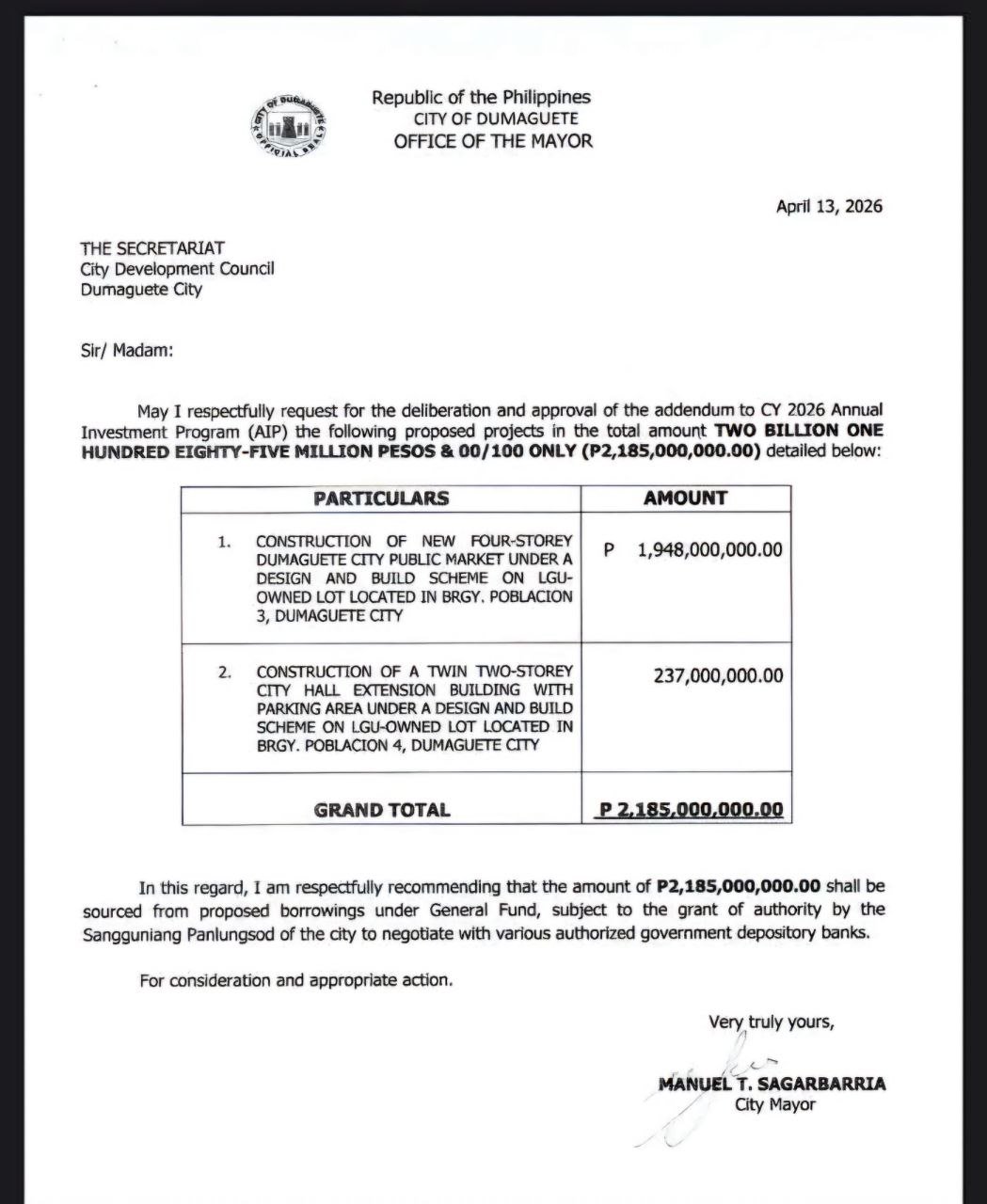
Mayor Manuel “Chiquiting” T. Sagarbarria has submitted a ₱2.185 billion borrowing request to the Dumaguete City Council, seeking authorization for what would become the largest debt obligation in the city’s history to finance major infrastructure developments.
The sweeping financial proposal aims to fund construction of a four-storey public market facility in Barangay Poblacion 3 costing ₱1.948 billion, alongside a two-storey City Hall expansion with parking infrastructure in Barangay Poblacion 4 valued at ₱237 million.
City records show the borrowing package received endorsement from the City Development Council (CDC) during its April 13, 2026 meeting. The proposal has been placed on the City Council’s April 28 agenda for initial legislative review.
According to official documentation, Mayor Sagarbarria specified that both infrastructure projects would be funded through general fund borrowings, contingent upon council authorization to enter negotiations with government depository banking institutions.
Massive Financial Commitment for Growing City
The proposed debt represents an extraordinary fiscal undertaking for Dumaguete, which recently achieved second-class city classification. The borrowing amount approaches 1.8 times the city’s total annual revenue of approximately ₱1.218 billion recorded in 2024.
Population data from the Philippine Statistics Authority shows Dumaguete with 142,171 residents in 2024, meaning the proposed loan would create a per-capita debt obligation of roughly ₱15,369 for each city resident.
The borrowing request also surpasses Dumaguete’s complete 2025 Annual Investment Program allocation of ₱1.4 billion, underscoring the unprecedented scale of the financial commitment being sought.
Economic Headwinds Complicate Borrowing Timeline
The multi-billion peso loan proposal emerges during a period of intensifying economic pressures affecting local communities. March 2026 data revealed headline inflation climbing to 4.1%, with transport, housing, and utility expenses driving the increases.
Global petroleum price volatility has already compelled city officials to launch a local fuel subsidy initiative this April, demonstrating the financial challenges confronting both Dumaguete’s government and its residents.
Provincial Debt Controversy Provides Cautionary Context
The mayor’s borrowing initiative inevitably draws scrutiny given recent provincial-level financial controversies involving his son, Negros Oriental Governor Manuel L. Sagarbarria.
Provincial authorities secured ₱5.85 billion in loan agreements with the Land Bank of the Philippines and Development Bank of the Philippines during February 2024, targeting major construction projects including the ₱3.3 billion Negros Oriental Medical City and ₱1.46 billion Government Center.
The 2024 Commission on Audit (COA) Annual Audit Report subsequently revealed serious procedural deficiencies in the provincial borrowing process.
Audit Findings Reveal Procedural Violations
COA investigators determined that Governor Sagarbarria and the provincial Bids and Awards Committee advanced the ₱5.85 billion loan without completing required feasibility studies or cost-benefit evaluations, violating Government Procurement Reform Act (R.A. 9184) provisions.
Auditors warned that the province’s ₱179.3 million annual debt payments would consume approximately 30% of its 20% Development Fund allocation, creating what they characterized as a “substantial debt servicing burden” limiting resources for essential services and constraining future administrative options.
Observers are closely watching whether Dumaguete’s ₱2.185 billion proposal will include the comprehensive feasibility assessments and economic viability studies that provincial officials omitted.
Complex Regulatory Approval Process Ahead
Should the City Council authorize loan negotiations, multiple regulatory clearances remain necessary before final execution.
Philippine local government finance regulations require the city to obtain a Certificate of Net Debt Service Ceiling and Borrowing Capacity from the Bureau of Local Government Finance (BLGF). The Department of Finance also mandates a positive assessment from the Monetary Board of the Bangko Sentral ng Pilipinas (BSP) prior to loan execution.
Local Government Code provisions strictly limit local government debt service appropriations to 20% of regular income annually. Dumaguete must demonstrate compliance with this threshold when assuming the proposed ₱2.185 billion obligation.
Development Benefits Weighed Against Fiscal Impact
The planned infrastructure offers substantial improvements for Dumaguete’s development trajectory. The modern four-storey market facility would upgrade commercial infrastructure, while the expanded City Hall complex addresses administrative capacity requirements and parking shortages.
Nevertheless, the financial scope raises fundamental questions regarding long-term fiscal sustainability and the debt burden transferring to subsequent administrations and taxpayers.
Legislative Review Commences
The City Council’s April 28 first reading will initiate formal legislative examination of the borrowing authorization. Council members must weigh infrastructure development priorities against fiscal responsibility and long-term debt sustainability concerns.
These deliberations unfold amid ongoing provincial borrowing controversies, offering a relevant case study of potential risks associated with insufficient due diligence in major financial decisions.
Focus now turns to how city legislators will assess the balance between infrastructure advancement promises and the reality of承担ing substantial multi-generational financial obligations that significantly exceed current municipal fiscal capabilities.
Related stories