
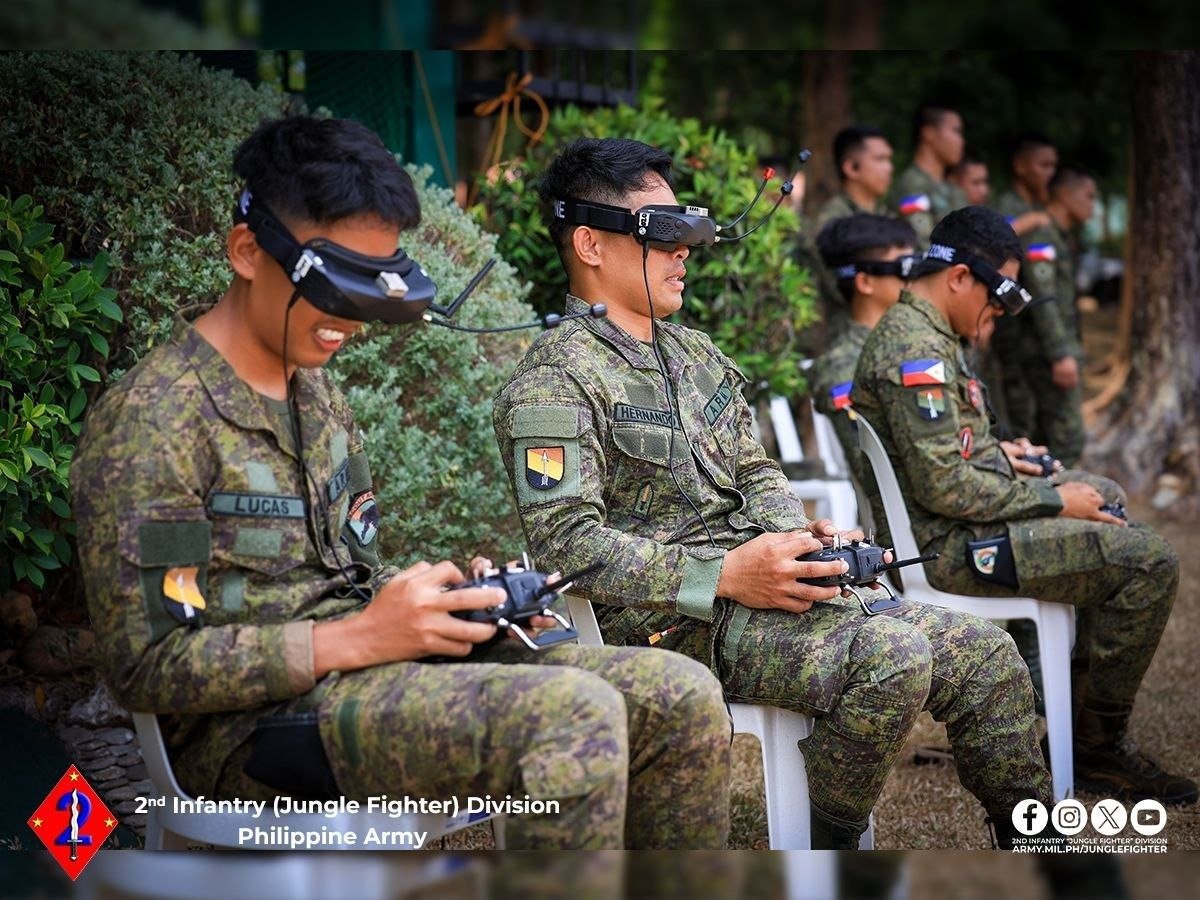
In a signal of how seriously the Philippine Army is taking the rise of unmanned aerial warfare, the 2nd Infantry (Jungle Fighter) Division staged a full-scale drone racing competition at Camp Capinpin in Tanay, Rizal on Saturday, May 16, 2026 — pulling in personnel from some of the country’s most operationally seasoned military formations and framing the activity squarely within the broader imperative of technological adaptation in modern combat.
Multi-Unit Gathering at Camp Capinpin
The event, formally designated the Drone Racing Fellowship 2026, was organized under the leadership of 2nd Infantry Division (2ID) Commander Major General Ramon Zagala. According to the 2ID, the activity was designed not merely as a recreational exercise but as a structured capability-building initiative aimed at widening drone technology awareness across a broad cross-section of the Philippine Army’s operational force.
Units represented at the competition included the 2nd Infantry Division itself, the First Scout Ranger Regiment (FSRR), the Special Forces Regiment (Airborne) (SFRA), the Reserve Command of the Philippine Army (RCPA), the Explosive Ordnance Disposal (EOD) Unit, and the Light Reaction Regiment (LRR), among other specialized formations. The deliberate inclusion of units beyond conventional infantry reflected what military planners described as a recognition that drone literacy must be distributed across multiple operational specializations — not confined to dedicated UAV teams alone.
The multi-unit composition also served a secondary purpose: reinforcing inter-unit cohesion and professional familiarity among personnel from different formations who may be tasked to operate together in joint missions. The convergence of Scout Rangers, Special Forces operators, EOD specialists, and Light Reaction troops in a shared technical environment underscored the joint nature of how the Philippine Army increasingly envisions future operations.
Structured Preparation Before the Main Competition
Before the competitive rounds began, participants went through a series of preparatory phases that included track orientation walkthroughs, practice flight sessions, and formal qualifying rounds. The 2ID said these preliminary activities were structured to test each pilot’s precision, situational awareness, composure under pressure, and capacity for rapid decision-making while navigating aerial obstacle courses.
The racing format placed pilots in scenarios requiring fine motor control, spatial reasoning, and real-time adaptability — qualities that military trainers and planners increasingly identify as directly transferable to battlefield drone applications, including intelligence-gathering flights, target tracking operations, and electronic surveillance missions. According to the 2ID, the qualifying structure was intentionally designed to replicate the kind of high-stakes, low-margin-for-error conditions that UAV operators face in actual field deployments.
Training specialists have increasingly recognized competitive and gamified formats as effective mechanisms for developing genuine technical instincts in military personnel. By routing training through a racing competition rather than conventional classroom instruction, the 2ID allowed participants to build authentic piloting reflexes in a controlled, relatively low-risk environment before confronting real operational conditions.
Zagala Issues Stark Warning on Technology Adaptation
The fellowship’s most pointed moment came during remarks delivered by Major General Zagala, who used the occasion to issue a direct warning about the consequences of institutional failure to keep pace with rapidly evolving warfare technology.
“Tomorrow’s operations will demand not only courage in the field, but also adaptability in technology. We must continue learning, evolving, and preparing our personnel for the changing operational environment. If we will not adapt, we will fail,” Zagala said, according to the 2ID’s account of the proceedings.
The general went further, emphasizing that drone technology is not a future challenge to be prepared for at some later date but an immediate operational reality already shaping the conduct of armed conflict globally.
“Drone technology is already here. Future wars will be fought with it, and our ability to harness it will provide a differentiation,” Zagala added, as quoted by the 2ID.
His remarks were consistent with a growing awareness within the Armed Forces of the Philippines that the nature of conflict has shifted decisively in recent years. Unmanned systems have played increasingly prominent and, in some theaters, decisive roles in armed conflicts observed around the world — spanning reconnaissance and surveillance functions all the way through to direct strike missions and electronic warfare support.
Drones as Operational Tools: Reconnaissance and Situational Awareness
Beyond the competitive framing, organizers from the 2ID positioned the Drone Racing Fellowship 2026 explicitly as an awareness and capacity-development exercise. The event highlighted the expanding operational utility of drone platforms across reconnaissance missions, real-time situational awareness mapping, and broad-based mission support functions in diverse military scenarios.
The Philippine Army has been progressively incorporating unmanned aerial vehicles into its operational toolkit over the past several years. Drone platforms have been deployed in various internal security operations across conflict-affected areas of the country, according to the 2ID, with their utility in surveillance, area monitoring, and intelligence-driven operations becoming increasingly well-established within the force’s operational doctrine.
The Drone Racing Fellowship 2026 is designed to institutionalize this technology familiarity more broadly — pushing drone literacy beyond dedicated UAV units and into the wider operational force. The goal, as articulated by the 2ID, is to ensure that a much larger share of the army’s personnel possesses both the practical handling skills and the tactical awareness necessary to operate effectively in environments where drones — whether friendly or adversarial — are a constant factor.
Serving Both Internal Security and External Defense Mandates
The 2nd Infantry Division, headquartered at Camp Capinpin in Tanay, Rizal, carries responsibility for a substantial portion of the Philippine Army’s operational area in Luzon. It functions under a dual mandate that encompasses internal security operations — including counter-insurgency and anti-criminality functions — alongside contributions to external defense preparedness in support of the Armed Forces of the Philippines’ ongoing modernization agenda.
According to the 2ID, the Drone Racing Fellowship 2026 was explicitly structured to serve both dimensions of this mandate. On the internal security side, deeper drone familiarity strengthens the division’s surveillance and intelligence capacity. On the external defense side, understanding the operational capabilities, tactical applications, and available countermeasures associated with drone warfare is increasingly viewed as a foundational requirement for any modern military formation operating in today’s threat environment.
Part of a Broader Push Toward Technology-Intensive Training
The Camp Capinpin event fits within a wider trend across the Armed Forces of the Philippines toward modernizing training methodologies and equipping personnel with the technical and cognitive skills necessary to function effectively on a technology-intensive battlefield. As unmanned aerial systems continue to evolve globally and demonstrate their capacity to shape operational outcomes in conflicts around the world, the Philippine Army’s investment in building organic drone literacy across its units positions the force to respond more effectively to both conventional and asymmetric threats involving aerial platforms.
As of May 17, 2026, the 2ID had not announced a scheduled follow-up event to the Drone Racing Fellowship. The division indicated, however, that the integration of drone-related technology awareness into training activities is expected to continue as part of its ongoing capability development programs.
Originally reported by: Philippine Army 2nd Infantry Division / wire reports