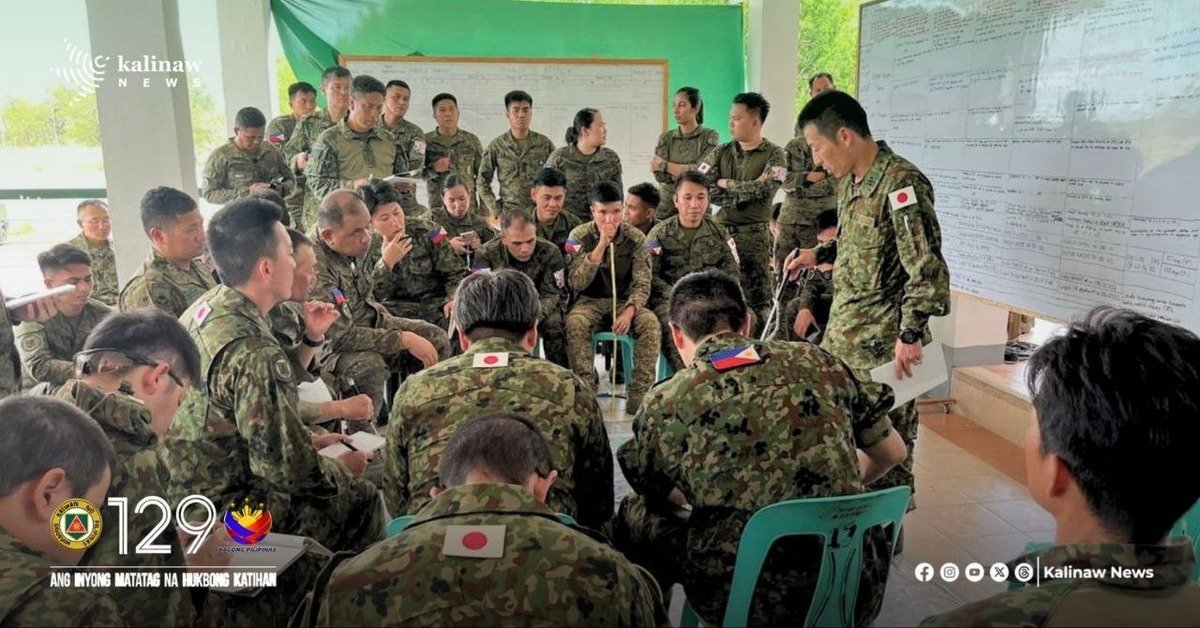
Filipino and Japanese ground forces are currently engaged in the second phase of Exercise Salaknib, a recurring bilateral military training program that has expanded its scope and complexity as both armies deepen their operational partnership across several training locations in Luzon. The Philippine Army formally announced the exercises on Saturday, May 16, 2026, from its headquarters at Fort Bonifacio in Taguig City.
Salaknib Phase 2 Gets Underway Across Luzon
Exercise Salaknib, which serves as the primary bilateral training framework between the Philippine Army and the Japan Ground Self Defense Force (JGSDF), has moved into its second phase, with troops from both armies deploying to multiple designated training areas across Luzon to carry out an extensive series of joint military activities.
The training menu for Phase 2 is deliberately broad in scope. It includes command post exercises, combat support training, interoperability drills, and displaced civilian operations — a combination that reflects the exercise’s dual mandate of sharpening warfighting skills while also building capacity for civil-military coordination scenarios.
Col. Louie G. Dema-ala, Chief Public Affairs of the Philippine Army, said in a statement that the exercises are structured to provide troops on both sides with practical experience in executing synchronized operations within complex and demanding operational environments. The joint drills allow Philippine and Japanese forces to rehearse real-world coordination procedures and fine-tune joint communication protocols under actual field conditions.
Interoperability drills are regarded as a cornerstone of the second phase. Ground forces from the Philippines and Japan must be able to share information fluidly, coordinate movements with precision, and execute combined operations with minimal friction — a level of seamless coordination that can only be developed through sustained and repeated joint training. Photos from various Philippine Army Major Units (PAMUs) documenting the ongoing field activities have been released by the Army’s public affairs office.
SALAKNIB 2026 Targets Indo-Pacific Ground Force Readiness
According to the Philippine Army’s public affairs release, SALAKNIB 2026 is designed with a strategic objective that extends beyond the bilateral level: strengthening joint operational capabilities among allied and partner ground forces operating across the broader Indo-Pacific region.
The exercise reflects the Philippine Army’s sustained effort to deepen its partnerships with neighboring defense establishments as the security environment in the region continues to shift. By providing a structured environment for rehearsing synchronized operations, both armies are developing practical skills that can be applied directly in real-world contingencies — whether conventional military scenarios or complex humanitarian emergencies that require military involvement.
The dual focus on warfighting and civil-military operations — illustrated by the inclusion of displaced civilian operations in the training program — signals that both armies are preparing for a wide spectrum of possible future missions, not just conventional combat scenarios.
Artillery Regiment Debuts Historic Hybrid Training Model at JPMRC-X
Running parallel to the Salaknib Phase 2 activities, the Philippine Army’s Artillery Regiment carried out a significant first on May 13, 2026, at the Col. Ernesto Rabina Air Base (CERAB) in Capas, Tarlac, during the Joint Pacific Multinational Readiness Center-Exportable (JPMRC-X) Exercise.
According to the Philippine Army’s official statement, the Artillery Regiment launched what it described as a first-of-its-kind Hybrid Training Model — an integration of reserve and active-duty personnel that has no precedent in the branch’s history of bilateral exercises. The training unit that participated in JPMRC-X was composed of 85 percent reserve personnel and only 15 percent active-duty soldiers, a composition that dramatically reverses the traditional ratio seen in conventional military exercises.
This configuration was not an improvised arrangement. The Philippine Army described it as a deliberate and carefully structured initiative conducted under its “Total Force” framework — a doctrinal concept that treats active-duty and reserve components as fully integrated elements of a single unified fighting force, rather than as separate and unequal tiers of military capability.
What the “Total Force” Framework Means Going Forward
The “Total Force” concept represents a meaningful shift in how the Philippine Army thinks about its reserve components. Under this framework, reservists are no longer viewed primarily as a standby pool to be called up only during emergencies or full-scale mobilizations. Instead, they are positioned as active participants in routine bilateral and multinational exercises — trained alongside active-duty soldiers and held to the same standards that high-intensity joint training demands.
By fielding a unit in which four out of every five participants were reservists, the Philippine Army is effectively stress-testing its own assumptions about reserve readiness. The exercise provides hard data on whether reserve personnel can perform at the levels required by complex multinational drills, and whether the logistical, communications, and command structures are in place to support that kind of integrated deployment at scale.
The Philippine Army has indicated that if the Hybrid Training Model delivers strong results, there is a clear pathway to expanding the concept beyond the Artillery Regiment to other branches and major units across the Army. Such an expansion could fundamentally alter the scale and nature of reserve participation in future exercises and, potentially, in actual operational deployments.
JPMRC-X Brings U.S. Army Pacific Training Standards to Philippine Forces
The JPMRC-X Exercise is a U.S. Army Pacific-led initiative designed to extend high-quality combat training center capabilities to allied and partner nations throughout the Indo-Pacific. By hosting JPMRC-X activities at CERAB in Capas, Tarlac, the Philippine Army gains access to the same evaluation methodologies and observer-controller/trainer expertise ordinarily associated with major combat training centers in the United States — essentially bringing world-class training assessment tools directly to Philippine soil.
The fact that the Artillery Regiment chose to debut its Hybrid Training Model within the JPMRC-X framework carries added significance. It means the “Total Force” concept is not being tested in a controlled domestic setting with reduced scrutiny, but against the rigorous evaluation standards of a multinational training environment where performance benchmarks are set and enforced by an external, experienced training authority.
Philippine Army Signals Broad Modernization of Training Posture
The concurrent execution of Salaknib Phase 2 and the JPMRC-X Artillery exercise is not coincidental. Together, they reflect a deliberate and sustained push by the Philippine Army to sharpen its interoperability with key regional partners while simultaneously modernizing its force structure concepts to meet both conventional and non-conventional security challenges.
According to the Philippine Army’s public affairs statement, both exercises align with the Army’s institutional motto — “Serving the People, Securing the Land” — indicating that the training objectives are framed within a dual commitment to internal security responsibilities and broader external defense obligations. The official release also carried the hashtag #StrongerArmyStrongerCountry, part of a broader institutional communications strategy aimed at projecting confidence in the Army’s growing capabilities to both domestic and international audiences.
The Philippine Army has confirmed that additional updates and documentation from its various major units will be released in the coming days as both exercises continue at their respective Luzon and Tarlac training sites, providing a fuller picture of the scope and outcomes of the joint activities now underway.
Originally reported by: Philippine Army Public Affairs Office / Fort Bonifacio, Taguig City