
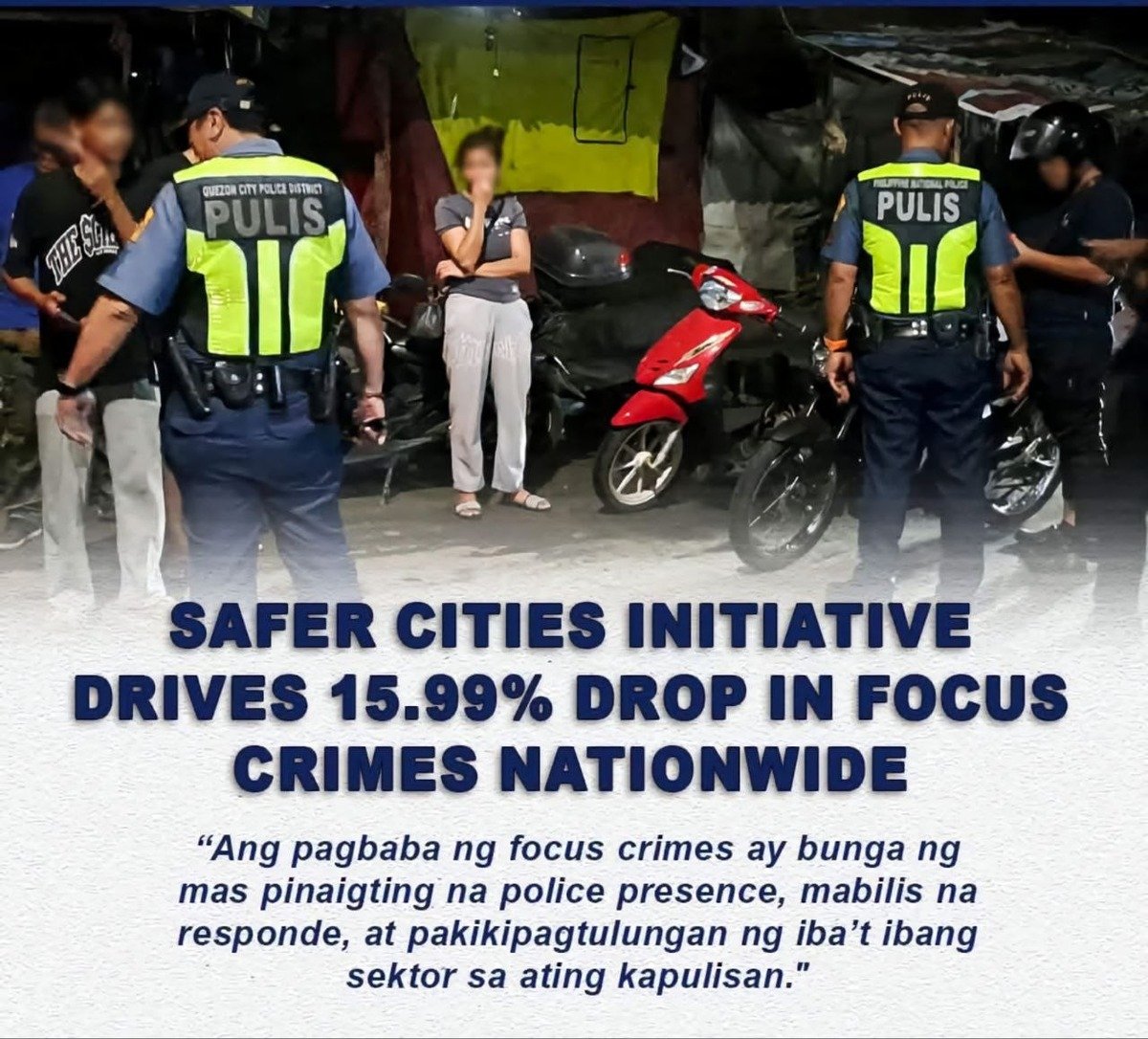
Forty-three days after the Philippine National Police rolled out its Safer Cities Initiative, crime figures are moving in a clear direction — downward. The PNP announced on Friday, May 22, 2026, that the number of recorded focus crime incidents nationwide fell by 719 cases, equivalent to a 15.99-percent reduction, during the program’s first monitored stretch of implementation that began April 6, 2026.
According to comparative data released by the PNP Public Information Office, total focus crime incidents stood at 4,495 cases during the 43-day baseline period from February 22 to April 5, 2026. That figure dropped to 3,776 cases over the corresponding 43-day post-launch window spanning April 6 to May 18, 2026 — a deliberate apples-to-apples comparison designed to isolate the initiative’s early effect on crime volumes.
Every Crime Category Registered a Decline
One of the more striking findings in the PNP’s May 22 data release was that none of the eight focus crime categories moved in the wrong direction. All eight posted decreases during the post-SCI monitoring period, the PNP Public Information Office confirmed in its statement.
Rape saw the largest proportional drop among the eight categories, falling by 30.61 percent. Carnapping of motor vehicles followed at 28.20 percent, and physical injury cases declined by 25.93 percent. Robbery was down 15.12 percent, theft by 10.61 percent, and motorcycle carnapping by 6.64 percent. Homicide declined by 5 percent, while murder posted the most modest decrease at 2.17 percent — still a reduction, nonetheless.
PNP officials described the uniform improvement across all categories as evidence that the Safer Cities Initiative’s multi-pronged strategy — blending visible police deployment, intelligence-led operations, and community engagement — is producing consistent outcomes rather than isolated wins in select crime types.
Metro Manila Posts Its Own Gains, Though Below National Average
In the National Capital Region, focus crime cases fell by 8.57 percent over the same 43-day period, according to the PNP. The agency attributed gains in Metro Manila to intensified police operations and a sustained buildup of police presence across the region’s densely populated districts and urban corridors.
The NCR figure, while lower than the 15.99-percent national average, was still characterized by officials as meaningful progress. Law enforcement authorities noted that Metro Manila’s sheer population density and the complexity of urban crime environments make any measurable reduction a significant operational achievement.
PNP Chief Points to Coordination and Public Trust
PNP Chief Police General Jose Melencio C. Nartatez Jr. credited the early numbers to layered enforcement strategies and the cooperation extended by communities and partner agencies. In a statement tied to the data release, PGen Nartatez said in Filipino that the drop in focus crimes is the result of heightened police presence, faster response times, and active collaboration from various sectors of society, adding that the PNP will continue strengthening its measures to preserve peace and ensure the safety of the public.
PGen Nartatez framed the results as validation of the program’s architecture, rather than a reason to ease up on operations. The emphasis, officials indicated, remains on sustaining the operational tempo established since the April launch.
What Drove the Numbers Down
The PNP credited a combination of proactive policing strategies, intelligence-driven field operations, and the targeted deployment of personnel to high-risk zones as the primary drivers behind the recorded improvements. Sustained coordination with local government units and community stakeholders was also flagged as a key enabler, according to the PNP statement.
These strategies were framed as core components of the broader Safer Cities Initiative, which was championed by Department of the Interior and Local Government Secretary Juanito Victor “Jonvic” C. Remulla Jr. as a structured framework for raising public safety standards in both densely populated urban centers and provincial communities across the Philippines.
Program Background and Methodology
The Safer Cities Initiative was formally launched on April 6, 2026, under the DILG’s direction and forms part of the Marcos administration’s ongoing commitment to improving peace and order conditions nationwide. The initiative operates within the PNP’s institutional vision articulated as Bagong PNP para sa Bagong Pilipinas: Serbisyong Mabilis, Tapat at Nararamdaman — translated as “New PNP for a New Philippines: Service that is Fast, Honest, and Felt.”
The choice to use matching 43-day windows — one before and one after the SCI launch — was deliberate. According to the PNP’s released figures, the mirrored timeframe was intended to produce a statistically comparable dataset that would allow for a direct, credible assessment of the program’s immediate impact on crime volumes without seasonal distortions or unequal monitoring periods skewing the results.
PNP Flags Continued Monitoring and Commitment to Gains
The PNP said in its statement that sustaining and building upon the early gains of the Safer Cities Initiative remains an institutional priority. The agency signaled that proactive policing, public safety programming, and community partnership efforts will continue to be reinforced in the weeks and months ahead.
No numerical targets for further crime reductions were specified in the PNP’s May 22 release. However, the PNP Public Information Office confirmed that monitoring of focus crime trends under the SCI framework will remain ongoing, with further updates anticipated as the program extends its implementation across all regions of the country.
Focus crimes are a standardized group of eight serious offenses — murder, homicide, physical injury, rape, robbery, theft, carnapping of motor vehicles, and carnapping of motorcycles — that the PNP tracks as primary indicators of public safety conditions in the Philippines. Performance against these categories serves as a key benchmark for evaluating the effectiveness of anti-criminality programs at both local and national levels, according to standard PNP monitoring protocols.
Originally reported by: PNP Public Information Office / wire reports