MANILA, June 11, 2026 — Earthquake monitors detected a moderate aftershock south of Balut Island on Thursday afternoon, adding to an ongoing series of seismic events that began days earlier with a powerful offshore tremor near Sarangani. The Philippine Institute of Volcanology and Seismology under the Department of Science and Technology (PHIVOLCS-DOST) confirmed the event and said no structural damage is anticipated from the latest shaking.
Details of the June 11 Aftershock
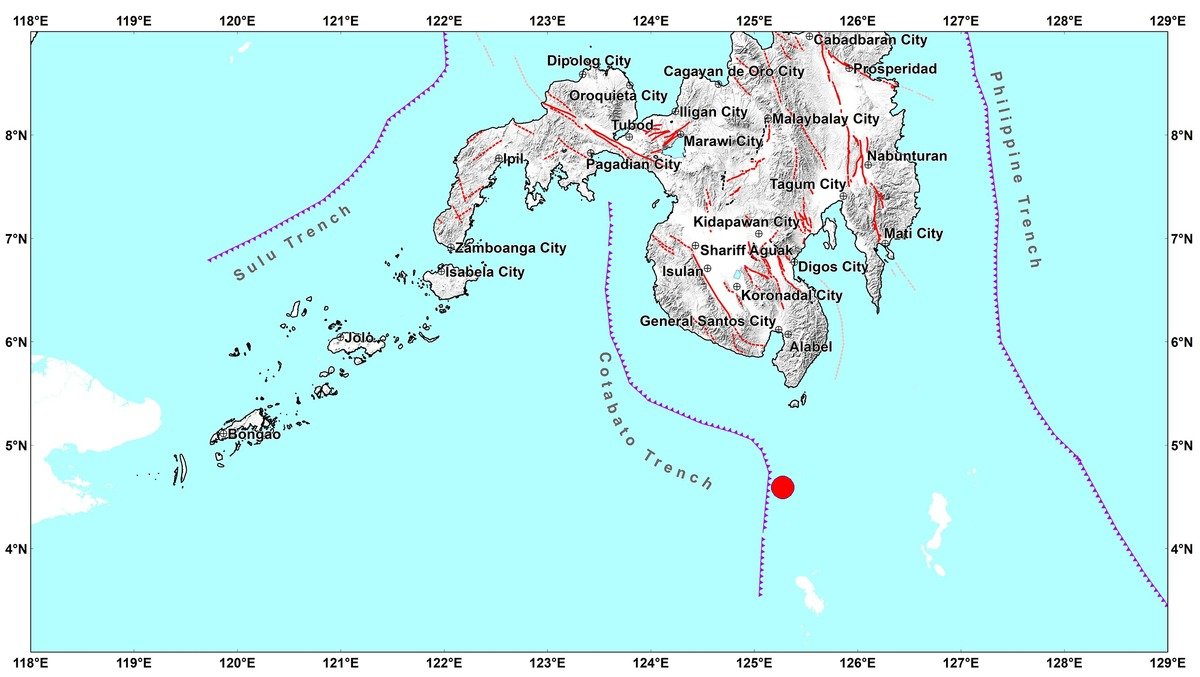
According to PHIVOLCS-DOST, the earthquake was recorded at precisely 3:33:13 in the afternoon of June 11, 2026. The agency placed the epicenter approximately 93 kilometers south 10 degrees west of Balut Island, which falls under the Municipality of Sarangani in Davao Occidental. Geographic coordinates were fixed at 4.58 degrees North latitude and 125.28 degrees East longitude — a location well out to sea, situated in open waters south of the Philippine island chain.
PHIVOLCS-DOST further determined that the earthquake had a focal depth of 15 kilometers, which classifies it as a shallow-focus event. Shallow earthquakes, while sometimes more strongly felt at the surface compared to deeper ones, tend to dissipate energy over a limited area. The earthquake’s origin was attributed to tectonic activity. The agency released its official bulletin at 4:50 in the afternoon of the same day.
Areas That Felt the Tremor
Two localities reported instrumental shaking as measured by PHIVOLCS-DOST monitoring stations. The municipality of Santo Niño in South Cotabato recorded Intensity II on the PHIVOLCS Earthquake Intensity Scale (PEIS). Malungon in the province of Sarangani registered a lower reading of Intensity I under the same scale.
To put these readings in context: under the PEIS framework, an Intensity II designation means shaking was felt by a limited number of individuals — typically those who were at rest, lying down, or occupying the upper floors of buildings at the time. An Intensity I reading, by contrast, is classified as scarcely perceptible and would generally go unnoticed by people going about their normal activities. Such low-level tremors are usually only confirmed through sensitive seismographic instruments, PHIVOLCS-DOST explained in its bulletin.
Damage Assessment and Public Safety Advisory
PHIVOLCS-DOST assessed that the June 11 earthquake is not expected to have caused any physical damage to structures or infrastructure in the affected localities. The relatively low intensity readings in populated areas, combined with the offshore location of the epicenter, contributed to this assessment.
However, the agency reminded the public that aftershocks from this ongoing sequence are still expected to occur. Residents in areas close to the epicenter — particularly along coastal zones in Davao Occidental, South Cotabato, and Sarangani — are encouraged to stay alert and observe standard earthquake preparedness measures. The public is advised not to spread unverified information and to rely only on official PHIVOLCS-DOST bulletins for updates, the agency said.
Connection to the June 8 Major Earthquake
PHIVOLCS-DOST identified Thursday’s tremor as a direct aftershock of the much stronger Mw 7.8 Offshore Sarangani earthquake that struck on June 8, 2026. That earlier event — significantly more powerful — triggered the current series of follow-up tremors that seismologists continue to monitor closely.
The June 11 event has been designated as Earthquake Information No. 2 in the bulletin series tied to this aftershock sequence, according to PHIVOLCS-DOST records. This numbering reflects the agency’s systematic documentation of aftershocks following a major seismic event.
PHIVOLCS-DOST stated that the bulletin issued for the June 11 tremor will be the only one released for that specific event, barring the emergence of new or additional information that may warrant a follow-up release. This is standard protocol for lower-magnitude events within an active aftershock series, the agency noted.
Ongoing Monitoring and Where to Get Updates
As the aftershock sequence from the June 8 major event continues, PHIVOLCS-DOST is maintaining active monitoring operations. The agency has urged the public to stay informed through its official website at phivolcs.dost.gov.ph, where the latest earthquake bulletins, intensity reports, and safety advisories are posted in real time.
PHIVOLCS-DOST also regularly updates its official social media channels with seismic activity reports, particularly during periods of elevated aftershock activity. Communities in Mindanao’s southern provinces are advised to familiarize themselves with earthquake safety protocols, keep emergency kits ready, and know their local evacuation routes, especially given the continued likelihood of additional aftershocks in the coming days.
Authorities have not issued any tsunami warning in connection with the June 11 aftershock, consistent with its offshore depth and magnitude level. The June 8 mainshock, however, may have prompted earlier advisories, and residents in coastal barangays are reminded to remain vigilant and heed any future alerts from official government agencies.
For community-level preparedness guidance, local government units in affected provinces are coordinating with the Office of Civil Defense and the National Disaster Risk Reduction and Management Council (NDRRMC) to ensure that residents receive timely and accurate information throughout the duration of this seismic sequence.
Source: Philippine Institute of Volcanology and Seismology – Department of Science and Technology (PHIVOLCS-DOST) bulletin, as originally reported by wire reports.
Related stories