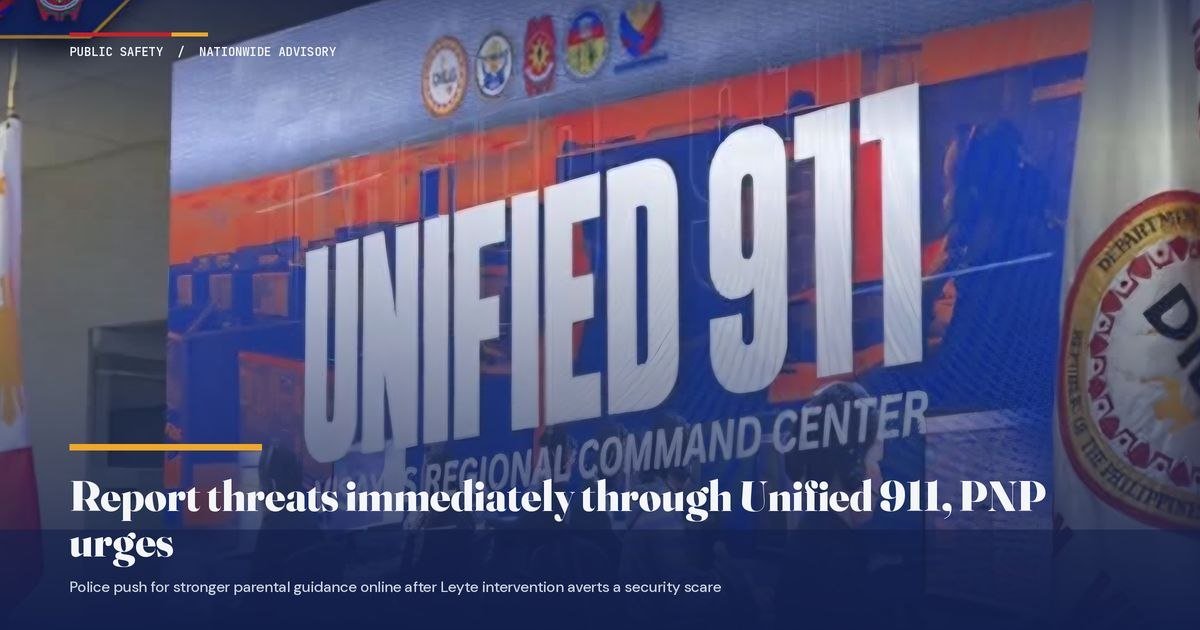
A social media post that sent alarm through a community in Leyte has prompted the Philippine National Police to mount a nationwide appeal — calling on every Filipino to pick up the phone and dial the Unified 911 emergency hotline the moment they come across any threat, suspicious digital content, or behavior that hints at possible violence.
The PNP issued the public advisory on Friday, June 26, 2026, days after police units in Leyte conducted rapid validation and intervention after a circulating post triggered concern among students, parents, and community residents. Authorities confirmed that because of the swift response, no violent incident occurred.
Top PNP Official: No Threat Is Too Small to Report
PNP Chief Police General Jose Melencio C. Nartatez Jr. was unequivocal in his message to the public: every threat, whether it surfaces online or in person, must be taken seriously and acted upon immediately.
“Ang pinakamahalaga rito ay huwag nating balewalain ang anumang banta o pahiwatig ng karahasan. Kung may makita, mabasa, o marinig na kahina-hinalang usapan o post sa social media, agad itong ireport sa Unified 911 upang maagapan at masuri ng mga awtoridad,” Nartatez said.
According to the PNP, General Nartatez’s statement built on a similar call delivered earlier that same day by the Secretary of the Interior and Local Government during a press briefing. Both officials drove home the same point: early reporting gives law enforcement the window it needs to intervene before a situation turns dangerous.
What Happened in Leyte
The PNP said that initial investigation into the Leyte incident showed a social media post had spread across platforms and triggered widespread anxiety among residents, students, and their families within a specific community. The exact nature of the post’s content was not publicly disclosed, but the PNP treated the matter as a credible threat that required an immediate on-ground response.
Police units moved swiftly — validating the information and carrying out intervention measures before any harm could occur. The PNP confirmed that the episode demonstrated precisely why prompt civilian reporting is indispensable: the tip-off reached authorities in time for them to neutralize any potential danger.
Parents Urged to Stay Involved in Children’s Online Lives
Beyond the operational response, PNP Chief Nartatez directed a pointed message at parents and guardians across the country, stressing that family-level vigilance is just as important as police action.
“Malaki ang papel ng mga magulang sa paggabay sa kanilang mga anak, lalo na sa kanilang social media engagement. Mahalaga ang bukas na komunikasyon sa loob ng tahanan upang maagapan ang anumang impluwensyang maaaring magtulak sa kabataan sa maling direksyon,” he said.
The PNP underscored that maintaining open lines of communication within the household is among the most practical and proven tools for shielding young people from online radicalization, harmful influences, or content that may push them toward destructive behavior. Authorities said that when parents are actively engaged, warning signs are far more likely to be caught early — before they escalate into a crisis that requires a police response.
Safety Is a Shared Civic Responsibility
The PNP was clear that neither law enforcement nor any single institution can carry the full weight of community safety on its own. According to the PNP, schools, families, barangay officials, community organizations, and government agencies must work together, each playing a distinct but complementary role in keeping neighborhoods secure.
The agency said the three pillars of prevention remain consistent: early and honest reporting by citizens, timely and well-coordinated intervention by authorities, and responsible digital behavior by everyone who uses social media. Remove any one of those pillars, the PNP warned, and the entire structure of community safety weakens.
Drive Anchored in PNP’s Enhanced Policing Framework
The PNP said the current public awareness push is an integral part of its Enhanced Managing Police Operations framework — a standing directive designed to sharpen proactive policing, deepen intelligence monitoring, and accelerate rapid-response protocols across all regions of the country.
The campaign also falls in line with the broader agenda of the Marcos administration, which has prioritized safer communities through tighter coordination between government agencies and ordinary citizens. The PNP framed the initiative under its institutional vision: Bagong PNP para sa Bagong Pilipinas: Serbisyong Mabilis, Tapat at Nararamdaman — a vision centered on fast, honest, and felt public service.
The Unified 911 Hotline: What You Need to Know
The PNP reminded the public that the Unified 911 hotline operates as the country’s central emergency reporting channel. It is the appropriate number to call when reporting threats of violence, alarming social media posts, suspicious individuals, or any situation that could endanger people or communities.
Authorities stressed that callers should not wait for absolute certainty before dialing in. According to the PNP, even unverified or seemingly minor concerns should be reported — trained personnel will conduct the proper threat assessment from there. The agency said that experience has repeatedly shown that an alert from an ordinary citizen can be the critical first link in the chain of events that prevents a tragedy.
The PNP encouraged Filipinos to save the number, share it within their households and peer groups, and commit to using it without hesitation whenever something feels wrong — online or off.
Originally reported by: PNP Public Information Office / wire reports