
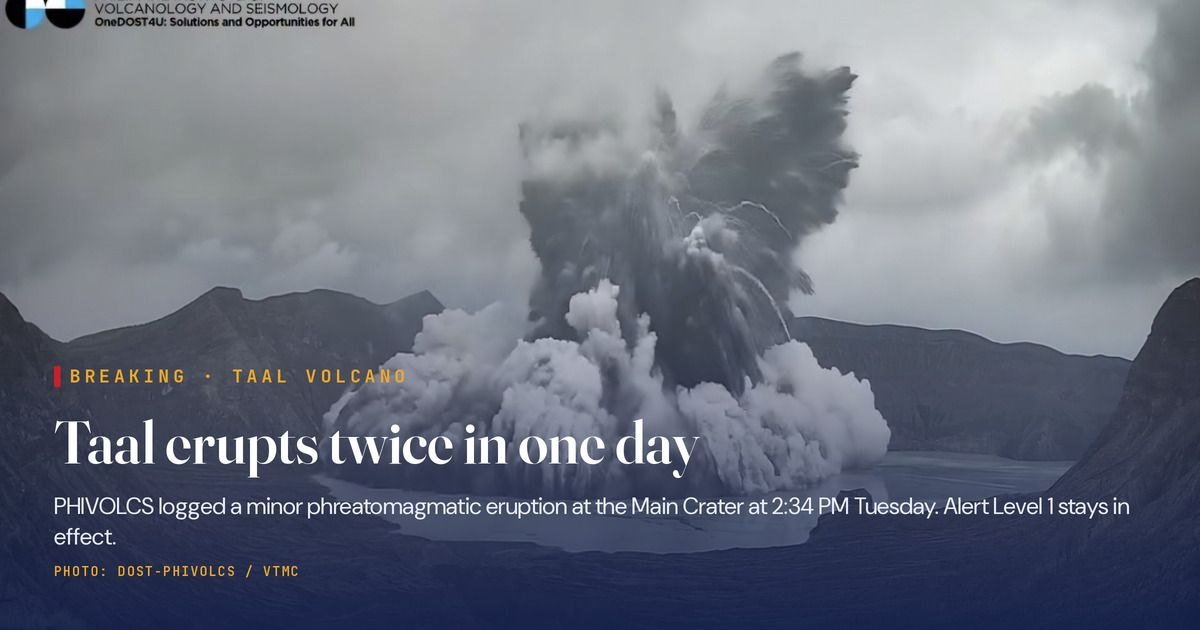
Taal Volcano in Batangas rattled observers twice on Tuesday, June 30, 2026, producing a pair of minor phreatomagmatic eruptions from its Main Crater within the same calendar day — a development that underscores the restless and unpredictable nature of one of the Philippines’ most closely watched volcanoes.
The Philippine Institute of Volcanology and Seismology (PHIVOLCS) confirmed that the second eruption of the day occurred at 2:34 in the afternoon, lasting approximately four and a half minutes. According to PHIVOLCS, the event was composed of three distinct pulses, as determined through seismic monitoring, infrasound recordings, and direct visual observation.
Dark gray ash and steam-laden plumes surged upward during the afternoon event, reaching as high as 1,200 meters above the crater rim before winds carried the column toward the southwest. The scale of this second eruption was notably larger than the one that had preceded it earlier that morning.
The first eruption of the day had taken place between 7:13 a.m. and 7:17 a.m., also originating from the Main Crater. PHIVOLCS reported that this morning event generated an ash and steam plume rising roughly 450 meters above the crater, which was captured by the volcano’s IP surveillance camera in real time.
PHIVOLCS classified the morning eruption as the fourth eruptive event recorded at Taal for the month of June 2026. Prior phreatomagmatic eruptions had been documented on June 4, June 5, and June 6, establishing a pattern of recurring eruptive activity throughout the month.
By the Numbers
- 2 phreatomagmatic eruptions recorded on June 30, 2026
- 4 total eruptive events at Taal in June 2026 (as of the morning eruption)
- 1,200 meters — height of the afternoon eruption plume above the crater
- 450 meters — height of the morning eruption plume above the crater
- 4.5 minutes — duration of the afternoon eruption
- 3 pulses recorded during the afternoon event
- 881 metric tons of sulfur dioxide emitted over the preceding 24-hour period
In its monitoring bulletin covering the period, PHIVOLCS recorded that Taal released 881 metric tons of sulfur dioxide (SO₂) over the 24 hours preceding the report — a significant figure that points to continued magmatic activity beneath the surface.
Despite the two eruptions, PHIVOLCS kept Alert Level 1 in place over Taal following the afternoon event. However, the agency was explicit in its bulletin that Alert Level 1 does not signal a return to normal conditions. PHIVOLCS stressed that the current alert status still reflects an abnormal volcanic state and that the threat of a more powerful eruption has not been eliminated.
The agency further cautioned that several hazards remain active within Taal Volcano Island. These include sudden steam-driven explosions, minor phreatomagmatic eruptions, episodes of minor ashfall, and potentially lethal concentrations or sudden expulsions of volcanic gases — all of which can occur without advance warning even under Alert Level 1 conditions, according to PHIVOLCS.
PHIVOLCS reiterated that Taal Volcano Island retains its status as a Permanent Danger Zone. Entry to the island — particularly to the Main Crater area and the Daang Kastila fissure zone — is strictly forbidden. The agency also issued a reminder to aviation authorities and pilots to steer clear of the volcano’s immediate vicinity.
Residents and local government units in nearby communities are urged by PHIVOLCS to remain on heightened alert and to rely exclusively on advisories issued through official DOST-PHIVOLCS communication channels. The agency discouraged reliance on unverified social media reports or unofficial sources during periods of volcanic unrest.
The dual eruptions on June 30 bring renewed public attention to Taal’s ongoing state of unrest, which has persisted through much of June. Scientists and volcanologists continue to monitor seismic activity, ground deformation, and gas emissions around the clock to detect any escalation that might warrant a change in alert status.
Why This Matters
Two phreatomagmatic eruptions occurring within a single day signals a heightened pace of eruptive activity at Taal, which has a history of destructive eruptions that have displaced thousands of residents in surrounding Batangas communities. The emission of 881 metric tons of sulfur dioxide in a single 24-hour period indicates sustained subsurface magmatic movement that may precede more intense volcanic events. PHIVOLCS’ continued enforcement of Permanent Danger Zone restrictions on Taal Volcano Island reflects the agency’s assessment that public safety risks remain real and immediate, even under the current Alert Level 1 classification.
Source: Philippine Institute of Volcanology and Seismology (PHIVOLCS)