
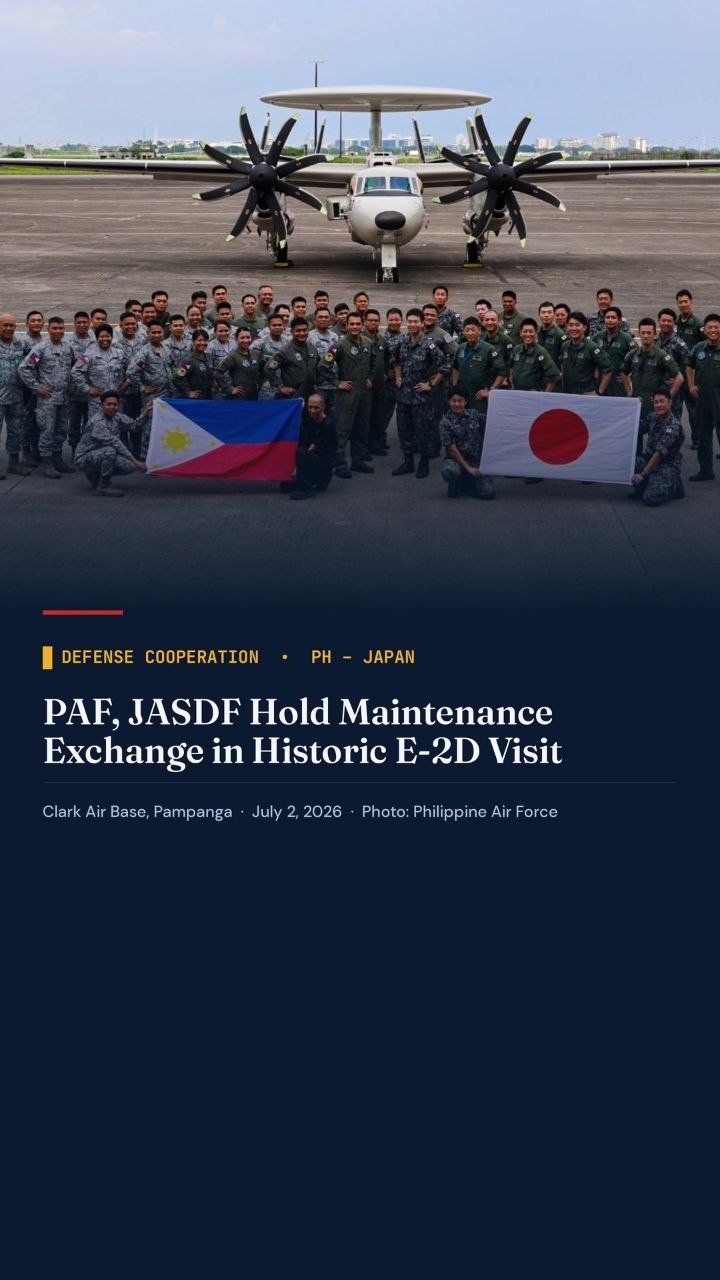
For the first time in history, a Japan Air Self-Defense Force (JASDF) E-2D Airborne Early Warning and Control aircraft set wheels down on Philippine territory, landing at Clark Air Base in Pampanga on July 2, 2026. The landmark arrival took place in the context of a structured bilateral defense engagement with the Philippine Air Force (PAF), signaling a new chapter in military cooperation between Manila and Tokyo.
A Transit Stop With Strategic Significance
The JASDF contingent was not making the Philippines a final destination — the delegation was en route to Australia to take part in “Southern Cross 26,” a trilateral military exercise involving Japan, the United States, and Australia. According to the Philippine Air Force, the stopover at Clark Air Base served a dual purpose: a logistical waypoint on a long transoceanic flight, and a deliberate opportunity for formal bilateral engagement between the two air forces.
The choice of Clark as a transit hub is itself meaningful. The base, located in Pampanga, has historically been a focal point of American military presence in the region and has grown into an increasingly active hub for multilateral defense activities involving Philippine allies and partners. Its use as a stopping point for the JASDF delegation underscores the facility’s expanding role in Indo-Pacific security arrangements.
What the E-2D Brings to the Table
The E-2D Advanced Hawkeye is no ordinary aircraft. It is a carrier-capable airborne early warning platform equipped with sophisticated radar systems capable of simultaneously detecting and tracking aerial and maritime threats across vast distances. The Philippine Air Force described the aircraft’s presence at Clark as a significant moment in the country’s defense history, given the E-2D’s advanced surveillance and battle-management capabilities. Its appearance in the Philippines — even briefly — gives Philippine defense planners and military professionals direct exposure to one of the most capable early warning systems currently operated by any regional air force.
Command-Level Meeting Reinforces Partnership
Beyond the aircraft itself, the visit included a courtesy call by the JASDF delegation on the Chief of Command Staff of the Air Defense Command, the Philippine Air Force confirmed. The meeting provided an opportunity for senior officers from both sides to engage directly, reaffirming the depth and seriousness of the defense partnership at the command level. Such command-to-command interactions are considered essential in building the mutual trust and institutional familiarity that underpin effective military cooperation.
Technical Knowledge Exchange Between Maintenance Specialists
One of the most operationally consequential elements of the visit was a Subject Matter Expert Exchange (SMEE) focused on aircraft maintenance. According to the Philippine Air Force, specialists from the PAF’s 410th Maintenance Wing and the 220th Airlift Wing joined their Japanese counterparts in a structured exchange of professional knowledge, technical expertise, and maintenance best practices.
This kind of hands-on, practitioner-level engagement is widely regarded as among the most effective forms of defense cooperation, as it builds real capability rather than simply reaffirming political commitments. The exchange was designed, the PAF said, to strengthen maintenance capacity on both sides and to deepen institutional ties between the two organizations — a goal that outlasts the brief duration of the visit itself.
Framed Within a Broader Defense Agenda
The Philippine Air Force placed the visit within a larger context of sustained bilateral defense cooperation. In a statement, the PAF said the engagement reflects the continuing commitment of both air forces to strengthening their partnership through professional military activities and capacity-building initiatives.
The PAF further noted that the visit supports broader goals of regional security and stability, and aligns with the vision of a free and open Indo-Pacific — a phrase that has become central to the strategic frameworks of both Japan and the Philippines, as well as their mutual allies. The engagement also fits within the PAF’s stated institutional goal of building a mission-ready, capability-driven, and values-based organization, according to the air force’s own characterization.
Japan and the Philippines have been steadily deepening their defense relationship in recent years, driven in part by shared concerns about maritime security in the South China Sea and the broader East Asian region. The two countries have pursued expanded military-to-military engagements, and Tokyo has emerged as one of Manila’s most active partners in defense capacity-building efforts.
The JASDF’s participation in “Southern Cross 26” alongside the United States and Australia also situates Japan within a growing network of like-minded countries working to strengthen collective deterrence and operational interoperability in the Indo-Pacific — a network in which the Philippines plays an increasingly prominent role.
By the Numbers
- July 2, 2026 — Date of the historic E-2D landing at Clark Air Base
- 3 nations — Japan, the United States, and Australia participating in “Southern Cross 26”
- 2 PAF units — The 410th Maintenance Wing and 220th Airlift Wing participated in the Subject Matter Expert Exchange
Why This Matters
The first-ever landing of a JASDF E-2D in the Philippines is more than a ceremonial milestone — it represents a concrete, operational expression of the deepening Japan-Philippines defense relationship at a moment when both nations are navigating heightened security pressures in the Indo-Pacific. The Subject Matter Expert Exchange on aircraft maintenance gives the visit lasting, practical value by directly enhancing the technical capabilities of Philippine Air Force personnel. Together, the command-level meeting and the knowledge exchange demonstrate that the bilateral security relationship is advancing on multiple tracks simultaneously — strategic, operational, and institutional.
Source: Philippine Air Force / breakingnewsnegrosoriental.com