
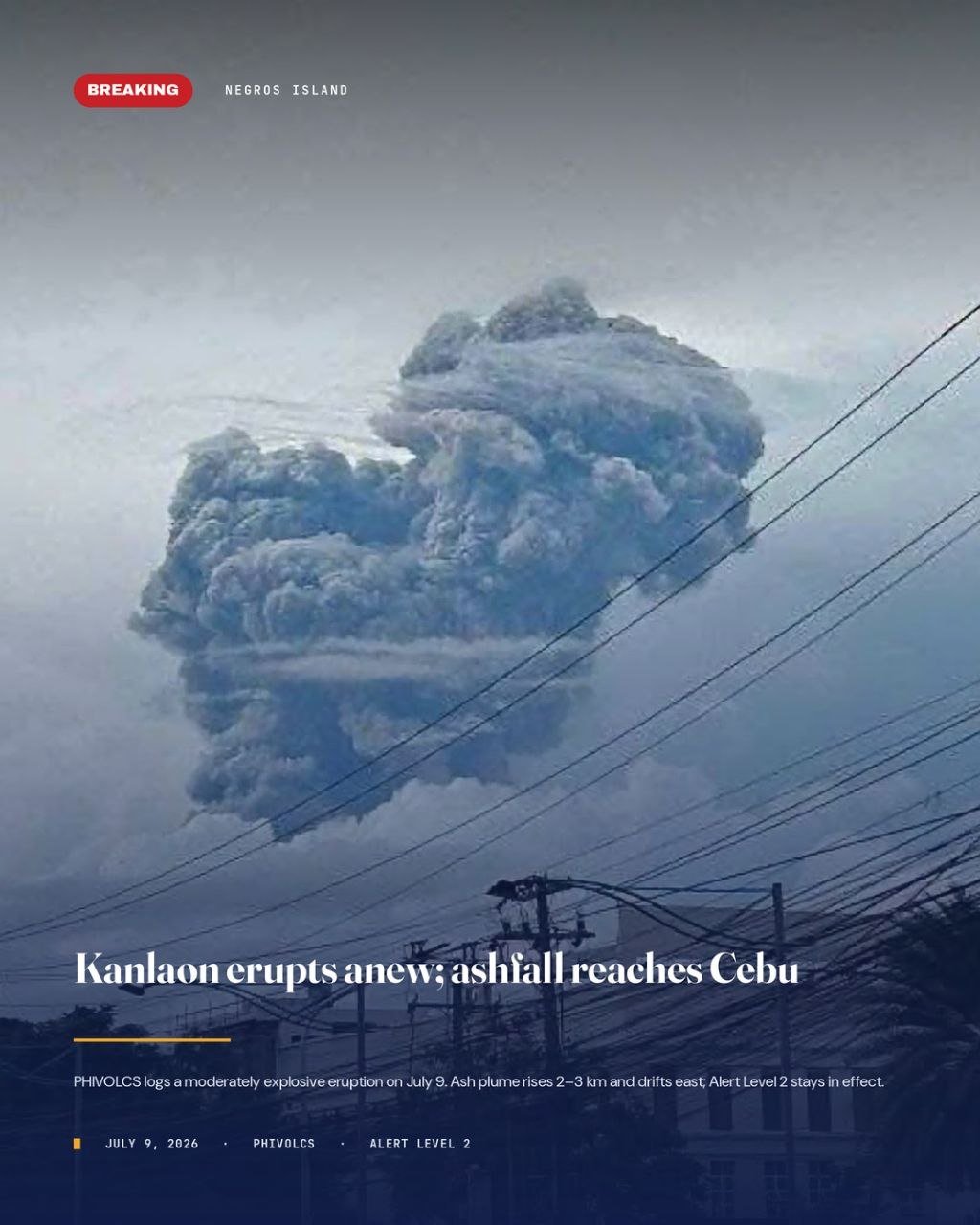
A moderately explosive eruption from Kanlaon Volcano on Thursday morning, July 9, sent a towering column of dark gray ash two to three kilometers into the air — thick enough to drift across the Tañon Strait and coat communities in western Cebu, triggering widespread class and work suspensions.
The Philippine Institute of Volcanology and Seismology (PHIVOLCS) confirmed that the eruption commenced at 7:33 a.m. and concluded at 7:36 a.m., lasting approximately three minutes. The event was recorded through seismic and infrasound monitoring instruments, with visual confirmation captured by the agency’s Upper Pantao Observation Station located in Canlaon City on Negros Island.
PHIVOLCS Director Teresito Bacolcol said the eruption generated a dark gray ash plume that climbed two to three kilometers above the volcano’s summit crater before prevailing winds steered it eastward. The agency also noted poorly visible pyroclastic density currents — fast-moving flows of hot gas and volcanic debris — descending the southeastern slopes of the volcano, potentially reaching within one kilometer of the summit crater.
Carried by prevailing winds across the Tañon Strait, volcanic ash descended on several western Cebu communities that face Negros Island. Ashfall was documented in Toledo City, Pinamungajan, and Aloguinsan, among other affected areas throughout Cebu province. The massive eruption column was reportedly visible as far as Iloilo City and portions of Panay Island.
In response to the ashfall, numerous Cebu local government units ordered the suspension of classes and, in some cases, government work. The jurisdictions that issued suspension orders included Cebu City, Toledo City, Talisay City, Mandaue City, Lapu-Lapu City, Minglanilla, Consolacion, Aloguinsan, and Pinamungajan.
By the Numbers
- 7:33 a.m. to 7:36 a.m. — time window of the eruption, lasting roughly 3 minutes
- 2–3 kilometers — height reached by the ash plume above the summit crater
- 19 — volcanic earthquakes logged in the 24-hour monitoring period prior to the eruption
- 2,454 metric tons — sulfur dioxide (SO₂) emissions recorded during the same monitoring period
- 4 kilometers — radius of the Permanent Danger Zone around the crater, where entry remains prohibited
- 1 kilometer — maximum estimated distance traveled by pyroclastic density currents from the summit crater
As of Thursday, PHIVOLCS confirmed that Kanlaon Volcano remains under Alert Level 2, which signals a state of increased volcanic unrest and indicates the potential for further sudden, hazardous eruptions without extended warning. The agency has strictly prohibited entry into the four-kilometer-radius Permanent Danger Zone encircling the crater, citing ongoing threats from ballistic projectiles, rockfalls, ashfall, and pyroclastic density currents.
For residents in communities affected by ashfall, PHIVOLCS and local authorities issued a set of precautionary advisories. People are urged to remain indoors as much as possible and to keep windows and doors shut to prevent ash from entering homes. Water storage containers should be covered to avoid contamination. When venturing outside is necessary, residents are advised to wear properly fitted N95 respirators or similarly effective face masks to reduce inhalation of fine ash particles.
Motorists in affected areas were also cautioned to drive carefully, as volcanic ash significantly reduces road visibility and creates slippery driving conditions that can lead to accidents.
PHIVOLCS said it is maintaining round-the-clock surveillance of the volcano, tracking seismic activity, sulfur dioxide flux, and ground deformation data to detect any changes in Kanlaon’s behavior that could signal escalating unrest. The agency said it will issue updated bulletins as conditions develop and urged the public to rely only on official information from PHIVOLCS and local government units.
In the lead-up to the eruption, PHIVOLCS recorded 19 volcanic earthquakes and measured sulfur dioxide emissions of 2,454 metric tons within a 24-hour monitoring window — indicators that pointed to rising magmatic activity beneath the volcano.
Why This Matters
Kanlaon’s July 9 eruption demonstrates that the volcano remains in an active phase of unrest capable of producing hazardous events with only minutes of observable activity, affecting not just Negros Island but communities in neighboring Cebu province across the strait. The suspension of classes and government work in multiple Cebu cities and towns underscores how far-reaching the public safety impact of a single eruption can be. With Alert Level 2 still in effect and PHIVOLCS monitoring ongoing volcanic indicators, residents in and around the danger zone must remain vigilant and prepared for further eruptive activity.
Source: Philippine Institute of Volcanology and Seismology (PHIVOLCS)