
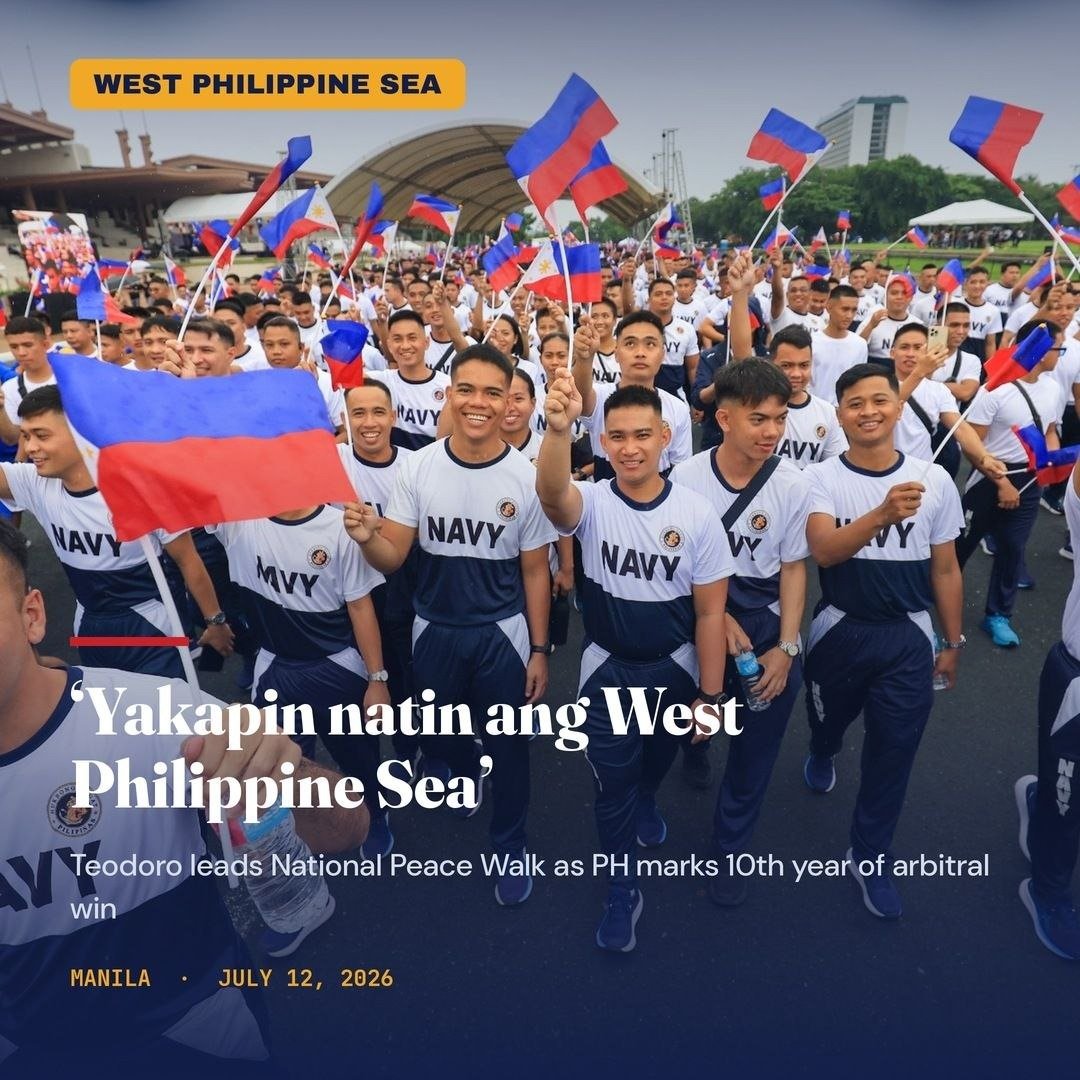
A decade after the landmark international ruling that invalidated China’s sweeping territorial claims in the South China Sea, the Philippines held a series of coordinated commemorations on Sunday — with Defense Secretary Gilberto C. Teodoro Jr. urging his countrymen to take genuine ownership of the West Philippine Sea as both a legal right and a national inheritance.
Teodoro headed the National Peace Walk for the West Philippine Sea at the historic Quirino Grandstand in Manila, leading Department of National Defense officials, personnel, government agencies, civil society organizations, and individual advocates in a unified demonstration of commitment to the country’s maritime rights as recognized under international law.
Embracing the Sea as a Living Legacy
Speaking to participants gathered at Quirino Grandstand, Teodoro articulated a vision that goes well beyond legal arguments. “Kailangan yakapin natin ang West Philippine Sea,” he said. “Unang-una, ano po ang niyayakap natin? Ang niyayakap po natin ay ang mga bagay na may halaga sa atin at kinikilala natin ang halaga nito sa buhay natin. Kaya yakapin po natin. Kapag niyayakap po natin ang isang tao, isang bagay, nagmamay-ari tayo dito in some way.”
For the defense chief, “embracing” the West Philippine Sea is not a mere symbolic act — it carries real obligations: to care for, protect, and responsibly steward the country’s maritime domain for the generations that are alive today and for those not yet born.
“Kaya po, hindi lang sa atin po pinaglalaban ang West Philippine Sea, kung hindi po lalong-lalo na (para) sa susunod na henerasyon — ang mga musmos ngayon at ang mga hindi pa pinanganganak,” Teodoro told the crowd. The statement underscored the intergenerational stakes that his department attaches to the ongoing West Philippine Sea issue.
Standing With Coastal Communities and Fisherfolk
Teodoro stressed that the National Peace Walk carried a direct message of solidarity with coastal villages and fishing communities — especially those in Masinloc, Zambales, among the Filipino towns nearest to the contested Scarborough Shoal.
“Ito pong lakad na ito ay nagsisilbing lakas-loob nila upang tulong-tulong tayong makapaglayag sila uli, hindi lang sa Scarborough Shoal kung hindi sa lahat ng mga lugar kung saan may karapatan ang Pilipinas,” he said, describing the walk as moral support intended to embolden Filipino fisherfolk to return to waters that are legally theirs.
He further described the activity as a whole-of-government undertaking — one aimed at deepening national knowledge and capability to make proper and sustainable use of the sea. “Kaya po, whole of government approach ito dahil kailangan pagtibayin natin ang ating mga kaalaman at kapabilidad para magamit natin nang tama ang karagatan na regalo ng Panginoon po sa atin,” the defense secretary added.
According to the Department of National Defense, the National Peace Walk is an inter-agency initiative organized and participated in by multiple government bodies alongside civil society partners and advocates. Its central purpose is to affirm and promote the Philippines’ enduring commitment to its maritime rights under international law.
DND and AFP Pledge Continued Resolve Under Marcos Administration
Teodoro reiterated that, under the leadership of President Ferdinand R. Marcos Jr., both the Department of National Defense and the Armed Forces of the Philippines are resolute in bolstering the country’s capacity and determination to defend its territorial integrity, sovereign rights, and the broader principle of sovereignty.
“Ito po’y kinakailangan, hindi bukas kung hindi kahapon pa. Hindi natin pwede ibalik ang kahapon, kaya pursigido tayo ngayon, ngayon natin gagawin. Sa pamamaraan ng paglakad ninyo, ito’y senyales ng commitment na nagkakaisa tayong lahat para sa kabutihan laban sa kasamaan,” he declared, framing the peace walk as a collective signal of national unity against what he characterized as wrongdoing.
Armed Forces of the Philippines Chief General Romeo Brawner Jr. also joined the walk and, according to statements made at the event, framed the 10th anniversary not as a purely legal occasion but as a reminder of shared national duty — something every Filipino has a stake in regardless of profession or location.
National Security Adviser Eduardo Oban, also present at the event, said the Philippines would continue to pursue peace in the West Philippine Sea while holding firm to its sovereignty and maritime entitlements, signaling that diplomatic engagement and legal assertion would proceed in tandem.
Synchronized Nationwide Events Mark the Decade
The Manila peace walk was just one element of a broader, synchronized set of commemorations held simultaneously across the archipelago. The Department of National Defense reported that Philippine Navy vessel horns were sounded in unison as part of the observance, while Palawan province hosted a parade drawing approximately 2,000 participants.
In Quezon City, the country unveiled what organizers described as the first monument dedicated to the fisherfolk of the West Philippine Sea — a symbolic recognition of the men and women on the front lines of the maritime territorial dispute. Meanwhile, the public was invited to join in by sounding their vehicle horns exactly 10 times in unison with church bells and naval ship horns, marking one honk for each year since the arbitral ruling was handed down.
What the 2016 Ruling Established — and What China Continues to Reject
The arbitral tribunal, constituted under the 1982 United Nations Convention on the Law of the Sea (UNCLOS) and seated in The Hague, issued its ruling on July 12, 2016. The tribunal declared that China’s nine-dash line claim — which covers the vast majority of the South China Sea — has no legal standing under international law.
On the occasion of the 10th anniversary, the Philippines and 13 other countries issued a joint statement affirming that the ruling is final and legally binding on the parties. Beijing, however, repeated its longstanding refusal, maintaining that it neither accepts nor recognizes the arbitral decision — a position China has held consistently since the ruling was issued.
By the Numbers
- 10 — Years since the July 12, 2016 Arbitral Award was handed down by the UNCLOS tribunal
- 2,000 — Approximate number of participants in the West Philippine Sea anniversary parade held in Palawan
- 13 — Other nations that co-signed a joint statement with the Philippines declaring the ruling final and legally binding
- 10 — Number of times the public was invited to sound vehicle, church bell, and ship horns in simultaneous commemoration
- 1982 — Year of adoption of the United Nations Convention on the Law of the Sea, under which the arbitral tribunal was constituted
Why This Matters
The 10th anniversary of the 2016 Arbitral Award is a pivotal diplomatic marker for the Philippines, consolidating internationally recognized maritime rights at a time when China continues to reject the tribunal’s decision and tensions in the South China Sea remain elevated. The breadth of the Marcos administration’s commemorations — spanning a Manila peace walk, a Palawan parade, a Quezon City monument, and synchronized nationwide horn-sounding — reflects a deliberate institutional strategy to keep public awareness and government resolve firmly anchored to the country’s legal position. The co-signed joint statement from 13 other nations reinforces that Manila’s legal stance carries growing multilateral backing, strengthening the Philippines’ posture in ongoing diplomatic and territorial standoffs.
Source: Department of National Defense Philippines / PND Philippines official statements