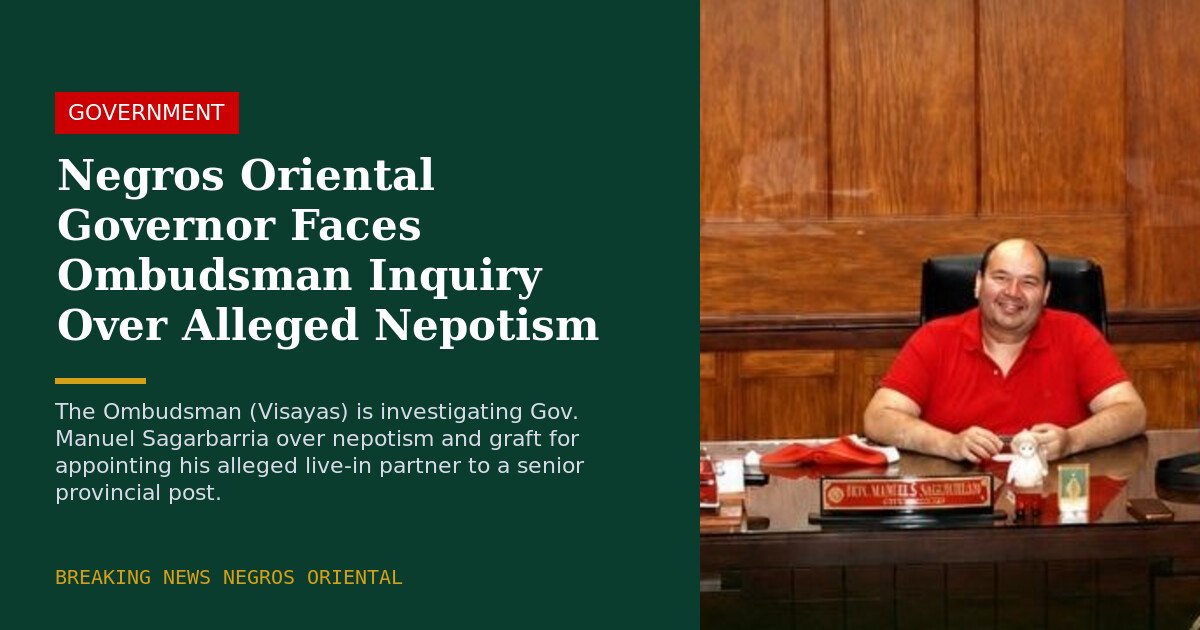
Negros Oriental Governor Manuel “Chaco” L. Sagarbarria is under formal investigation by the Office of the Ombudsman (Visayas) following the filing of both criminal and administrative complaints tied to the hiring of a woman alleged to be his common-law partner into a high-ranking position within the Provincial Governor’s Office. Case records confirm the anti-graft body has determined sufficient grounds to proceed.
Formal Proceedings Initiated by the Ombudsman
A Joint Order dated May 28, 2026, issued from the Ombudsman’s Area Office for the Visayas in Guadalupe, Cebu City, directed Governor Sagarbarria to submit a counter-affidavit within an inextendible 15-day period from receipt, along with controverting evidence in three legible copies with proof of service. According to case records, the Ombudsman found “enough basis to proceed with the criminal/administrative investigation.” Non-compliance with the order would be treated as a waiver of the right to submit a counter-affidavit, after which the investigation would continue under existing procedural rules.
The order was issued for Deputy Ombudsman for the Visayas Dante F. Vargas and signed by Portia A. Pacquiao, Acting Director of the Preliminary Investigation, Administrative Adjudication and Prosecution Bureau–A, per Office Order No. 210, Series of 2025. Motions to dismiss, motions for a bill of particulars, motions for extension of time, and second motions for reconsideration or reinvestigation were all barred as prohibited pleadings, the Joint Order stated, and would be stricken from the records.
Two Docketed Cases Arising From One Complaint
The complaint, which the Ombudsman received on April 1, 2026, gave rise to two separate docketed cases. The first is a criminal case for alleged violation of Section 3(e) of Republic Act No. 3019, the Anti-Graft and Corrupt Practices Act, docketed as OMB-V-C-MAY-26-0130. The second is an administrative case for Grave Misconduct and Conduct Prejudicial to the Best Interest of the Service, docketed as OMB-V-A-MAY-26-0170, according to the case records.
The Appointment That Triggered the Complaint
At issue is the appointment of Juvilin S. Calago to the position of Executive Assistant IV, Salary Grade 22, Step 1, in the Provincial Governor’s Office. The complaint alleges the appointment was made on the very day Governor Sagarbarria took office, making it among the first official acts of his administration.
Payroll documents attached to the complaint show Calago’s basic monthly salary at ₱71,511, with a total monthly gross compensation of ₱73,511, which includes a ₱2,000 personnel economic relief allowance.
Beyond the appointment itself, the complaint alleges that Calago is the governor’s live-in partner, that they share a common household in Tierra Alta, Valencia, Negros Oriental, and that they have two children together. The complaint further alleges that despite her designation as executive assistant, Calago was performing the duties of the provincial Public Information Officer — a distinct, permanent plantilla position — while the incumbent permanent information officer was reassigned to a tourist assistance desk at the Provincial Tourism Office. The complaint characterizes this reassignment as constructive dismissal.
Five Charges Laid Out in the Complaint
The complaint enumerates five separate violations attributed to the governor, according to the case records:
Nepotism under Section 59, Chapter 8, Book V of Executive Order No. 292, or the Revised Administrative Code of 1987, which prohibits appointments of relatives within the third degree of consanguinity or affinity. Section 79 of Republic Act No. 7160, the Local Government Code of 1991, extends the bar to the fourth civil degree within the local government career service. The complaint argues the prohibition should logically extend to common-law partners, citing the principle that what cannot be done directly cannot be done indirectly, and invoking Article 147 of the Family Code, under which the wages of cohabiting partners are owned in equal shares — meaning the governor would financially benefit from the salary drawn by the appointee.
Violation of Section 4(b) and (c) of Republic Act No. 6713, the Code of Conduct and Ethical Standards for Public Officials and Employees, which mandates professionalism and fairness, prohibits the dispensing of undue favors, and directs officials to avoid creating the perception that they are dispensers of patronage.
Grave Misconduct, on the basis that the appointment was allegedly made with willful intent to circumvent anti-nepotism rules, involved manifest partiality and evident bad faith, and constituted an abuse of the governor’s appointing authority for private gain.
Conduct Prejudicial to the Best Interest of the Service, premised on the allegation that the appointment damaged the image and integrity of public office, irrespective of whether any specific statute was technically violated.
Violation of Section 3(e) of RA 3019, which penalizes public officers who cause undue injury to the government or any party, or who grant any private party unwarranted benefits or advantages, through manifest partiality, evident bad faith, or gross inexcusable negligence.
Potential Penalties If the Charges Are Sustained
Under civil service rules, nepotism and grave misconduct are classified as grave offenses carrying dismissal from service even upon a first offense. Dismissal, case records note, carries accessory penalties including cancellation of civil service eligibility, forfeiture of retirement benefits, perpetual disqualification from public office, and a bar from future civil service examinations.
Conduct prejudicial to the best interest of the service, on a first offense, carries a penalty of suspension ranging from six months and one day to one year, with dismissal imposed upon a second offense.
A criminal conviction under Section 3(e) of RA 3019 carries a prison term of six years and one month to 15 years, perpetual disqualification from public office, and forfeiture of any prohibited interest or unexplained wealth. Under Section 11 of RA 6713, a violating official may face a fine equivalent to up to six months’ salary, suspension of up to one year, or removal from office — without prejudice to criminal liability carrying imprisonment of up to five years, a fine, or both.
The complaint additionally prays that the appointment be declared null and void, that the appointee vacate the position and refund all salaries and benefits received, that the governor be placed under preventive suspension for up to six months under Section 24 of RA 6770, the Ombudsman Act of 1989, and that the matter be referred to the Civil Service Commission Regional Office No. VII.
Governor Denies All Charges; Appointee Had Already Resigned
Governor Sagarbarria filed a counter-affidavit sworn on July 10, 2026, in Dumaguete City, categorically denying every allegation in the complaint. He argued, according to the filed documents, that Calago is not his relative within the legal definition since the two are not married, and that the position she occupied is primarily confidential in nature and therefore falls outside the coverage of the anti-nepotism rule. He asked the Ombudsman to dismiss both cases outright and to deny the prayer for preventive suspension.
Documents submitted alongside the governor’s counter-affidavit show that Calago had already tendered her resignation on March 31, 2026, which the governor accepted as effective on the same date.
The Ombudsman proceedings remain at the stage of preliminary investigation and administrative adjudication. As case records make clear, an order to file a counter-affidavit is a standard procedural step in the process and does not constitute a finding of guilt or administrative liability. Any such determination can only be made after the investigation has been fully concluded. Governor Sagarbarria is presumed innocent unless and until the Office of the Ombudsman rules otherwise.
By the Numbers
- ₱71,511 — Calago’s basic monthly salary as Executive Assistant IV, Salary Grade 22, Step 1
- ₱73,511 — Total monthly gross compensation, inclusive of a ₱2,000 personnel economic relief allowance
- ₱2,000 — Personnel economic relief allowance included in the monthly gross
- April 1, 2026 — Date the Ombudsman received the complaint
- May 28, 2026 — Date of the Joint Order directing the governor to submit a counter-affidavit
- July 10, 2026 — Date Governor Sagarbarria swore his counter-affidavit in Dumaguete City
- 15 days — Inextendible period given to the governor to file his counter-affidavit
- Up to 6 months — Maximum preventive suspension period prayed for by the complainant
- 6 years and 1 month to 15 years — Imprisonment range under Section 3(e) of RA 3019 if convicted
Why This Matters
The case places a sitting provincial governor under formal Ombudsman scrutiny for allegedly using his appointing authority to benefit a person with whom he shares a personal and domestic relationship — a situation the complaint argues falls within the spirit, if not the letter, of anti-nepotism law. If the charges are sustained, the applicable penalties include dismissal from office, perpetual disqualification from public service, and criminal imprisonment, which would have significant consequences for governance in Negros Oriental. The proceedings also raise broader questions about the scope of nepotism prohibitions under Philippine law, particularly whether those restrictions should extend to common-law partners and household arrangements not covered by formal marriage.
Source: Breaking News Negros Oriental / BNNO original reporting based on Office of the Ombudsman case records
Related stories