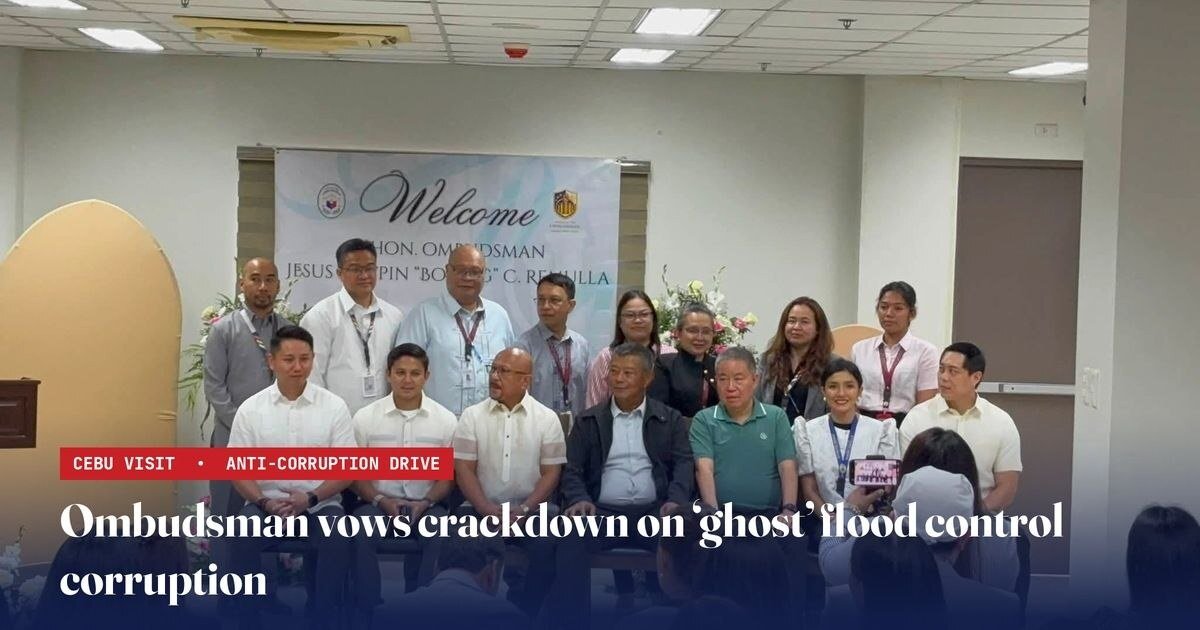
Weeks after Typhoon Tino left Cebu with the country’s highest death toll, Ombudsman Jesus Crispin “Boying” Remulla arrived in Cebu City on Monday — not to survey the wreckage, but to deliver a direct message to provincial officials and employees: the era of impunity in public infrastructure spending is over.
Remulla, who assumed office as the country’s seventh Ombudsman in October 2025 after previously serving as Secretary of Justice, used the visit to lay out a broad anti-corruption agenda with ghost flood control projects at its center. His presence in the province carries particular weight given that Cebu bore the brunt of Typhoon Tino’s devastation, according to the Daily Tribune.
Plunder Cases Eyed Against Lawmaker-Contractors
One of the most significant commitments Remulla outlined was the pursuit of plunder charges against members of Congress who allegedly wore two hats — acting simultaneously as legislators and as contractors who directly profited from flood control appropriations. The Ombudsman said his office would go after conflicts of interest at every level of government, leaving no rank untouched.
Beyond case filings, Remulla pushed for sweeping structural reform by calling for legislation that would require the full digitization of all government contracts, salaries, and permits — covering everything from barangay transactions up to the highest national offices. The goal, he said, is to close the gaps where corruption has historically been able to hide.
Punishment Certainty, Not Death Penalty, Is the Real Deterrent
Remulla also weighed in on the broader debate over how to effectively curb graft in government. Rather than supporting capital punishment as a deterrent, the Ombudsman argued that what truly discourages corruption is the near-certain prospect that offenders will actually end up in prison.
Achieving that certainty, he said, means building cases on solid and irrefutable evidence from the very beginning of the investigation — evidence strong enough that it cannot be neutralized, questioned, or politicized once it reaches the courts.
“We want Filipinos to rally behind public servants who stay true to their duty. This is the foundation for working together toward a better nation,” Remulla said, addressing the crowd in Cebuano.
Three Batches of Cases Filed in First 100 Days
The Cebu visit did not happen in a vacuum. It comes on the heels of an already-active prosecution record under Remulla’s first 100 days in office. According to GMA News Online, Ombudsman prosecutors filed three separate batches of criminal cases linked to anomalous flood control projects during that period.
The first batch involves malversation and graft charges against former Ako Bicol party-list representative Zaldy Co and 16 co-respondents over an alleged ₱289-million substandard road dike project in Oriental Mindoro, GMA News Online reported.
The second batch targets contractor Sarah Discaya and others in connection with a ₱96.5-million ghost flood control project in Davao Occidental. The third batch, also reported by GMA News Online, includes charges against former senator Ramon “Bong” Revilla Jr. — a filing that attracted considerable public attention given Revilla’s profile and long political history.
Cebu’s Disaster Record Puts It at the Center of the Probe
Cebu’s designation as a priority area for the Ombudsman’s special task force on flood control projects is directly tied to the destruction wrought by Typhoon Tino. The Daily Tribune reported that Cebu recorded the highest death toll in the country from the typhoon, making the question of whether flood mitigation funds were actually spent — or merely reported as spent — an urgent matter of public accountability.
The task force has formally committed to prioritizing infrastructure investigations in provinces most severely impacted by the typhoon, according to GMA News Online. For Cebu, that means scrutiny of a staggering volume of public works spending.
₱26.7 Billion in Cebu Projects Flagged for Investigation
The scale of the potential accountability exercise in Cebu is difficult to overstate. Advocacy groups have formally called for a probe into 414 infrastructure projects valued at a combined ₱26.7 billion in the province, according to GMA News Online. These projects — spanning flood control, road construction, and related public works — are now at risk of being examined for irregularities, ghost deliverables, and misuse of public funds.
The sheer breadth of the flagged projects explains in large part why Remulla chose Cebu as the site of his post-typhoon accountability visit. The province is caught at the intersection of two crises: acute disaster vulnerability and alleged systematic fraud in the infrastructure meant to address it.
A Prosecutorial Ombudsman Takes the Helm
Remulla’s background gives his Cebu pronouncements added credibility. Having previously served as Secretary of Justice, he brings a prosecutorial perspective and a legislative background to the Ombudsman’s office — a combination that officials and observers say may accelerate the pace of case development compared to his predecessors.
His early months in office have already been defined by high-profile filings tied to public infrastructure funds. Whether that pace continues — and whether the cases ultimately result in convictions — will determine how much of Monday’s visit translates from pledges into lasting accountability.
By the Numbers
- ₱289 million — alleged value of the substandard road dike project in Oriental Mindoro linked to former congressman Zaldy Co and 16 others
- ₱96.5 million — alleged value of the ghost flood control project in Davao Occidental involving contractor Sarah Discaya
- 3 batches — criminal case filings completed by the Office of the Ombudsman within Remulla’s first 100 days in office
- 414 projects — infrastructure projects in Cebu flagged by advocacy groups for formal investigation
- ₱26.7 billion — combined value of the 414 flagged Cebu infrastructure projects
- October 2025 — when Remulla was sworn in as the Philippines’ seventh Ombudsman
Why This Matters
The investigation into ghost flood control projects has moved well beyond preliminary inquiries — with three batches of criminal cases already filed and 414 projects worth ₱26.7 billion now under scrutiny in Cebu alone, the Office of the Ombudsman is mounting one of the most expansive public works accountability drives in recent Philippine history. The fact that sitting and former legislators are among those facing plunder charges signals a willingness to pursue high-level targets that earlier anti-corruption efforts often avoided.
Remulla’s twin proposals — mandatory digitization of government contracts and a prosecution strategy built on airtight evidence — represent a structural approach to anti-corruption that, if enacted and sustained, could reduce the conditions enabling ghost projects to recur across successive administrations. The outcome of pending cases will be a critical test of whether the current drive produces durable reform or fades like previous crackdowns.
Source: GMA News Online, Daily Tribune